Category: Sahan Tracker

Daily tracking of UN climate negotiations

  • Sahan Tracker | COP31, Day 10: The text got shorter. So did the promises.

    Sahan Tracker | COP31, Day 10: The text got shorter. So did the promises.

    ⏱️ Day 10 in one minute

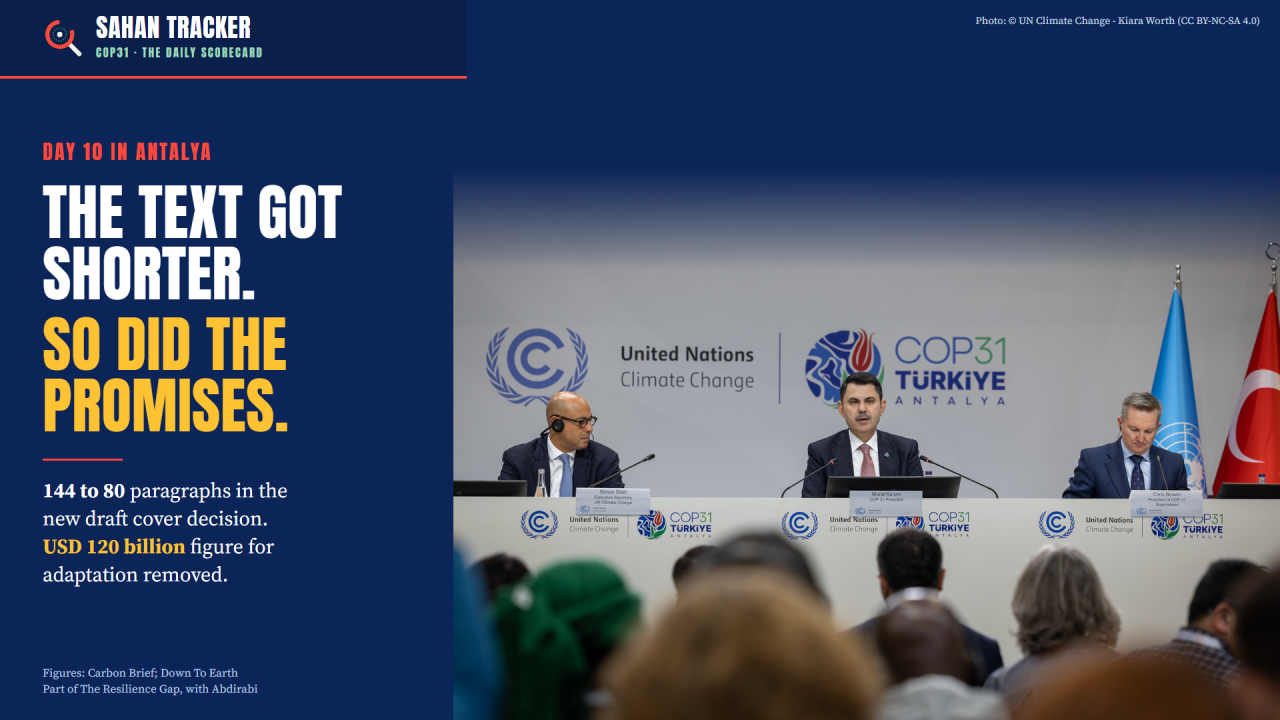
    • The second draft of the cover decision came out several hours late. It is about half as long: 80 paragraphs instead of 144.
    • The draft no longer mentions fossil fuels, and it drops the USD 120 billion figure for tripling adaptation finance.
    • The target to raise electricity to 35% of the world’s energy use by 2035 stays in.
    • Panama said it will not join a consensus that does not meet its principles, and will formally object.
    • COP31 President Murat Kurum said: “This is not the final text.” Talks may run past Friday.
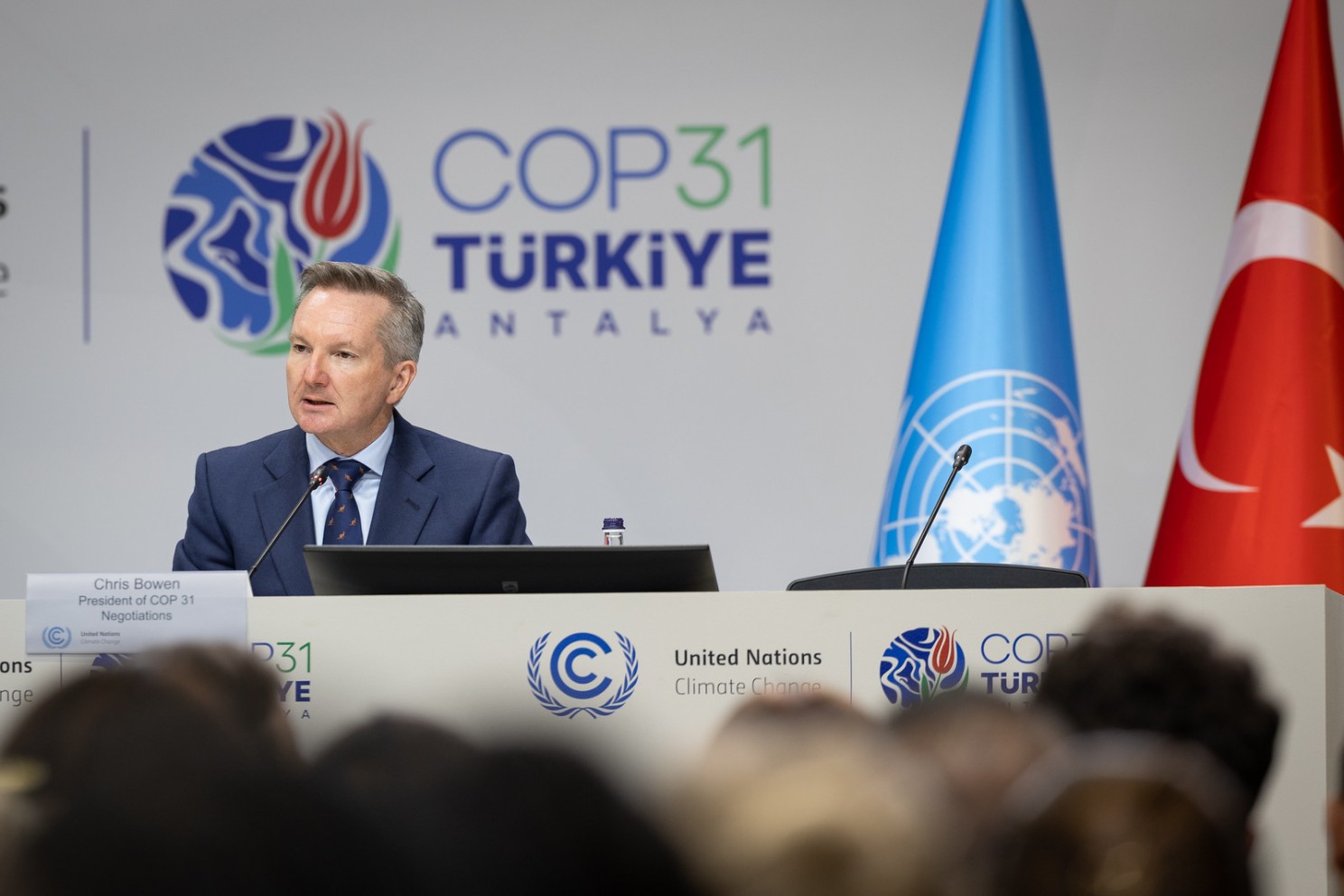
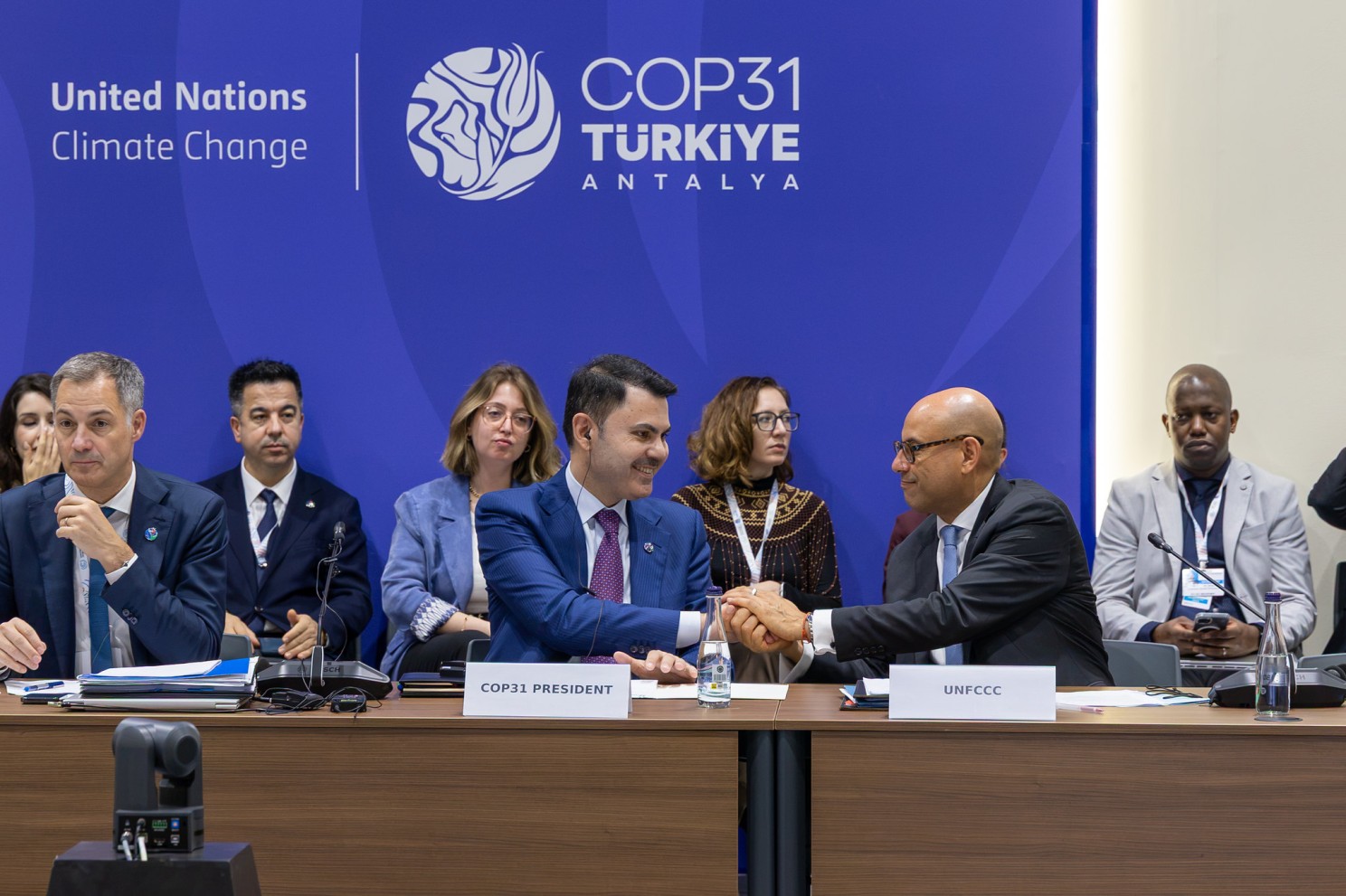
    Chris Bowen, President of Negotiations, at the COP31 Presidencies' press conference on the state of negotiations. Photo: © UN Climate Change - Kiara Worth (CC BY-NC-SA 4.0)
    Chris Bowen, President of Negotiations, at the COP31 Presidencies’ press conference on the state of negotiations. Photo: © UN Climate Change – Kiara Worth (CC BY-NC-SA 4.0)

    🟢 What moved forward?

    A shorter text. The Presidencies cut the cover decision from 144 to 80 paragraphs, according to Carbon Brief and Down To Earth. The Earth Negotiations Bulletin said the new texts have “significantly fewer brackets”, meaning fewer words still in dispute.

    New talks on overshoot. Carbon Brief reports that the draft “decides” to hold a high-level dialogue at COP32 on the science of overshooting 1.5°C. It also invites the IPCC, the UN’s science panel, to present its reports before the 2028 global stocktake.

    Mountains and the Ocean. The draft sets up a work programme on mountains and a high-level dialogue at COP32. It also asks for a report on ocean action, due in June 2028 (Carbon Brief).

    Agreement on a few smaller items. Countries agreed to send the text on national adaptation plans to the June 2027 session as an informal note. On the Climate Technology Centre, they agreed how it will work with the UN Environment Programme.

    Plans to leave fossil fuels, outside the text. Switzerland published its roadmap to move away from fossil fuels. The Earth Negotiations Bulletin counts six European countries with published roadmaps, and 21 more countries that plan to publish one.

    🔴 What got stuck?

    Fossil fuels left the text. Carbon Brief, Down To Earth, Climate Home News and IPS all report that the second draft no longer mentions fossil fuels. It also drops the welcome for Brazil’s roadmap to move away from them.

    The tripling number. Carbon Brief reports that the USD 120 billion adaptation finance target “has gone”. Climate Home News says the draft delays a number until COP32. IPS says it launches the “Antalya-to-Addis Ababa Roadmap for Adaptation and Resilience Finance”, but with no target and no baseline. Down To Earth reads it differently: it says the draft keeps a pathway to triple adaptation finance by 2035 under the climate finance work programme. The sources do not agree, so the final text will matter.

    Softer words. Carbon Brief reports that “rapid and substantial” cuts to methane became just “reductions”. On trade, “expresses serious concerns” became “notes the concerns”.

    Support for national technology offices. National bodies that link countries to the Climate Technology Centre get about USD 5,000 each. The G77 and China asked for at least USD 50,000. Senegal, Somalia and Uganda said USD 5,000 is not enough. Japan, Norway, Canada and the UK opposed writing any amount. The LDCs called that a red line.

    A deleted warning. In the talks on the Standing Committee on Finance, countries deleted a paragraph that noted, among other things, the decline in global adaptation finance.

    The stocktake dialogue. Countries could not agree on the report of the dialogue that helps countries use the first global stocktake in their national plans. A procedural decision will follow.
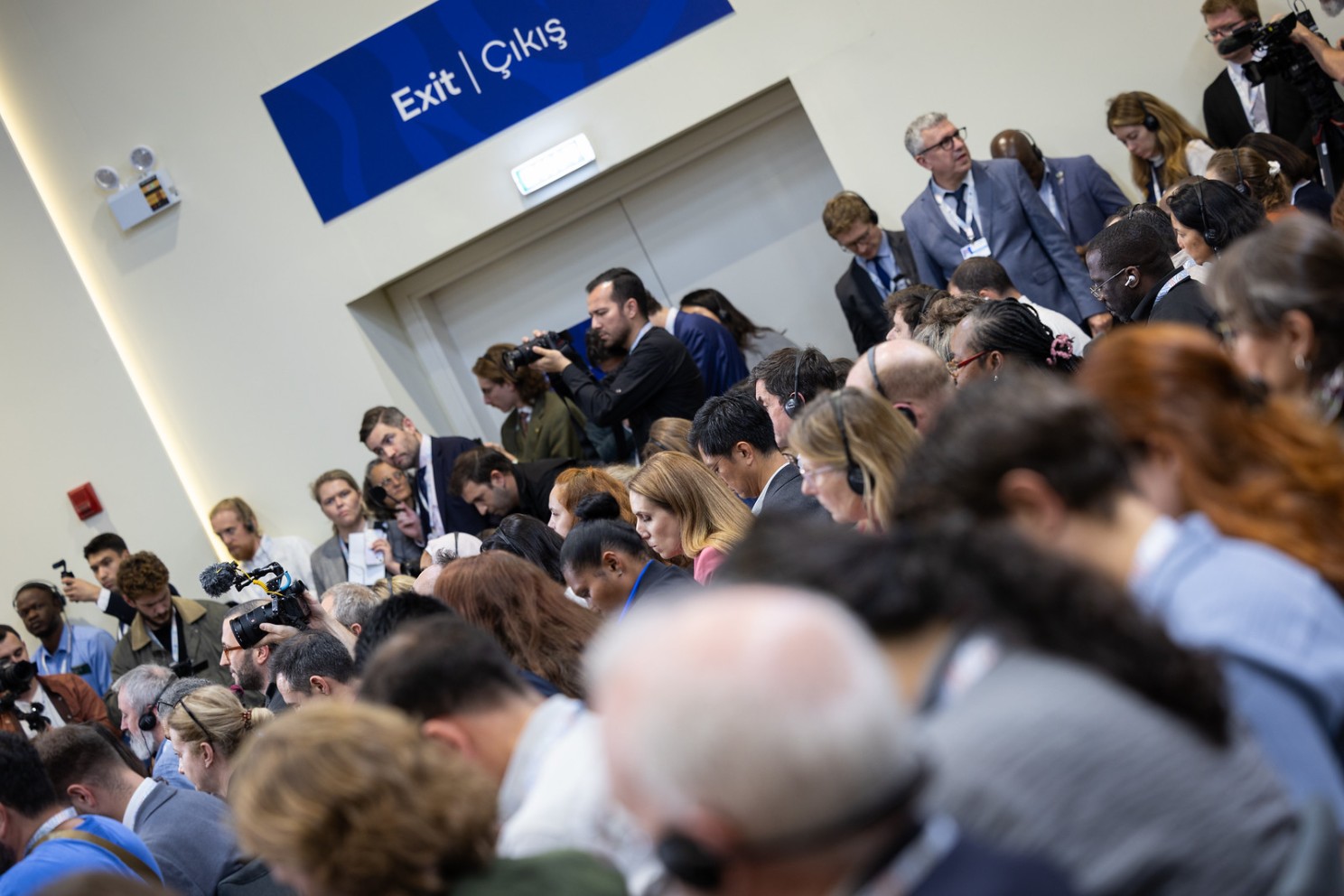
    Journalists and delegates at the COP31 Presidencies' press conference on the state of negotiations. Photo: © UN Climate Change - Kiara Worth (CC BY-NC-SA 4.0)
    Journalists and delegates at the COP31 Presidencies’ press conference on the state of negotiations. Photo: © UN Climate Change – Kiara Worth (CC BY-NC-SA 4.0)

    📝 What changed in the cover decision?

    This was the main story of Day 10. Here is the first draft (16 November) next to the second draft (19 November), based on Carbon Brief, Climate Home News, Down To Earth, Agence Europe and IPS:

    Length: 144 paragraphs, now 80.Fossil fuels: a faster move away from them and a phase-out goal, now no mention at all.Adaptation finance: at least USD 120 billion a year by 2035, now no number in most reports.Electrification: 35% by 2035, still in. Agence Europe notes there is no longer a dedicated reference to “clean” electrification.Overshoot: a programme on the science, now a high-level dialogue at COP32.Methane: “rapid and substantial reductions”, now “reductions”.

    • Length: 144 paragraphs, now 80.
    • Fossil fuels: a faster move away from them and a phase-out goal, now no mention at all.
    • Adaptation finance: at least USD 120 billion a year by 2035, now no number in most reports.
    • Electrification: 35% by 2035, still in. Agence Europe notes there is no longer a dedicated reference to “clean” electrification.
    • Overshoot: a programme on the science, now a high-level dialogue at COP32.
    • Methane: “rapid and substantial reductions”, now “reductions”.

    Reactions. Agence Europe reports that African negotiators said the COP30 promise to triple adaptation finance “must not be removed” from the final decision. Panama’s Environment Minister Juan Carlos Navarro wrote to the Presidencies that Panama “will not join any consensus, and will formally object in the closing plenaries” to a decision that does not meet its principles.

    Why it matters for LDCs: the LDCs fought all week for a number, a baseline and a way to track adaptation finance. In this draft, most of that is gone or pushed to next year.

    💰 The money picture

    USD 120 billion: the adaptation finance figure in the first draft, removed from the second (Carbon Brief).USD 5,000: what each national technology office gets now. The G77 and China asked for at least USD 50,000 (Earth Negotiations Bulletin).USD 106.2 million: the Climate Technology Centre budget. The G77 and China still want “at least” in front of it. The EU opposes.USD 1 trillion: the aim of a new agreement between Australia and the Republic of Korea to unlock money for cutting emissions, presented on Thursday (Earth Negotiations Bulletin).

    • USD 120 billion: the adaptation finance figure in the first draft, removed from the second (Carbon Brief).
    • USD 5,000: what each national technology office gets now. The G77 and China asked for at least USD 50,000 (Earth Negotiations Bulletin).
    • USD 106.2 million: the Climate Technology Centre budget. The G77 and China still want “at least” in front of it. The EU opposes.
    • USD 1 trillion: the aim of a new agreement between Australia and the Republic of Korea to unlock money for cutting emissions, presented on Thursday (Earth Negotiations Bulletin).

    🗣️ Who said what?

    • Murat Kurum, COP31 President: “This is not the final text.”
    • Chris Bowen, President of Negotiations: he will not leave the meeting rooms “until it is very clear to us that we have a consensus” (Agence Europe).
    • Simon Stiell, UN climate chief: “These are crucial days ahead for climate cooperation. And we have no time to lose” (IPS).
    • Panama: will formally object to a decision that does not meet its principles.
    • African negotiators: the promise to triple adaptation finance “must not be removed”.
    • One long-time delegate, on the quiet ministerial talks: “It’s strange not to hear a peep, in public at least, from the ministers conducting consultations, and a bit worrying.”

    🧭 So, who stands where?

    In one line: the Presidencies cut the text to find a deal, and the cuts fell hardest on fossil fuels and on the adaptation finance number. Countries that wanted those words, from Panama to the African Group, now have one day to bring them back.

    💡 My takeaways from Day 10

    One. Shorter is not always better. Half the text is gone. The question is what went first. Here, it was fossil fuels and the USD 120 billion.

    Two. Voluntary goals stayed, hard words left. The 35% electrification goal began as a voluntary pledge and made it into the draft. The words on fossil fuels, which countries agreed in Dubai, did not.

    Three. Small numbers tell the story. National technology offices get USD 5,000 each. Developing countries asked for USD 50,000, and some rich countries do not want any number written down. On the same day, a paragraph noting the fall in adaptation finance was deleted.

    📖 Words of the day

    Second draft: a new version of a text, written after countries react to the first one.Formal objection: when a country says no in the closing meeting. Because COPs decide by consensus, one objection can block a decision.High-level dialogue: a meeting of ministers to discuss a topic, without negotiating a text.National designated entity: the national office that links a country to the Climate Technology Centre.Roadmap to move away from fossil fuels: a national plan that sets out how and when a country will reduce its use of oil, gas and coal.Procedural decision: a short decision that only says when a topic will be discussed again.

    • Second draft: a new version of a text, written after countries react to the first one.
    • Formal objection: when a country says no in the closing meeting. Because COPs decide by consensus, one objection can block a decision.
    • High-level dialogue: a meeting of ministers to discuss a topic, without negotiating a text.
    • National designated entity: the national office that links a country to the Climate Technology Centre.
    • Roadmap to move away from fossil fuels: a national plan that sets out how and when a country will reduce its use of oil, gas and coal.
    • Procedural decision: a short decision that only says when a topic will be discussed again.

    👀 What to watch tomorrow?

    • A third draft of the cover decision, which Down To Earth says is expected.
    • Whether the words on fossil fuels and the tripling number come back.
    • Whether Panama, or any other country, objects in the closing plenary.
    • Whether the talks run into the weekend.

    See you tomorrow.

    Abdirabi

    📚 Sources

    Earth Negotiations Bulletin (IISD), daily report for 19 November 2026: https://enb.iisd.org/antalya-un-climate-change-conference-cop31-daily-report-19nov2026Carbon Brief, New: second draft “cover decision” at COP31: https://connect.carbonbrief.org/t/new-second-draft-cover-decision-at-cop31/188Climate Home News, COP31 Bulletin Day 10: https://www.climatechangenews.com/2026/11/19/cop31-antalya-turkiye-australia-ministers-agremeent-fossil-fuels-electrification/Down To Earth, COP31 update: cover decision drafts, climate finance and 35×35: https://www.downtoearth.org.in/climate-change/cop31-update-cover-decision-drafts-climate-finance-and-35×35Agence Europe, Second COP31 draft decision raises doubts about states’ ability to agree: https://agenceurope.eu/en/bulletin/article/13985/1/second-cop31-draft-decision-raises-doubts-about-states-ability-to-agree-on-climate-crisis-responseIPS via allAfrica, COP31 nears close as “weak”, “compromised” draft draws fierce backlash: https://allafrica.com/stories/202611200097.html

    First published on LinkedIn in The Resilience Gap newsletter by Abdirabi Mohamed. Read the original.
  • Sahan Tracker | COP31, Day 9: One room agreed. The rest are waiting.

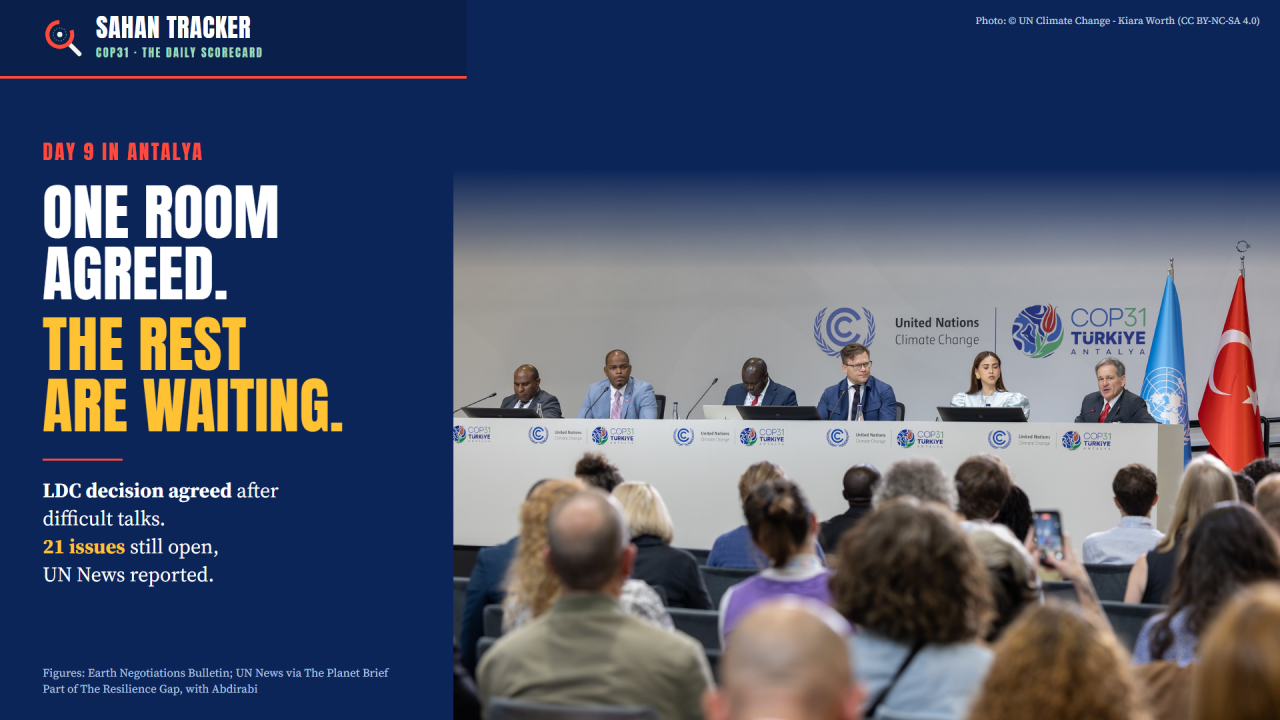
    Sahan Tracker | COP31, Day 9: One room agreed. The rest are waiting.

    ⏱️ Day 9 in one minute

    • Countries agreed a text on matters relating to the least developed countries (LDCs), after difficult talks. It now goes to the COP and CMA for adoption.
    • Ministers met behind closed doors in a “Divan”, a high-level meeting to move towards what the Presidency called a “balanced package”.
    • UN News reported 21 unresolved issues, with new texts expected the next morning.
    • The second global stocktake was launched. It will check, by 2028, whether the world is delivering on its climate promises.
    • Finance stayed stuck. Rich and poor countries still disagree on who must pay for adaptation and for loss and damage.

    🟢 What moved forward?

    A text for the poorest countries. After difficult talks, countries agreed an unbracketed text on matters relating to the LDCs and sent it to the COP and CMA for adoption. The Arab Group asked to replace “finance providers” with “funding channels”, and the others accepted. One delegate told the Earth Negotiations Bulletin: “This decision may not make the headlines, but it means a lot for the more than one billion most vulnerable people who benefit from the work under this agenda item.” Japan welcomed the text, but said much of it was negotiated outside the official meetings.

    The second global stocktake begins. The global stocktake is the Paris Agreement’s check on whether the world is on track. The second one started on Wednesday and ends at COP33 in 2028. UN climate chief Simon Stiell said 90% of countries reflected the results of the first stocktake in their national climate plans, according to The Planet Brief.

    Ministers at the table. The Presidency asked governments to send their top people to a Divan at 5pm, Climate Home News reported. The word comes from an Ottoman council. The aim was to move towards a “balanced package” before the last days.

    Electrification gains support. UN News reported that 75 countries now back the target to raise electricity to 35% of the world’s energy use by 2035, according to The Planet Brief.

    🔴 What got stuck?

    The loss and damage fund. The Arab Group said it cannot accept any call to scale up money unless it also mentions developed countries’ duty to pay. The EU, Switzerland and New Zealand said they cannot accept a text that does not mention all sources of finance. The LDCs, the Philippines, AILAC, China and others were disappointed that guidance on paying out money fast was removed. The EU again called such guidance “micromanaging”.

    Pledges or real money. Many developing countries asked the text to show both the money pledged to the loss and damage fund and the money actually received. Canada said contributions depend on national processes and may change.

    Finance talks linked together. The ministers said the Climate Finance Work Programme and the talks on aligning all finance flows with climate goals (Article 2.1(c)) are now linked. The Presidency offered three options: real decisions on both, procedural decisions on both, or no text on either. Countries still disagree on whether the work programme is about Article 9.1, rich countries’ duty to pay, or all of Article 9.

    National adaptation plans. Many countries were disappointed that so little time was given to this item. The G77 and China agreed to send the draft text to the June 2027 session. The EU and UK opposed, saying the text is unbalanced and crosses red lines.

    The Adaptation Fund. Developing countries want the Fund’s Board to report on the goal of tripling the money it pays out. The EU, Norway and the UK want minimal guidance.

    Cutting emissions. In the mitigation work programme, the Arab Group called a wider scope a red line. The EU, UK, AILAC, AOSIS and Japan want a broader scope.

    Who decides, and how. Russia proposed that objections raised by countries must be addressed before a decision is adopted. It cited the adoption of the climate finance goal at COP29 as an example. Tuvalu and AILAC could not support the proposal to keep using the draft rules of procedure without the rule on voting. The Presidency proposed to continue at COP32.

    💰 The money picture

    Loss and damage fund: no agreement on who must pay, or on guidance for fast payments.Pledged or paid: developing countries want both numbers in the text. Canada says amounts may change.Adaptation Fund: developing countries want a report on tripling its payouts. The EU, Norway and the UK prefer minimal guidance.Climate Technology Centre: the UK, Norway, the EU and Japan want to delete a request to at least double support to national bodies that work with the Centre.

    • Loss and damage fund: no agreement on who must pay, or on guidance for fast payments.
    • Pledged or paid: developing countries want both numbers in the text. Canada says amounts may change.
    • Adaptation Fund: developing countries want a report on tripling its payouts. The EU, Norway and the UK prefer minimal guidance.
    • Climate Technology Centre: the UK, Norway, the EU and Japan want to delete a request to at least double support to national bodies that work with the Centre.

    🗣️ Who said what?

    • One delegate, on the LDC decision: “This decision may not make the headlines, but it means a lot for the more than one billion most vulnerable people.”
    • Arab Group: no call to scale up money without developed countries’ duty to pay.
    • EU, Switzerland and New Zealand: the text must refer to all sources of finance.
    • EU: guidance on fast payments from the loss and damage fund is “micromanaging”.
    • Simon Stiell, UN climate chief: 90% of countries reflected the first stocktake in their national climate plans.
    • One negotiator, in the finance meeting: warned against “hostage taking”, meaning blocking one issue to win another.

    🧭 So, who stands where?

    In one line: the LDCs got a text of their own, but on the big money files the lines have not moved. Developing countries want developed countries named as the ones who pay. Developed countries want the text to refer to all sources of finance.

    💡 My takeaways from Day 9

    One. Small wins still matter. The LDC text will not make headlines. But it shows that hard talks can end in agreement, when countries stay in the room.

    Two. Pledged is not paid. Developing countries asked the loss and damage text to show both what was promised and what arrived. That one request explains the resilience gap better than any speech.

    Three. Trust is now the missing piece. Negotiators spoke about “hostage taking” and about not reopening settled deals. With three official days left, the question is not only what is in the text, but whether countries trust each other enough to agree.

    📖 Words of the day

    Divan: a closed-door meeting of ministers with the Presidency. The word comes from an Ottoman council.Global stocktake: the Paris Agreement’s check on progress, every five years.Unbracketed text: a draft with no words in [brackets], meaning countries no longer dispute it.Rules of procedure: the rules for how a COP works. The rule on voting was never agreed, so COPs decide by consensus.Article 2.1(c): the Paris Agreement goal of making all finance flows consistent with climate goals.“Hostage taking”: blocking one issue to win something on another.

    • Divan: a closed-door meeting of ministers with the Presidency. The word comes from an Ottoman council.
    • Global stocktake: the Paris Agreement’s check on progress, every five years.
    • Unbracketed text: a draft with no words in [brackets], meaning countries no longer dispute it.
    • Rules of procedure: the rules for how a COP works. The rule on voting was never agreed, so COPs decide by consensus.
    • Article 2.1(c): the Paris Agreement goal of making all finance flows consistent with climate goals.
    • “Hostage taking”: blocking one issue to win something on another.

    👀 What to watch tomorrow?

    • The second draft of the cover decision: does it keep a number for tripling adaptation finance?
    • The 21 open issues: how many can ministers close?
    • The loss and damage fund: guidance on fast payments, or none.
    • The fossil fuel language: does it stay in the text?

    See you tomorrow.

    Abdirabi

    📚 Sources

    Earth Negotiations Bulletin (IISD), daily report for 18 November 2026: https://enb.iisd.org/antalya-un-climate-change-conference-cop31-daily-report-18nov2026Climate Home News, COP31 Bulletin Day 9: https://www.climatechangenews.com/2026/11/18/cop31-bulletin-day-9-crunch-ministerial-talks-planned-for-wednesday-evening/The Planet Brief, COP31 Day 9 roundup (citing UN News and UN Climate Change): https://theplanetbrief.com/carbon/climate-policy/cop31-day-9-roundup-2026/

    First published on LinkedIn in The Resilience Gap newsletter by Abdirabi Mohamed. Read the original.
  • Sahan Tracker | COP31, Day 8: The ministers arrived. The red lines did not move.

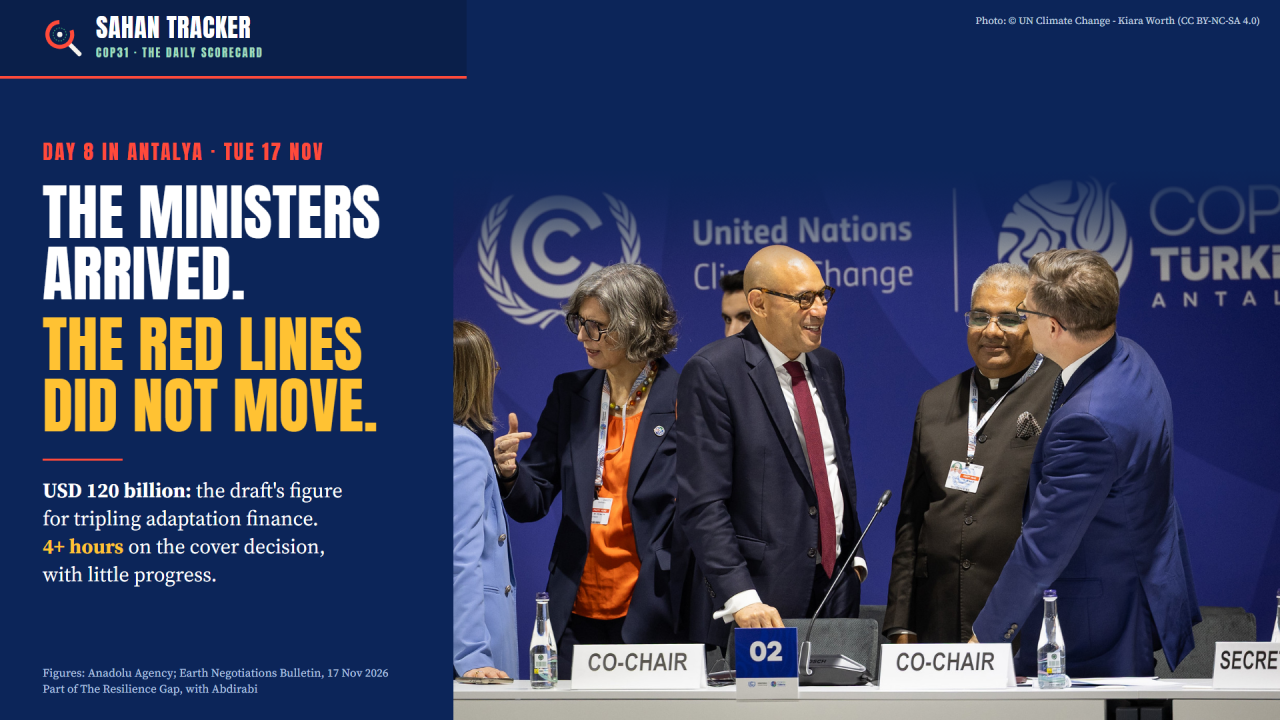
    Sahan Tracker | COP31, Day 8: The ministers arrived. The red lines did not move.

    Tuesday 17 November 2026 · Antalya, Türkiye · Part of The Resilience Gap, with Abdirabi

    ⏱️ Day 8 in one minute

    On Monday, the Presidencies shared the first draft of the cover decision, the one text meant to sum up COP31. It proposes to triple adaptation finance to at least USD 120 billion a year by 2035.On Tuesday, countries spent more than four hours on that draft, with little progress. The Arab Group rejected roadmaps, top-down targets for sectors and a reference to the International Court of Justice.The first closed-door meetings of ministers started in the afternoon. The technical talks were meant to finish, but most rooms did not agree.The EU backed the target to raise electricity to 35% of the world’s energy use by 2035. The EU climate commissioner called the draft a “shopping list”.The head of the Green Climate Fund said rich countries must lead the fund’s next funding round.

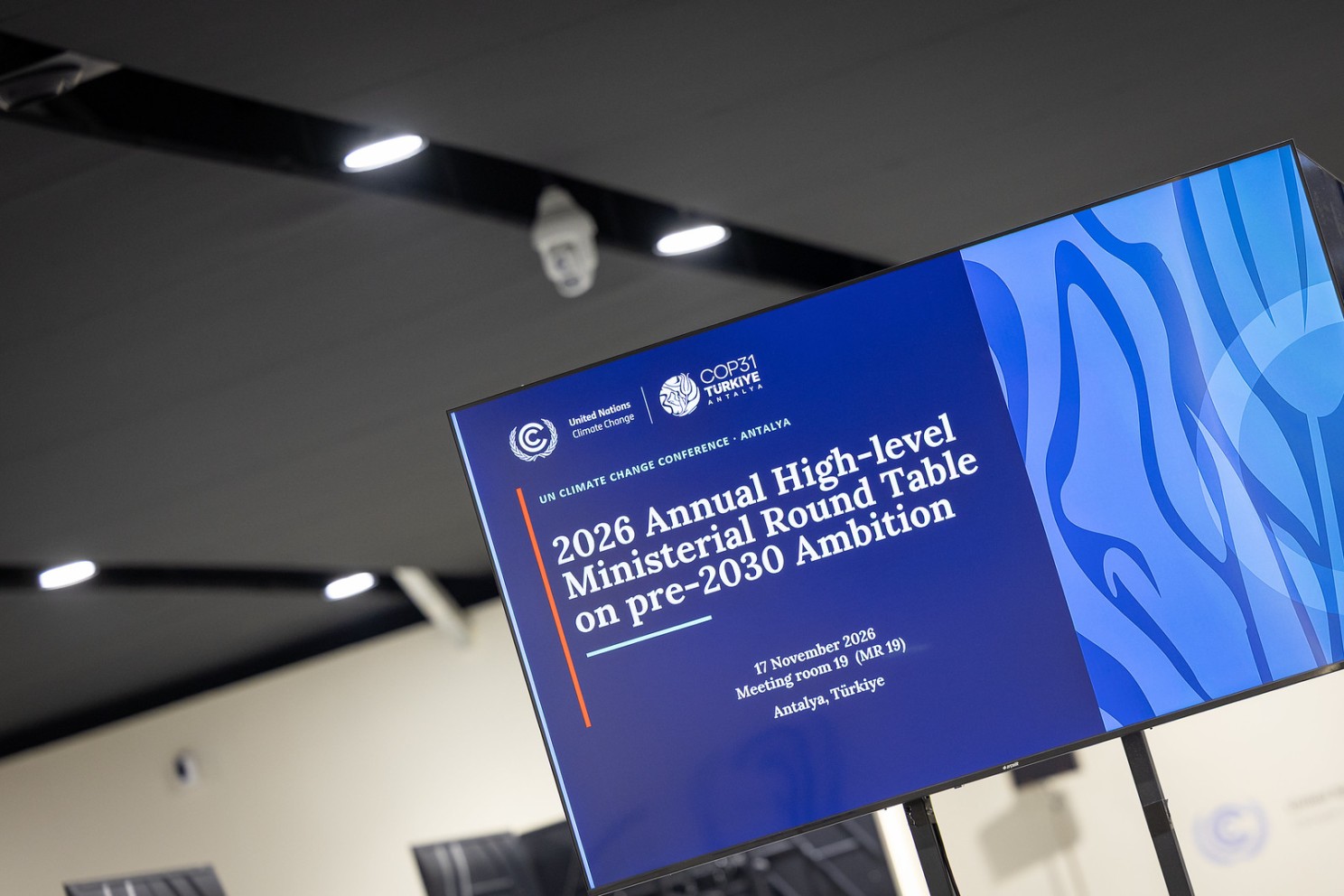
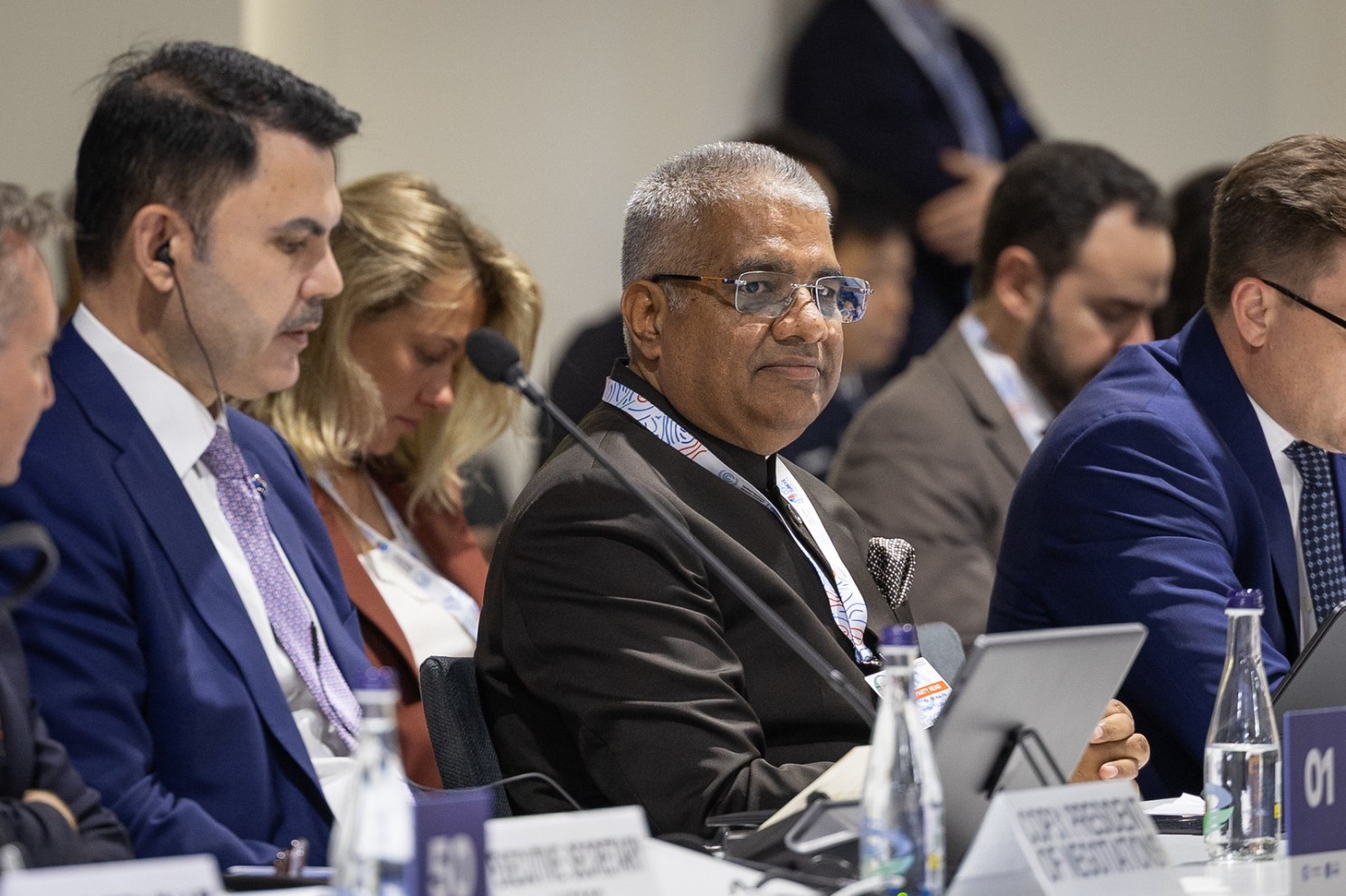
    The meeting room for the 2026 Annual High-level Ministerial Round Table on pre-2030 Ambition, 17 November. Photo: © UN Climate Change - Kiara Worth (CC BY-NC-SA 4.0)
    The meeting room for the 2026 Annual High-level Ministerial Round Table on pre-2030 Ambition, 17 November. Photo: © UN Climate Change – Kiara Worth (CC BY-NC-SA 4.0)
    • On Monday, the Presidencies shared the first draft of the cover decision, the one text meant to sum up COP31. It proposes to triple adaptation finance to at least USD 120 billion a year by 2035.
    • On Tuesday, countries spent more than four hours on that draft, with little progress. The Arab Group rejected roadmaps, top-down targets for sectors and a reference to the International Court of Justice.
    • The first closed-door meetings of ministers started in the afternoon. The technical talks were meant to finish, but most rooms did not agree.
    • The EU backed the target to raise electricity to 35% of the world’s energy use by 2035. The EU climate commissioner called the draft a “shopping list”.
    • The head of the Green Climate Fund said rich countries must lead the fund’s next funding round.

    🟢 What moved forward?

    A number for tripling adaptation finance. For more than a week, countries talked about tripling adaptation finance with no figure. The first draft of the cover decision now has one. Anadolu Agency reports that the 18-page draft, dated 16 November, calls for at least USD 120 billion a year by 2035. It urges developed countries to raise their support and present a roadmap to reach it. It also proposes an “Antalya-to-Addis Ababa Roadmap on Adaptation and Resilience Finance”, with a report at COP32 in 2027.

    Where the number comes from. The Earth Negotiations Bulletin calls it the “tripling of the doubling”. At COP26 in Glasgow, countries agreed to double adaptation finance, and many read that as about USD 40 billion. Three times 40 is 120. Developing countries do not want to repeat Glasgow’s “mistakes”, so they are asking for a clear baseline, a method and a way to track the money.

    Ministers are at work. Ministers held their first closed-door meetings on finance, adaptation, mitigation and the just transition. The Presidency of Negotiations asked negotiators to finish the technical work, so ministers can focus on the political choices.

    Plans to move away from fossil fuels. Climate Home News reports that Denmark presented its roadmap to move away from fossil fuels, and that five more countries promised theirs.

    New money for cooling. Governments and partners announced more than USD 20 million for the UNEP-led Cool Coalition. The Planet Brief notes this is an announcement, not money already paid.

    🔴 What got stuck?

    The cover decision. Countries spent more than four hours on it on Tuesday, with little progress. On Monday, one negotiator asked: “How are we supposed to digest and coordinate on 144 paragraphs in one hour?” The fossil fuel paragraphs are still open. One urges a faster move away from fossil fuels. The next one names phasing them out as the goal, but gives no end date.

    The adaptation goal. In the talks on the Global Goal on Adaptation, Solomon Islands and Fiji proposed to park the tripling discussion there, because the cover decision now covers it. Belize rejected text on adaptation “beyond the temperature goals”. The Presidency will prepare a new text.

    The LDC plan to fund adaptation plans. The least developed countries (LDCs) want a platform to turn their national adaptation plans into real projects. Japan said it must stay within existing mandates and money. Switzerland asked what it would cost. On Monday, the EU, Japan and Switzerland opposed text that reaffirms developed countries’ duty to provide adaptation finance.

    The budget of the Climate Technology Centre. Its proposed budget is USD 106.2 million. The G77 and China want to add “at least”. The EU opposed. On funding, the G77 and China want developed countries to provide it. The EU wants money from various sources. The EU warned the Centre must be able to keep working after February 2027.

    Words on who pays. In the talks on the Standing Committee on Finance, the Arab Group asked to replace “finance providers” with “developed country Parties” throughout the text. China wants South-South finance in a separate paragraph.

    Education and information. Countries spent more than three hours on Action for Climate Empowerment, the work on climate education and public information. Russia, Saudi Arabia and Paraguay wanted to delete work on media literacy and misinformation. The EU, UK, Norway, Iceland, Mexico, Canada and Chile strongly supported it.

    The just transition. Many developing countries prefer “agriculture” or “food production” to “food systems”. China proposed a new dedicated body, which the EU called a red line. The EU also opposed a new finance framework.

    A review of the 1.5°C goal. Three options are on the table: start the review soon, wait until COP34 in 2029, or stop it. Chile said more delay might break the due diligence duties set out by the International Court of Justice.

    Dignitaries during the High-level Ministerial on Pre-2030 Ambition, 17 November. Photo: © UN Climate Change - Kiara Worth (CC BY-NC-SA 4.0)
    Dignitaries during the High-level Ministerial on Pre-2030 Ambition, 17 November. Photo: © UN Climate Change – Kiara Worth (CC BY-NC-SA 4.0)

    📝 What is in, and out of, the cover decision?

    This was the main story of Day 8. Here is what each group said on Tuesday:

    Least developed countries, with Malaysia: pointed to the adaptation finance gap, asked for more climate finance, and welcomed the reference to the Advisory Opinion of the International Court of Justice.African Group: climate finance must not add to African countries’ debt. Treat overshoot of 1.5°C, support and loss and damage in a balanced way.Small island states (AOSIS): move away from fossil fuels, keep finance promises and refill the climate funds, especially for loss and damage.Arab Group: raised concerns about the legitimacy of the process, and rejected roadmaps, top-down sectoral targets and the Court’s Advisory Opinion.European Union: backed the 35% electrification target by 2035, and called for faster cuts to all greenhouse gases.Environmental Integrity Group (EIG): address overshoot, invite more actors to give voluntarily, and speed up the move away from fossil fuels.Bhutan and Tajikistan: a work programme and high-level dialogue on mountains.Indonesia and DR Congo: add peatland protection as a way to respond to overshoot.

    • Least developed countries, with Malaysia: pointed to the adaptation finance gap, asked for more climate finance, and welcomed the reference to the Advisory Opinion of the International Court of Justice.
    • African Group: climate finance must not add to African countries’ debt. Treat overshoot of 1.5°C, support and loss and damage in a balanced way.
    • Small island states (AOSIS): move away from fossil fuels, keep finance promises and refill the climate funds, especially for loss and damage.
    • Arab Group: raised concerns about the legitimacy of the process, and rejected roadmaps, top-down sectoral targets and the Court’s Advisory Opinion.
    • European Union: backed the 35% electrification target by 2035, and called for faster cuts to all greenhouse gases.
    • Environmental Integrity Group (EIG): address overshoot, invite more actors to give voluntarily, and speed up the move away from fossil fuels.
    • Bhutan and Tajikistan: a work programme and high-level dialogue on mountains.
    • Indonesia and DR Congo: add peatland protection as a way to respond to overshoot.

    On Monday, the Like-Minded Developing Countries (LMDCs) said the draft crosses their red lines, including the 35% electrification target. The Arab Group and Russia rejected the draft.

    Why it matters for LDCs: the USD 120 billion figure is the clearest win for adaptation so far. But it now sits in one text that several groups reject. If the cover decision falls, the number could fall with it.

    💰 The money picture

    USD 120 billion a year by 2035: the draft’s figure for tripling adaptation finance (Anadolu Agency).USD 40 billion: the doubling level that many use as the starting point (Earth Negotiations Bulletin).USD 106.2 million: the proposed budget of the Climate Technology Centre, still disputed.More than USD 20 million: announced for the Cool Coalition, not yet paid (The Planet Brief).Green Climate Fund: its next funding round covers 2028 to 2031. Its head, Mafalda Duarte, told Climate Home News that rich countries must lead it. Solomon Islands was the first country to give to this round.

    • USD 120 billion a year by 2035: the draft’s figure for tripling adaptation finance (Anadolu Agency).
    • USD 40 billion: the doubling level that many use as the starting point (Earth Negotiations Bulletin).
    • USD 106.2 million: the proposed budget of the Climate Technology Centre, still disputed.
    • More than USD 20 million: announced for the Cool Coalition, not yet paid (The Planet Brief).
    • Green Climate Fund: its next funding round covers 2028 to 2031. Its head, Mafalda Duarte, told Climate Home News that rich countries must lead it. Solomon Islands was the first country to give to this round.

    🗣️ Who said what?

    • Wopke Hoekstra, EU climate commissioner: called the draft a “shopping list”. He said the decision should focus “on the gap that the world has in terms of delivery and in terms of implementation”.
    • Chris Bowen, President of Negotiations: “There are elements in this draft that not all parties will agree on.”
    • Least developed countries: the work programme for LDCs, from 2018, no longer reflects their needs.
    • Arab Group: no roadmaps, no top-down sectoral targets.
    • Chile: delaying the review of the 1.5°C goal might break due diligence duties.
    • One delegate, in the corridors: it is “high time” for the Presidencies to find compromises at the political level.

    🧭 So, who stands where?

    In one line: the LDCs, small islands, the EU and the EIG want a strong cover decision on overshoot and fossil fuels. The Arab Group, the LMDCs and Russia reject its core. On money, developing countries want a number with a baseline and tracking, while the EU, Japan and Switzerland resist new duties to pay.

    💡 My takeaways from Day 8

    One. A number is finally on the table. After a week of talk about tripling with no figure, the draft names USD 120 billion. That is real progress. But a number in a draft is not a decision.

    Two. All the eggs are in one basket. The tripling figure now lives in the cover decision, and some countries want to park it in the other rooms. That makes sense only if the cover decision survives. Several groups reject it today.

    Three. Small words decide who pays. “Finance providers” or “developed country Parties”. “At least” or not. “Parties in a position to do so”. These words decide whose money is expected, and how much.

    📖 Words of the day

    Cover decision: the one text meant to sum up the political message of a COP.Red line: a point a country or group says it will never accept.Baseline: the starting amount used to measure a goal, like “triple from what?”Advisory Opinion of the International Court of Justice: the Court’s 2025 legal opinion on what countries must do about climate change.Closed-door ministerial consultations: private meetings where ministers try to find compromises.South-South finance: money that developing countries give to other developing countries.

    • Cover decision: the one text meant to sum up the political message of a COP.
    • Red line: a point a country or group says it will never accept.
    • Baseline: the starting amount used to measure a goal, like “triple from what?”
    • Advisory Opinion of the International Court of Justice: the Court’s 2025 legal opinion on what countries must do about climate change.
    • Closed-door ministerial consultations: private meetings where ministers try to find compromises.
    • South-South finance: money that developing countries give to other developing countries.

    👀 What to watch tomorrow?

    • A new version of the cover decision: does the USD 120 billion figure survive?
    • The Presidency’s new text on the adaptation goal.
    • The fossil fuel paragraphs: do they keep the word “phase out”?
    • Whether ministers can close the finance and LDC files.

    See you tomorrow.

    Abdirabi

    📚 Sources

    Earth Negotiations Bulletin (IISD), daily report for 17 November 2026: https://enb.iisd.org/antalya-un-climate-change-conference-cop31-daily-report-17nov2026Earth Negotiations Bulletin (IISD), daily report for 16 November 2026: https://enb.iisd.org/antalya-un-climate-change-conference-cop31-daily-report-16nov2026Yeni Şafak (Anadolu Agency), COP31 draft urges tripling adaptation finance to USD 120 billion by 2035: https://en.yenisafak.com/world/cop31-draft-urges-tripling-adaptation-finance-to-120b-by-2035-3725650Climate Home News, COP31 Bulletin Day 8: https://www.climatechangenews.com/2026/11/17/cop31-bulletin-day-8-arab-group-russia-reject-cover-text-over-fossil-fuels-and-electrification-goal/Climate Home News, Rich countries must step up to replenish Green Climate Fund, Duarte says: https://www.climatechangenews.com/2026/11/17/rich-countries-must-step-up-to-replenish-green-climate-fund-duarte-says/The Planet Brief, COP31 roundup, 17 November: https://theplanetbrief.com/carbon/climate-policy/cop31-day-8-roundup-2026/

    First published on LinkedIn in The Resilience Gap newsletter by Abdirabi Mohamed. Read the original.
  • Sahan Tracker | COP31, Week 1: Much was sent forward. Little was funded.

    Sahan Tracker | COP31, Week 1: Much was sent forward. Little was funded.

    Monday 16 November 2026 · Antalya, Türkiye · Week 1 (9 to 14 November) · Part of The Resilience Gap, with Abdirabi

    What is Sahan Tracker? It is my daily update during COP31, the UN climate conference in Antalya, Türkiye (9 to 20 November 2026). During COP31, The Resilience Gap comes to you every day as Sahan Tracker, focused on what is happening inside the negotiation rooms. After COP31, we go back to one edition a week.

    ⏱️ Week 1 in one minute

    The technical talks closed at 12:48 am on Sunday 15 November. A few topics were agreed. Most of the big ones, including the adaptation goal, national adaptation plans, the mitigation work programme and the just transition, were sent to week two without agreement.From Monday, ministers take over the hardest topics in five pairs: mitigation, finance, adaptation, just transition and the Ocean.The cover decision, the one text meant to sum up COP31, is now the main fight. The Arab Group and the Like-Minded Developing Countries (LMDCs) said no to new targets for sectors. Some countries question whether there should be a cover decision at all.Money moved the wrong way all week: USD 5.1 billion less for the Green Climate Fund, a 27% smaller Global Environment Facility, and climate finance pledges down 70%, according to Carbon Brief.The smallest pledge of the week sent the biggest message: Solomon Islands gave USD 400,000 to the Green Climate Fund.

    • The technical talks closed at 12:48 am on Sunday 15 November. A few topics were agreed. Most of the big ones, including the adaptation goal, national adaptation plans, the mitigation work programme and the just transition, were sent to week two without agreement.
    • From Monday, ministers take over the hardest topics in five pairs: mitigation, finance, adaptation, just transition and the Ocean.
    • The cover decision, the one text meant to sum up COP31, is now the main fight. The Arab Group and the Like-Minded Developing Countries (LMDCs) said no to new targets for sectors. Some countries question whether there should be a cover decision at all.
    • Money moved the wrong way all week: USD 5.1 billion less for the Green Climate Fund, a 27% smaller Global Environment Facility, and climate finance pledges down 70%, according to Carbon Brief.
    • The smallest pledge of the week sent the biggest message: Solomon Islands gave USD 400,000 to the Green Climate Fund.

    📅 The week, day by day

    • Day 1 (Mon 9 Nov): The agenda fight. The finance work programme, including Article 9.1, made it onto the agenda. Tripling adaptation finance did not get its own item.
    • Day 2 (Tue 10 Nov): Real talks began. 119 countries have asked the loss and damage fund for USD 2.8 billion. The EU, UK and Canada called guidance to the fund “premature”.
    • Day 3 (Wed 11 Nov): Leaders arrived. Guterres called for a “climate justice compact” and a windfall tax on fossil fuel profits. No new money for adaptation or loss and damage was reported.
    • Day 4 (Thu 12 Nov): First draft texts arrived. A debate opened on how to fix the UN climate process. Solomon Islands made its pledge.
    • Day 5 (Fri 13 Nov): Everyone shared a wish list for the cover decision. Developed countries called loss and damage guidance “micromanaging”.
    • Day 6 (Sat 14 Nov): The technical talks closed after midnight. People marched in Antalya for climate justice. It was also Children, Youth, Education and Skills Day
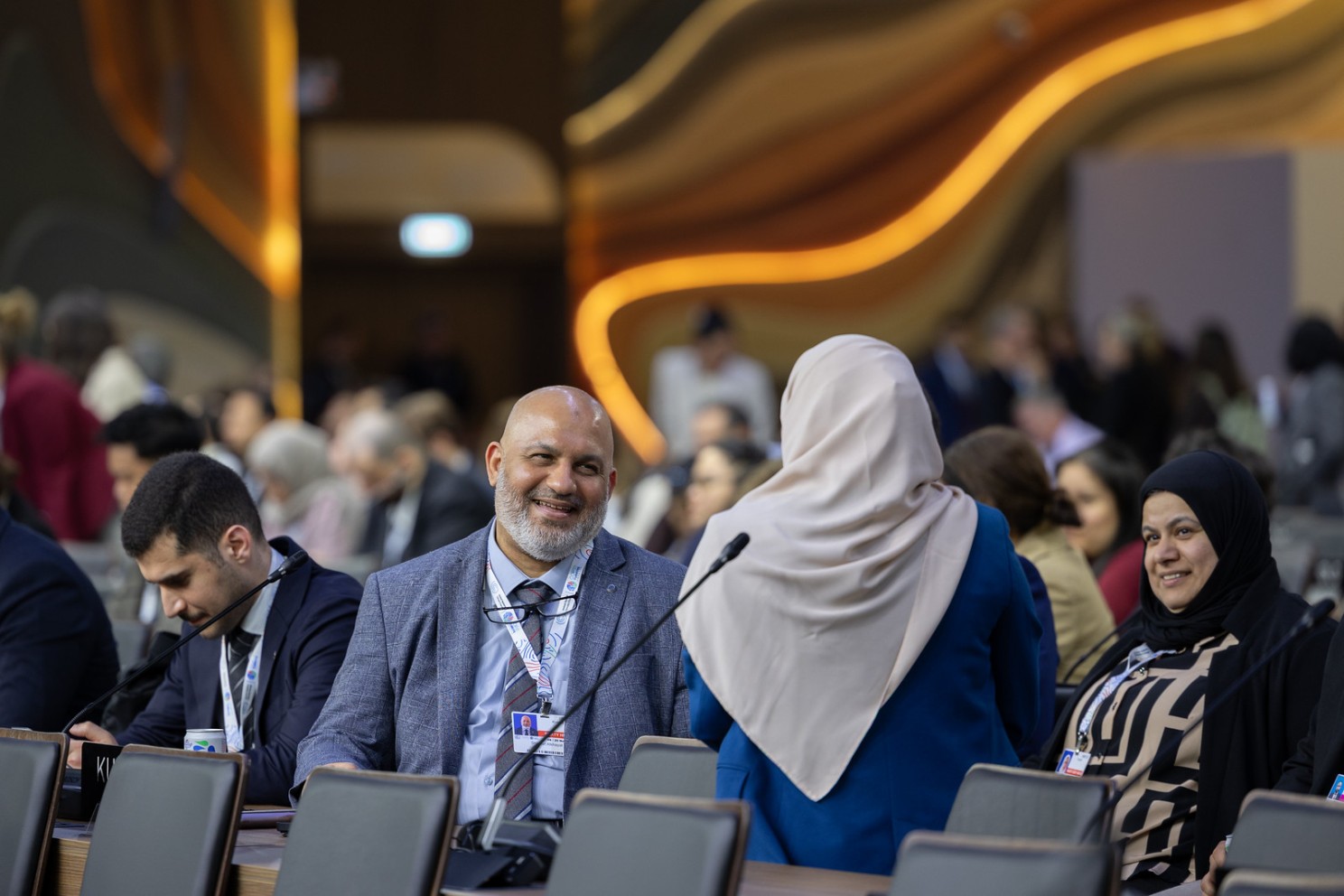
    Delegates during the closing plenary of the Subsidiary Bodies, 14 November. Photo: © UN Climate Change - Kiara Worth (CC BY-NC-SA 4.0)
    Delegates during the closing plenary of the Subsidiary Bodies, 14 November. Photo: © UN Climate Change – Kiara Worth (CC BY-NC-SA 4.0)

    🟢 What moved forward?

    A few topics were agreed. The technical bodies adopted short outcomes, called conclusions, on guidance for adaptation communications (the reports where countries share their adaptation needs and actions), matters relating to the least developed countries (LDCs), gender, research and systematic observation, capacity-building, and support for developing countries’ reporting.

    Loss and damage reporting. The report of the Warsaw International Mechanism on loss and damage was adopted as COP and CMA decisions.

    Ministers have a plan for week two. The COP31 President, Murat Kurum, set out four streams of work and named five pairs of ministers: Germany and India on mitigation, France and the Philippines on climate finance, Sierra Leone and the UK on adaptation, Mexico and Poland on the just transition, and Canada and Palau on the Ocean.

    A carbon market starts to work. The Article 6.4 mechanism, the new UN carbon market, issued its first credits this week.

    Tripling adaptation finance has support as a topic. In the finance talks, there was broad support for discussing tripling adaptation finance and access to finance. That is a start, but there is still no starting year and no dollar figure.

    🔴 What got stuck?

    The adaptation goal. The Global Goal on Adaptation, the shared goal for making the world more resilient, was sent to the CMA on a draft text with “no formal status”. The Secretariat said it can still be the basis for talks.

    National adaptation plans. Many countries were disappointed that there was not more time. The text was sent to the COP for week two.

    The mitigation work programme. The African Group, the Arab Group and the LMDCs rejected the updated informal note, saying it goes beyond the mandate. The matter was sent to the CMA with no agreed text. Countries still disagree on whether it should run to 2030 or 2040.

    The just transition work programme. Sent on to the CMA, taking note of an informal note.

    Agriculture and food security. A procedural decision was adopted, but a real decision is delayed until 2027. One observer called it “a real shame”.

    The Adaptation Fund. Countries are still divided over how the Fund moves to serve only the Paris Agreement, and over who sits on its Board. The EU and Norway want to change the terms used for Board seats. The African Group asked whether that would also remove the invitation for developed countries to keep funding it. The LDCs defended the Fund as a source of grants.

    Cooperation with other organisations. This item, which includes the link between the three Rio Conventions on climate, biodiversity and land, was put off to June 2027. One delegate said: “refusing to negotiate is something else.”

    Officials confer on the podium during the closing plenary of the Subsidiary Bodies, 14 November. Photo: © UN Climate Change - Kiara Worth (CC BY-NC-SA 4.0)
    Officials confer on the podium during the closing plenary of the Subsidiary Bodies, 14 November. Photo: © UN Climate Change – Kiara Worth (CC BY-NC-SA 4.0)

    📝 The cover decision: the fight of week two

    This is the main story going into week two.

    What is on the table? The Presidencies’ note on the cover decision still holds almost every idea: responding to overshoot of 1.5°C, welcoming the COP30 roadmaps on fossil fuels and deforestation, and a 35% electrification target by 2035.

    The red lines are out. At the Saturday night stocktake, the Arab Group said it will not accept “top-down” global targets, or targets for specific sectors or energy sources. Climate Home News reported that Saudi Arabia rejected mentioning Brazil’s roadmap to move away from fossil fuels, and that India opposed mentioning reports “external” to the UN process, like the UN Environment Programme’s report on overshoot.

    Reform of the process. Russia, the Arab Group, the African Group, the LMDCs and Argentina opposed putting the outcome of the talks on reforming the UN climate process into the cover decision. The EU, the Umbrella Group, the LDCs, AILAC, AOSIS and Switzerland supported continuing those talks.

    The overshoot fight. The EU, the UK, the LDCs and the small island states want COP31 to make the response to overshooting 1.5°C a priority. Saudi Arabia and other large developing countries questioned the science of the UNEP report on overshoot. Its authors defended it.

    The first draft is out. On Monday 16 November, the first draft of the cover decision was published. Climate Home News reports it holds asks from 160 countries and now has to be cut down.

    Why it matters for LDCs: tripling adaptation finance has no agenda item of its own. The cover decision is the main political place where it can get a number, a starting year and a way to track it. The LDC asks (concrete adaptation measures, new money for the funds including the loss and damage fund, and milestones to track progress) now need to survive into the next drafts.

    💰 The money picture

    USD 2.8 billion: what 119 countries have asked the loss and damage fund for.USD 5.1 billion: how much less the Green Climate Fund gets in one year after UK and US cuts.27%: how much smaller the new funding round of the Global Environment Facility (GEF-9) is.70%: the drop in climate finance pledges, according to Carbon Brief.USD 7.9 billion of USD 10 billion: the Tropical Forest Forever Facility is still short of its start-up target.USD 400,000: the pledge from Solomon Islands to the Green Climate Fund, the first from a small island developing state to the fund’s replenishment.GBP 6 billion over three years: the climate finance figure the UK spoke of.

    • USD 2.8 billion: what 119 countries have asked the loss and damage fund for.
    • USD 5.1 billion: how much less the Green Climate Fund gets in one year after UK and US cuts.
    • 27%: how much smaller the new funding round of the Global Environment Facility (GEF-9) is.
    • 70%: the drop in climate finance pledges, according to Carbon Brief.
    • USD 7.9 billion of USD 10 billion: the Tropical Forest Forever Facility is still short of its start-up target.
    • USD 400,000: the pledge from Solomon Islands to the Green Climate Fund, the first from a small island developing state to the fund’s replenishment.
    • GBP 6 billion over three years: the climate finance figure the UK spoke of.

    Grants or loans? In the talks on guidance to the Green Climate Fund, the Philippines said loans are inappropriate, especially for adaptation. The EU supported grants for adaptation in the LDCs and small island states. The Arab Group said expanding the donor base, meaning asking more countries to pay in, is a red line.

    🗣️ Who said what?

    Least developed countries: the expected overshoot of 1.5°C is “a grave betrayal”. Give guidance to the loss and damage fund and speed up its replenishment.Landlocked developing countries: “A plan that cannot be financed protects no one.”António Guterres, UN Secretary-General: “polluters must pay”.Arab Group: no top-down global targets, and no targets for specific sectors or energy sources.EU, Japan, Canada, New Zealand and Norway: detailed guidance for the loss and damage fund is “micromanaging”.Switzerland: limiting overshoot of 1.5°C is important.Argentina: splitting the talks into “technical” and “political” tracks risks undermining the Convention and the Paris Agreement.One delegate, on a long draft text: “This document does not need streamlining, it needs a chainsaw.”

    • Least developed countries: the expected overshoot of 1.5°C is “a grave betrayal”. Give guidance to the loss and damage fund and speed up its replenishment.
    • Landlocked developing countries: “A plan that cannot be financed protects no one.”
    • António Guterres, UN Secretary-General: “polluters must pay”.
    • Arab Group: no top-down global targets, and no targets for specific sectors or energy sources.
    • EU, Japan, Canada, New Zealand and Norway: detailed guidance for the loss and damage fund is “micromanaging”.
    • Switzerland: limiting overshoot of 1.5°C is important.
    • Argentina: splitting the talks into “technical” and “political” tracks risks undermining the Convention and the Paris Agreement.
    • One delegate, on a long draft text: “This document does not need streamlining, it needs a chainsaw.”

    🧭 So, who stands where?

    In one line: developing countries stand together on public money, grants and Article 9.1. Developed countries keep finance broad and resist new guidance for the funds. On the cover decision, the lines are different: the Arab Group and the LMDCs reject new targets, while the LDCs, small islands, the EU and AILAC push for strong text on overshoot and ambition.

    💡 My takeaways from Week 1

    One. Sent forward is not the same as solved. Almost every big topic went to week two without agreement. Ministers now have one week to do what negotiators could not.

    Two. The money is moving the other way. Every day this week, I wrote about a need: USD 2.8 billion for loss and damage, tripling adaptation finance, help to turn adaptation plans into projects. And every day, the money got smaller. That is the resilience gap in one week.

    Three. The LDCs can be a bridge. On finance, they stand with the G77 and China. On the cover decision and overshoot, they stand closer to the EU and small islands than to some large developing countries. That gives them a chance to connect the two sides, if they keep their asks clear and simple.

    📖 Words of the week

    Subsidiary Bodies (SBs): the two technical bodies (SBI and SBSTA) that prepare work for the COP. They close at the end of week one.Forwarded: a topic sent on to the COP or CMA for week two, often without agreement.“No formal status”: a draft text that countries have not agreed, but that can still be used as a starting point.Ministerial pair: two ministers, usually one from a developed and one from a developing country, who lead talks on a hard topic.Overshoot: when warming goes above 1.5°C for a time before, hopefully, coming back down.Sectoral target: a goal for one part of the economy, like electricity or transport.Donor base: the group of countries that pay into a fund.

    • Subsidiary Bodies (SBs): the two technical bodies (SBI and SBSTA) that prepare work for the COP. They close at the end of week one.
    • Forwarded: a topic sent on to the COP or CMA for week two, often without agreement.
    • “No formal status”: a draft text that countries have not agreed, but that can still be used as a starting point.
    • Ministerial pair: two ministers, usually one from a developed and one from a developing country, who lead talks on a hard topic.
    • Overshoot: when warming goes above 1.5°C for a time before, hopefully, coming back down.
    • Sectoral target: a goal for one part of the economy, like electricity or transport.
    • Donor base: the group of countries that pay into a fund.

    👀 What to watch in Week 2?

    • The first draft of the cover decision, and how many LDC asks survive into the next version.
    • The finance ministers (France and the Philippines): will tripling adaptation finance get a starting year and a number?
    • The adaptation ministers (Sierra Leone and the UK): can they turn the adaptation goal text into an agreement?
    • Loss and damage: guidance for the fund, or none.

    See you tomorrow.

    Abdirabi

    📚 Sources

    Earth Negotiations Bulletin (IISD), daily report for 14 November 2026: https://enb.iisd.org/antalya-un-climate-change-conference-cop31-daily-report-14nov2026Earth Negotiations Bulletin (IISD), daily reports for 9 to 13 November 2026: https://enb.iisd.org/antalya-un-climate-change-conference-cop31Climate Home News, COP31 Bulletin Day 6: https://www.climatechangenews.com/2026/11/14/cop31-bulletin-day-6-limited-progress-as-ministers-arrive-in-antalya/Climate Home News, COP31 Bulletin Day 7: https://www.climatechangenews.com/2026/11/16/cop31-bulletin-day-7-sharp-divisions-lower-expectations-for-cop-outcome/Climate Home News, scientists defend UN overshoot report: https://www.climatechangenews.com/2026/11/14/scientists-defend-un-overshoot-report-after-saudi-led-push-to-sideline-it-at-cop31/Carbon Brief, DeBriefed 13 November 2026: https://www.carbonbrief.org/debriefed-13-november-2026-make-or-bake-electrification-push-climate-finance-down-70UN News, Guterres urges climate justice pact: https://news.un.org/en/story/2026/11/1168783

    First published on LinkedIn in The Resilience Gap newsletter by Abdirabi Mohamed. Read the original.
  • Sahan Tracker | COP31, Day 5: Everyone has a wish list. The money is shrinking.

    Sahan Tracker | COP31, Day 5: Everyone has a wish list. The money is shrinking.

    Friday 13 November 2026 · Antalya, Türkiye · Part of The Resilience Gap, with Abdirabi

    What is Sahan Tracker? It is my daily update during COP31, the UN climate conference in Antalya, Türkiye (9 to 20 November 2026). During COP31, The Resilience Gap comes to you every day as Sahan Tracker, focused on what is happening inside the negotiation rooms. After COP31, we go back to one edition a week.

    ⏱️ Day 5 in one minute

    Week one is closing. Several rooms agreed conclusions or sent their topics to week two, when ministers arrive.We got a first look at the cover decision, the one text meant to sum up COP31. The Presidencies published a “Summary of Reflections” of countries’ views. It is not a negotiated draft, and a first draft is due early next week.The least developed countries (LDCs) set out what they want in it: concrete adaptation measures, new money for the climate funds, including the loss and damage fund, and a way to track milestones and progress.The loss and damage fund split the room. All the main developing country groups want the COP to give the fund guidance. The EU, Japan, Canada, New Zealand and Norway want none.It was Finance and Trade Day. A Carbon Brief analysis found that climate finance pledges have dropped by 70%.

    Simon Stiell, Murat Kurum and Alexander De Croo at the COP31 Legacy Initiative event on the Climate Implementation Bridge, 13 November. Photo: © UN Climate Change - Kubilay Ciftci (CC BY-NC-SA 4.0)
    Simon Stiell, Murat Kurum and Alexander De Croo at the COP31 Legacy Initiative event on the Climate Implementation Bridge, 13 November. Photo: © UN Climate Change – Kubilay Ciftci (CC BY-NC-SA 4.0)
    • Week one is closing. Several rooms agreed conclusions or sent their topics to week two, when ministers arrive.
    • We got a first look at the cover decision, the one text meant to sum up COP31. The Presidencies published a “Summary of Reflections” of countries’ views. It is not a negotiated draft, and a first draft is due early next week.
    • The least developed countries (LDCs) set out what they want in it: concrete adaptation measures, new money for the climate funds, including the loss and damage fund, and a way to track milestones and progress.
    • The loss and damage fund split the room. All the main developing country groups want the COP to give the fund guidance. The EU, Japan, Canada, New Zealand and Norway want none.
    • It was Finance and Trade Day. A Carbon Brief analysis found that climate finance pledges have dropped by 70%.

    🟢 What moved forward?

    Week one wrapped up. Negotiators tried to close topics at the technical level before the closing meetings on Saturday. Several rooms agreed short outcomes, called conclusions, or sent their topics on to week two.

    The cover decision is taking shape. The people leading the talks invited views on an informal note. Almost everything is still in it, including responding to overshooting 1.5°C, welcoming the COP30 roadmaps on fossil fuels and deforestation, and a 35% electrification target.

    More openness. Observers could follow the cover decision talks online and in overflow rooms. One observer called it “a glimpse behind the curtain”.

    A carbon market starts to work. The Article 6.4 mechanism, the new UN carbon market, has issued its first credits. It now has five methodologies, the rules for counting credits, including one for clean cooking.

    More countries back electrification. More than 50 countries now support the electrification push, according to Carbon Brief.

    🔴 What got stuck?

    Guidance for the loss and damage fund. Draft texts offer two options: give the fund guidance, or give none. The African Group, Arab Group, LDCs, small island states (AOSIS), China, the Philippines and Brazil want guidance, including on how the fund will work in the long term, fast payments and grants. The EU, Japan, Canada, New Zealand and Norway want none and called it “micromanaging”. Switzerland and the UK want limited guidance. The LDCs asked to speed up new pledges to the fund, because demand is bigger than the money. The EU said this is already under way.

    Was the USD 100 billion goal met? Countries are still split. The OECD and Oxfam use different methods and reach different answers. The Like-Minded Developing Countries (LMDCs) want to continue the work on long-term finance. Canada said it ends in 2027, as agreed.

    Weaker words on the LDCs. In the talks on matters related to the LDCs, the LDCs said the new text waters down the language on their challenges, and asked to go back to the earlier version.

    Adaptation plans and the money behind them. The UK and EU want the text on national adaptation plans to mention the new finance goal, private finance and locally-led adaptation. The LMDCs, with Grupo Sur, the African Group and the LDCs, want the finance overview revised to match the mandate. The people leading the talks asked for guidance from above.

    How long to keep cutting emissions together. The Arab Group, the African Group and Malaysia want the mitigation work programme to run to 2030. The EU and Mongolia want 2040. Switzerland wants 2031 or no end date.

    The carbon market needs money. The Article 6.4 mechanism is not yet paying for itself and needs more money to continue after 2027.

    Technology outage. A global Microsoft outage slowed emails and draft texts. One co-facilitator joked that “the keyboard does not allow us to place any new brackets”.

    📝 What goes into the final deal?

    This was the main story of Day 5. Countries said what they want in, or out of, the cover decision:

    Least developed countries: concrete adaptation measures, ongoing work on the first Global Stocktake, new money for the funds including the loss and damage fund, and tracking of milestones and progress.Small island states (AOSIS): new money for the Green Climate Fund, and the best available science guiding national climate plans.African Group: no language that weakens “common but differentiated responsibilities”. Overshoot raises adaptation costs. No electrification targets without the money and support to reach them.Latin American countries (AILAC): developed countries’ historical responsibility, a clearer pathway to tripling adaptation finance, and Article 9.1 duties.Arab Group: against top-down targets for sectors and energy. Developed countries failed on finance.Like-Minded Developing Countries: address implementation gaps. Developed countries must provide finance.European Union: no new mandates. Reflect overshoot, the move away from fossil fuels, human rights and gender.Environmental Integrity Group (EIG): carbon capture, early warning systems and phasing out inefficient fuel subsidies.UK: resilience of public budgets against climate shocks, and GBP 6 billion in climate finance over three years.

    • Least developed countries: concrete adaptation measures, ongoing work on the first Global Stocktake, new money for the funds including the loss and damage fund, and tracking of milestones and progress.
    • Small island states (AOSIS): new money for the Green Climate Fund, and the best available science guiding national climate plans.
    • African Group: no language that weakens “common but differentiated responsibilities”. Overshoot raises adaptation costs. No electrification targets without the money and support to reach them.
    • Latin American countries (AILAC): developed countries’ historical responsibility, a clearer pathway to tripling adaptation finance, and Article 9.1 duties.
    • Arab Group: against top-down targets for sectors and energy. Developed countries failed on finance.
    • Like-Minded Developing Countries: address implementation gaps. Developed countries must provide finance.
    • European Union: no new mandates. Reflect overshoot, the move away from fossil fuels, human rights and gender.
    • Environmental Integrity Group (EIG): carbon capture, early warning systems and phasing out inefficient fuel subsidies.
    • UK: resilience of public budgets against climate shocks, and GBP 6 billion in climate finance over three years.

    A trade topic was dropped from the agenda at the start, so its supporters now see the cover decision as the next-best place for it. One delegate summed up the mood: “we have more than enough work to do under the existing mandates.”

    Why it matters for LDCs: the cover decision is the political home for issues that have no agenda item of their own, like tripling adaptation finance. The LDC asks now need to survive into the first draft.

    💰 The money picture

    Pledges are falling. A Carbon Brief analysis found that climate finance pledges have dropped by 70%.The loss and damage fund needs more. The LDCs said demand is bigger than the money available and asked to speed up new pledges.A new UK figure. The UK spoke of GBP 6 billion in climate finance over three years.The old goal is still disputed. Countries do not agree on whether the USD 100 billion a year goal was met.

    • Pledges are falling. A Carbon Brief analysis found that climate finance pledges have dropped by 70%.
    • The loss and damage fund needs more. The LDCs said demand is bigger than the money available and asked to speed up new pledges.
    • A new UK figure. The UK spoke of GBP 6 billion in climate finance over three years.
    • The old goal is still disputed. Countries do not agree on whether the USD 100 billion a year goal was met.

    🗣️ Who said what?

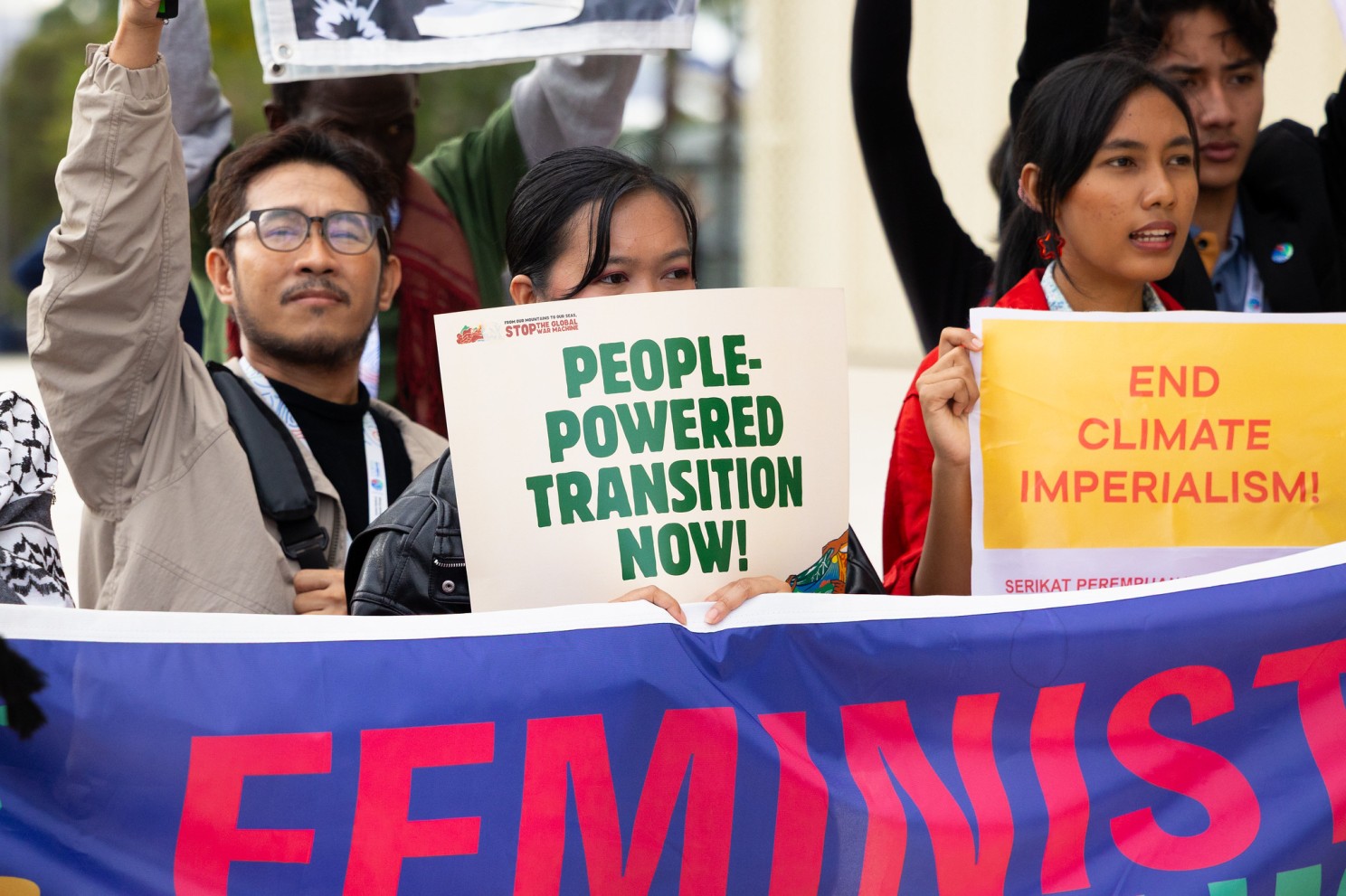
    Members of civil society demonstrate in the corridors, 13 November. Photo: © UN Climate Change - Kubilay Ciftci (CC BY-NC-SA 4.0)
    Members of civil society demonstrate in the corridors, 13 November. Photo: © UN Climate Change – Kubilay Ciftci (CC BY-NC-SA 4.0)
    • Least developed countries: give guidance to the loss and damage fund and speed up its replenishment. Restore the stronger text on LDC challenges.
    • African Group: protect common but differentiated responsibilities. No electrification targets without support.
    • Small island states (AOSIS): new money for the Green Climate Fund, and guidance for the loss and damage fund.
    • EU, Japan, Canada, New Zealand and Norway: no guidance for the loss and damage fund, calling it “micromanaging”.
    • European Commission: the EU supports the Presidencies’ proposal to acknowledge and address overshoot in the cover decision.
    • Russia, the Arab Group and China: questioned the mandate for the talks on reforming the UN climate process.

    🧭 So, who stands where?

    In one line: on the loss and damage fund, all the main developing country groups stand together for guidance, against a united group of developed countries.

    💡 My takeaways from Day 5

    One. Everyone has a wish list, but the money is moving the other way. The cover decision now holds almost every idea, from overshoot to electrification. At the same time, climate finance pledges have dropped by 70%, according to Carbon Brief. A long list of goals means little without the money to reach them.

    Two. “Micromanaging” is the word of the week. When developing countries ask the COP to guide the loss and damage fund on fast payments and grants, developed countries call it micromanaging. For communities waiting for help after a disaster, how fast the money moves is not a detail.

    Three. Watch the first draft. The LDC asks on adaptation, new money for the funds and milestones are now on the table. Next week will show whether they survive into the first draft of the cover decision.

    📖 Words of the day

    Cover decision: the one text meant to sum up the political message of a COP.Summary of Reflections: a Presidency paper that lists countries’ views. It is not negotiated text.Conclusions: a short outcome from a technical body, often sending a topic to the COP or to the next session.Long-term model: how the loss and damage fund will work after its start-up phase.Self-financing: a body that pays for itself from fees, like the Article 6.4 carbon market.Micromanaging: the word developed countries use for detailed guidance they see as interfering with a fund’s Board.

    • Cover decision: the one text meant to sum up the political message of a COP.
    • Summary of Reflections: a Presidency paper that lists countries’ views. It is not negotiated text.
    • Conclusions: a short outcome from a technical body, often sending a topic to the COP or to the next session.
    • Long-term model: how the loss and damage fund will work after its start-up phase.
    • Self-financing: a body that pays for itself from fees, like the Article 6.4 carbon market.
    • Micromanaging: the word developed countries use for detailed guidance they see as interfering with a fund’s Board.

    👀 What to watch next?

    • Saturday 14 November: closing meetings of the technical bodies, the deadline for written views on the cover decision, and Children, Youth, Education and Skills Day.
    • Early next week: the first draft of the cover decision.
    • Week two: ministers take over the open topics, including guidance for the loss and damage fund, the mitigation work programme, the adaptation goal and the finance work programme.

    See you tomorrow.

    Abdirabi

    📚 Sources

    Earth Negotiations Bulletin (IISD), Vol. 12 No. 906, daily report for 13 November 2026: https://enb.iisd.org/antalya-un-climate-change-conference-cop31-daily-report-13nov2026Climate Home News, COP31 Bulletin Day 5: https://www.climatechangenews.com/2026/11/13/cop31-bulletin-day-5-cover-decision-wishlist-issued-as-china-bows-out-of-cop33/Carbon Brief, DeBriefed 13 November 2026: https://www.carbonbrief.org/debriefed-13-november-2026-make-or-bake-electrification-push-climate-finance-down-70The Climate Watch, COP31 divisions deepen: https://theclimatewatch.com/cop31-divisions-deepen-over-climate-finance-and-fossil-fuel-transition/Royal Meteorological Society (RMetS), COP31 Day 5: https://www.rmets.org/news/cop31-day-5-climate-finance-why-science-must-guide-investment-our-future-13-november-2026

    First published on LinkedIn in The Resilience Gap newsletter by Abdirabi Mohamed. Read the original.
  • Sahan Tracker | COP31, Day 4: A small island gave. Few others did.

    Sahan Tracker | COP31, Day 4: A small island gave. Few others did.

    Thursday 12 November 2026 · Antalya, Türkiye · Part of The Resilience Gap, with Abdirabi

    What is Sahan Tracker? It is my daily update during COP31, the UN climate conference in Antalya, Türkiye (9 to 20 November 2026). During COP31, The Resilience Gap comes to you every day as Sahan Tracker, focused on what is happening inside the negotiation rooms. After COP31, we go back to one edition a week

    ⏱️ Day 4 in one minute

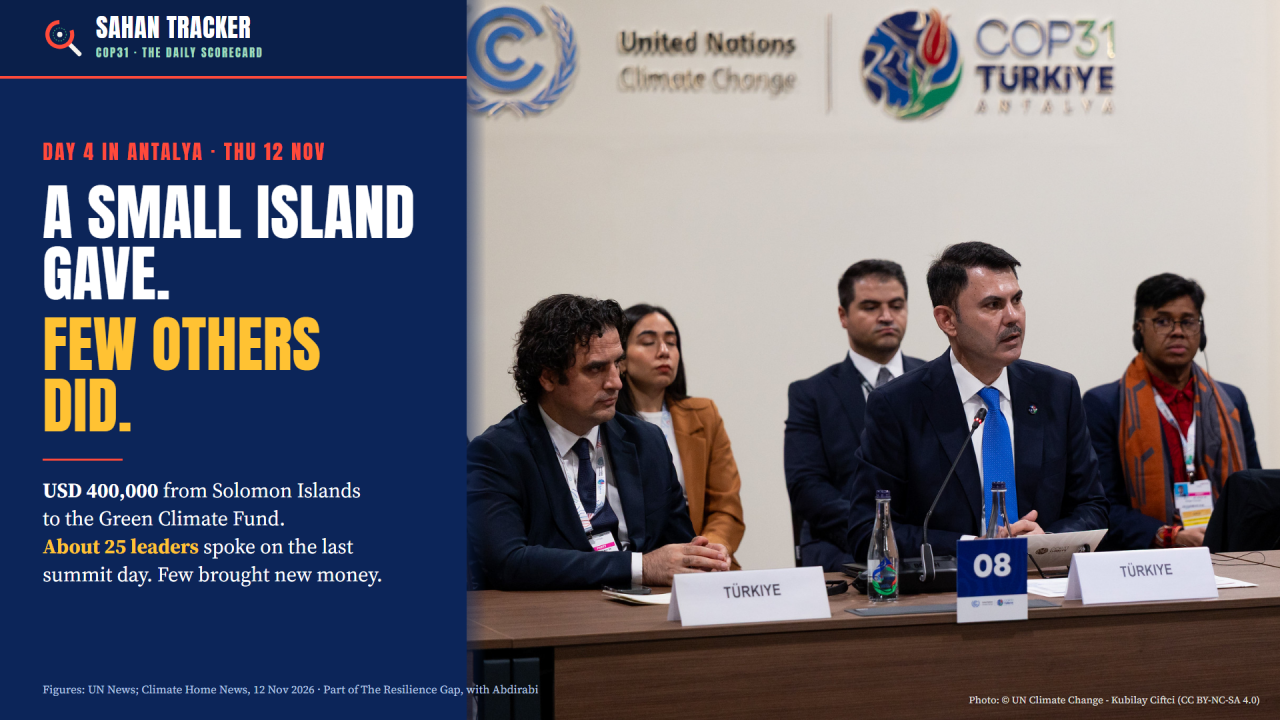
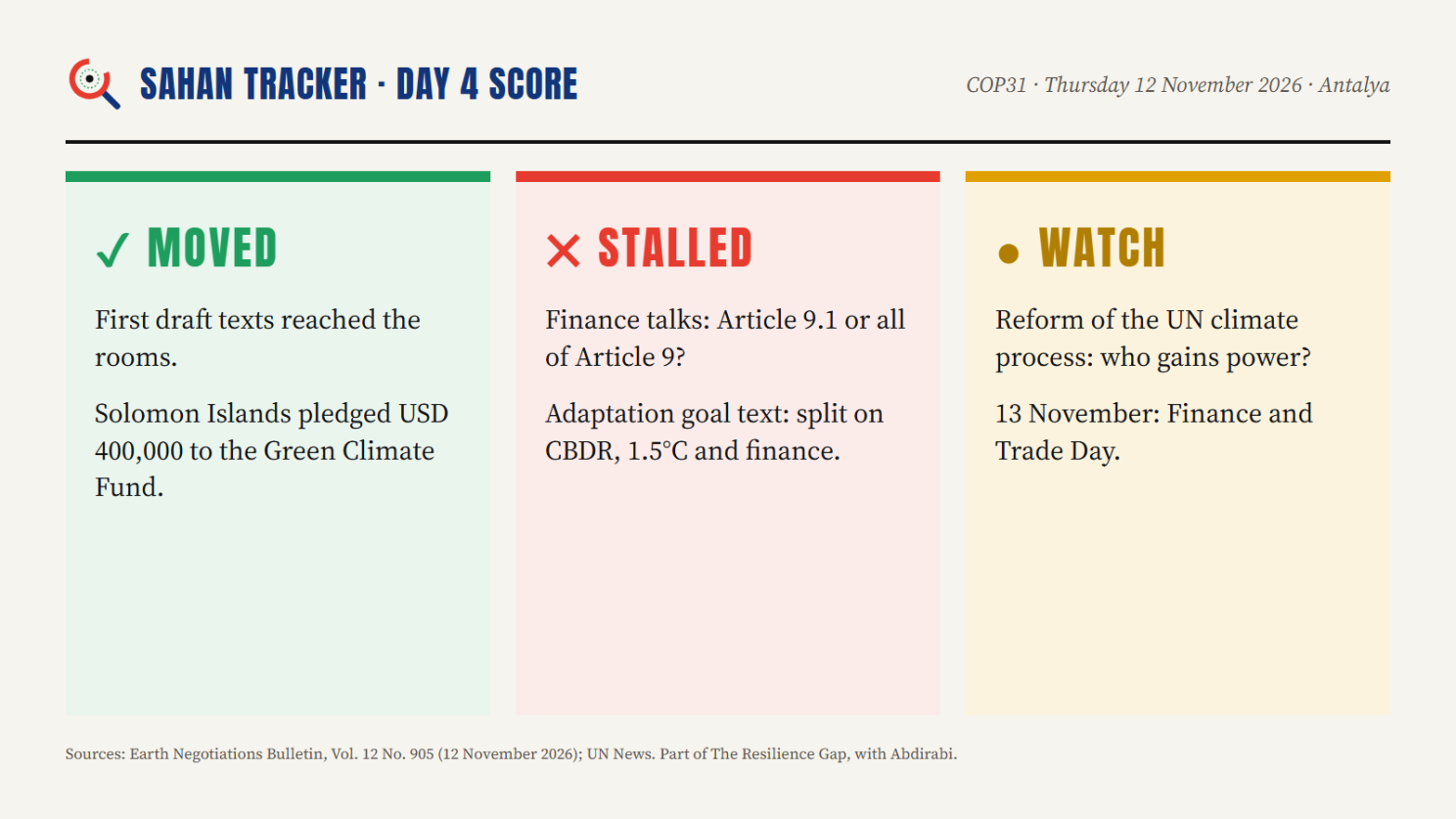
    The Leaders’ Summit closed. About 25 leaders spoke on Thursday, after around 40 on Wednesday. Many said climate finance is not enough, but few offered new money.Solomon Islands, a small island state and one of the least developed countries, pledged USD 400,000 to the Green Climate Fund. It is the first small island developing state to give to the fund’s replenishment.The COP31 Presidency opened a debate on how to fix the UN climate process itself. Ideas ranged from multi-year agendas to holding COPs only every two or three years.The first draft texts reached the rooms, so countries moved from general views to arguing about exact wording.The finance split stayed wide. But there was broad support for tripling adaptation finance and access to finance as topics in the finance talks.

    The high-level roundtable on the second decade of the Paris Agreement and access to finance, 12 November. Photo: © UN Climate Change - Kubilay Ciftci (CC BY-NC-SA 4.0)
    The high-level roundtable on the second decade of the Paris Agreement and access to finance, 12 November. Photo: © UN Climate Change – Kubilay Ciftci (CC BY-NC-SA 4.0)
    • The Leaders’ Summit closed. About 25 leaders spoke on Thursday, after around 40 on Wednesday. Many said climate finance is not enough, but few offered new money.
    • Solomon Islands, a small island state and one of the least developed countries, pledged USD 400,000 to the Green Climate Fund. It is the first small island developing state to give to the fund’s replenishment.
    • The COP31 Presidency opened a debate on how to fix the UN climate process itself. Ideas ranged from multi-year agendas to holding COPs only every two or three years.
    • The first draft texts reached the rooms, so countries moved from general views to arguing about exact wording.
    • The finance split stayed wide. But there was broad support for tripling adaptation finance and access to finance as topics in the finance talks.

    🟢 What moved forward?

    Draft texts arrived. The people leading each topic (co-facilitators) shared first drafts or informal notes on many items, including the Global Goal on Adaptation, the shared goal for making the world more resilient. Countries can now negotiate real words, not just positions.

    Tripling adaptation finance has support as a topic. In the Climate Finance Work Programme, there was broad support for discussing tripling adaptation finance and access to finance. A first text is coming.

    Adaptation reporting may be close. On guidance for adaptation communications (the reports where countries share their adaptation needs and actions), Latin American countries in Grupo Sur said agreement was close. A revised text with options is coming.

    The just transition work will continue. There was broad consensus to extend the work programme on a fair shift to clean economies.

    One small technical step. A draft text on how to fund the work under Article 6.2 (rules for countries trading carbon credits) was sent to the next level of the talks.

    🔴 What got stuck?

    What does the finance work programme cover? The least developed countries (LDCs), landlocked countries (LLDCs), the Like-Minded Developing Countries (LMDCs) and South Africa say it is about Article 9.1 of the Paris Agreement: rich countries shall provide finance. New Zealand, Canada, the UK, Norway, Switzerland, Korea and Japan want all of Article 9, including other sources of money. Countries still do not even agree on whether the programme started last year or starts now.

    The adaptation goal text. The G77 and China want “common but differentiated responsibilities” in the text. The EU, UK, Canada and Norway oppose. The small island states (AOSIS), with the EU and Latin American countries (AILAC), want the 1.5°C goal recognised. Russia opposes. Countries also argued over who sits on a new taskforce, and over whether finance belongs in this text at all. The G77 and China say the finance paragraphs are critical. Developed countries say finance belongs in the finance talks.

    Loss and damage support. The G77 and China asked for a minimum share of technical help to go to vulnerable communities, no role for the private sector, reporting by developed countries on loss and damage support, and multi-year funding for the Santiago Network, which connects countries to technical help. The EU, UK, Norway and the Environmental Integrity Group said this goes beyond the mandate.

    Food systems in the just transition. The LDCs, India and others oppose references to a just transition in food systems. The EU supports them. Brazil and the African Group said food security is non-negotiable.

    Keep or end a review of the 1.5°C goal? Canada and the EU want to end the periodic review of the long-term goal, saying the Global Stocktake already does this job. AOSIS and the African Group want to keep it, calling it the only space for the 1.5°C goal.

    “Mandate-mania.” The Earth Negotiations Bulletin noted that many rooms argued about who is allowed to do what. Mandates protect a process led by countries, but they can also become roadblocks.

    🏛️ Can the COP fix itself?

    This was the main story of Day 4. The Presidency asked heads of delegation how to make the UN climate process stronger, more effective and more inclusive. The answers showed very different ideas:

    Environmental Integrity Group (EIG): the biggest package. A ministerial process reporting to COP32 in 2027, with changes from 2028: multi-year planning, limits on new agenda items, end dates for old ones, caps on delegation size, COPs every two to three years, an independent review, and agreeing the rules of procedure, including on voting.Small island states (AOSIS): group related items, make agendas shorter, plan over several years, but keep a way to handle urgent new issues.European Union: organise the agenda by themes and find overlapping or outdated mandates.Japan: there are too many mandates for a stretched Secretariat after its largest contributor left.Norway and Canada: the process is not broken, but it can improve.Brazil: a dedicated process with a clear end date.African Group: efficiency must not cost equity, inclusion and consensus.Like-Minded Developing Countries: questioned the value of these talks.

    • Environmental Integrity Group (EIG): the biggest package. A ministerial process reporting to COP32 in 2027, with changes from 2028: multi-year planning, limits on new agenda items, end dates for old ones, caps on delegation size, COPs every two to three years, an independent review, and agreeing the rules of procedure, including on voting.
    • Small island states (AOSIS): group related items, make agendas shorter, plan over several years, but keep a way to handle urgent new issues.
    • European Union: organise the agenda by themes and find overlapping or outdated mandates.
    • Japan: there are too many mandates for a stretched Secretariat after its largest contributor left.
    • Norway and Canada: the process is not broken, but it can improve.
    • Brazil: a dedicated process with a clear end date.
    • African Group: efficiency must not cost equity, inclusion and consensus.
    • Like-Minded Developing Countries: questioned the value of these talks.

    On the rules of procedure, there was a proposal from the COP30 Presidency to keep applying the draft rules, except rule 42 on voting, without agreeing it again every year. AILAC and the African Group warned against “opening Pandora’s box”. Tuvalu wants a real discussion on voting options. The Arab Group said consensus is the only way.

    Why it matters for LDCs: LDC delegations are small. Fewer agenda items and multi-year planning could help them follow the talks. But voting rules and caps on delegation size change who has power, so these ideas need careful reading.

    💰 The money picture

    The smallest pledge with the biggest message. Solomon Islands pledged USD 400,000 to the Green Climate Fund. It is a small island and an LDC, and the first small island developing state to give to the fund’s replenishment.Few new pledges from leaders. Many leaders said climate finance is not enough, but few offered new money.Who pays, and how much? The Arab Group, the Philippines and South Africa asked for burden-sharing, meaning an agreement on how much each developed country should give.No reopening of the finance goal. Switzerland, the EU, Korea and Japan said the finance work programme cannot reopen the new finance goal agreed in 2024 (the NCQG).

    • The smallest pledge with the biggest message. Solomon Islands pledged USD 400,000 to the Green Climate Fund. It is a small island and an LDC, and the first small island developing state to give to the fund’s replenishment.
    • Few new pledges from leaders. Many leaders said climate finance is not enough, but few offered new money.
    • Who pays, and how much? The Arab Group, the Philippines and South Africa asked for burden-sharing, meaning an agreement on how much each developed country should give.
    • No reopening of the finance goal. Switzerland, the EU, Korea and Japan said the finance work programme cannot reopen the new finance goal agreed in 2024 (the NCQG).

    🗣️ Who said what?

    At the Pacific Resilience Facility pledging event, 12 November. Photo: © UN Climate Change - Kubilay Ciftci (CC BY-NC-SA 4.0)
    At the Pacific Resilience Facility pledging event, 12 November. Photo: © UN Climate Change – Kubilay Ciftci (CC BY-NC-SA 4.0)
    • Andy Burnham, for the UK: said the old consensus on climate science is “gone” and the world will reach 1.5°C. He named the UK’s first special representative for climate security.
    • Seychelles: warned that recovering from storms and floods can trap small countries in debt.
    • Nepal: raised the dangers for mountain communities.
    • Mali: those who contributed least should not carry the biggest burden.
    • Least developed countries: the finance work programme is about Article 9.1. They want the adaptation reporting review to start in 2027 and stronger text on overshooting 1.5°C.
    • African Group: efficiency must not cost equity. Food security is non-negotiable.
    • Tuvalu: wants a real discussion on voting options.
    • Arab Group: consensus is the only way.

    On the final deal: Russia, Saudi Arabia and the Like-Minded Developing Countries pushed back on the cover decision, the text meant to sum up COP31, and emerging economies questioned the need for one.

    🧭 So, who stands where?

    In one line: on finance, developing countries stand together on Article 9.1 and tripling adaptation finance. On the just transition, the LDCs part ways with the EU over food systems. On reform, small islands want a leaner process, while the African Group and the LMDCs warn it must not cost fairness.

    💡 My takeaways from Day 4

    One. A small island showed what leadership looks like. Solomon Islands gave USD 400,000 to the Green Climate Fund, at a summit where many leaders asked for money and few offered it. The amount is small. The message is not.

    Two. Fixing the process is not a neutral topic. Shorter agendas could help small delegations like those of the LDCs. But voting rules and caps on delegation size decide who has power in the room. I will watch this closely.

    Three. Everyone talks about tripling adaptation finance. Nobody agrees where it lives. Developed countries want it in the finance talks. Developing countries also want it in the adaptation goal. As I wrote on Day 2, where a topic sits decides whether it gets a number and a way to track it, or stays a promise.

    📖 Words of the day

    Rules of procedure: the rules for how a COP works. They were never formally adopted because countries disagree on rule 42 on voting, so COPs decide by consensus.Mandate: the official permission a body or meeting has to do a task.Held in abeyance: an agenda item that is kept open but not discussed.Burden-sharing: agreeing how much each developed country should give.Periodic review: a UN review of whether the long-term temperature goal is enough.Replenishment: a funding round where countries pledge new money to a fund.

    • Rules of procedure: the rules for how a COP works. They were never formally adopted because countries disagree on rule 42 on voting, so COPs decide by consensus.
    • Mandate: the official permission a body or meeting has to do a task.
    • Held in abeyance: an agenda item that is kept open but not discussed.
    • Burden-sharing: agreeing how much each developed country should give.
    • Periodic review: a UN review of whether the long-term temperature goal is enough.
    • Replenishment: a funding round where countries pledge new money to a fund.

    👀 What to watch on Day 5?

    • 13 November: Finance and Trade Day, and the Presidency’s summary on the cover decision.
    • New draft texts: the first finance work programme text, a revised adaptation goal text and a revised adaptation reporting text.
    • 14 November: Children, Youth, Education and Skills Day.
    • Next week: ministers arrive and the harder political trade-offs begin.

    See you tomorrow.

    Abdirabi

    📚 Sources

    Earth Negotiations Bulletin (IISD), Vol. 12 No. 905, daily report for 12 November 2026: https://enb.iisd.org/antalya-un-climate-change-conference-cop31UN News, cities rise up the climate agenda: https://news.un.org/en/story/2026/11/1168792Climate Home News, COP31 Bulletin Day 4: https://www.climatechangenews.com/2026/11/12/cop31-bulletin-day-4-burnham-speaks-with-uk-climate-policy-under-fire/UPI, leaders warn climate goals slipping away: https://www.upi.com/Top_News/World-News/2026/11/12/un-cop31-burnham-thunberg-climate-change/7781794506629/

    First published on LinkedIn in The Resilience Gap newsletter by Abdirabi Mohamed. Read the original.
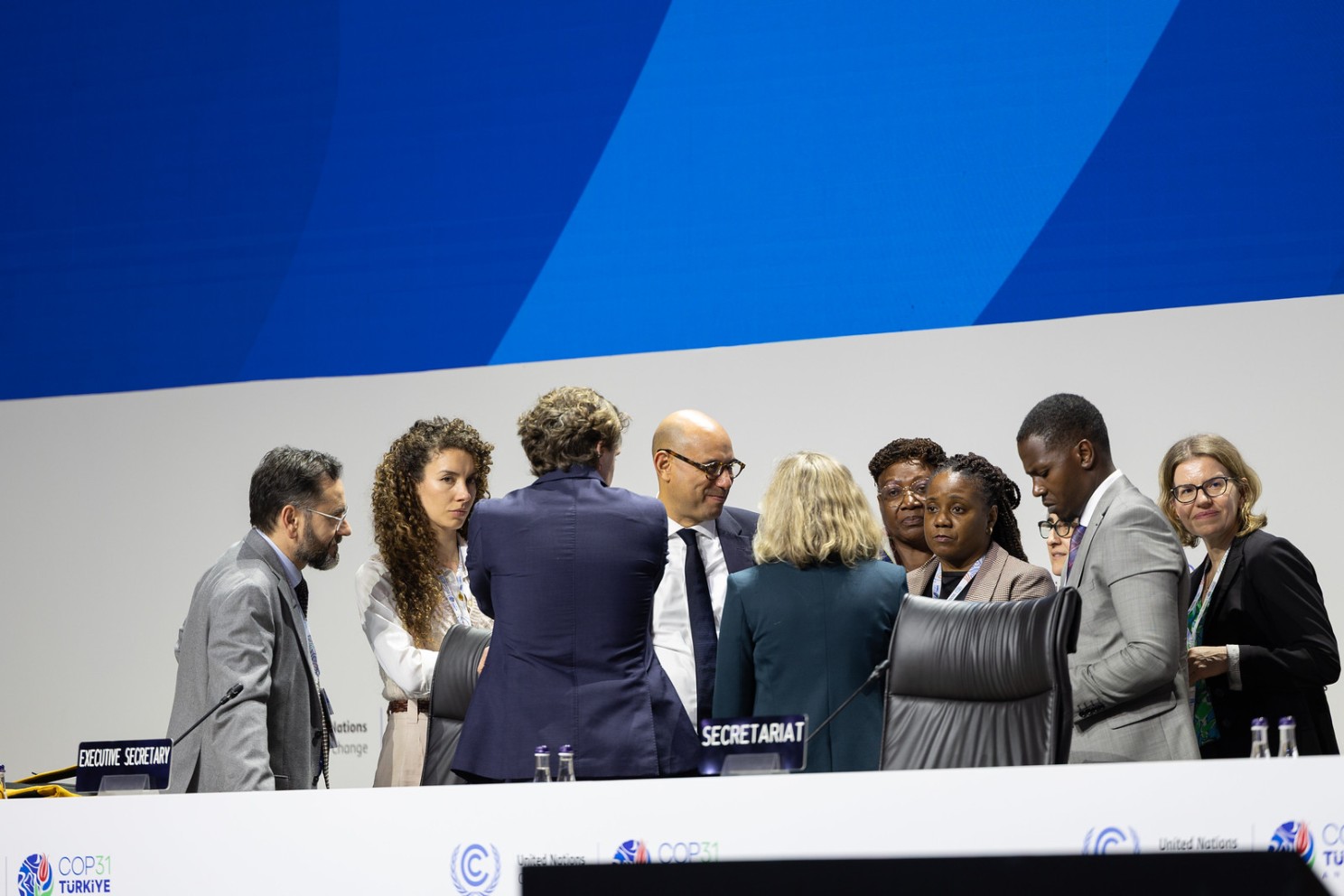
  • Sahan Tracker | COP31, Day 3: The leaders came. The money did not.

    Sahan Tracker | COP31, Day 3: The leaders came. The money did not.

    Wednesday 11 November 2026 · Antalya, Türkiye · Part of The Resilience Gap, with Abdirabi

    What is Sahan Tracker? It is my daily update during COP31, the UN climate conference in Antalya, Türkiye (9 to 20 November 2026). During COP31, The Resilience Gap comes to you every day as Sahan Tracker, focused on what is happening inside the negotiation rooms. After COP31, we go back to one edition a week.

    These are my notes from the day. I follow the talks from home, reading the Earth Negotiations Bulletin, the UN, journalists and colleagues who are in the rooms, and I put it together in plain words. Every hard word gets an explanation.

    ⏱️ Day 3 in one minute

    The Antalya Leaders’ Summit opened. Heads of state and government came to give the talks a political push, while negotiators kept working in the other rooms.UN Secretary-General António Guterres called for a “climate justice compact” and a windfall tax on fossil fuel profits. It was his last COP speech as UN chief.The Global Environment Facility (GEF), one of the main climate funds, has 27% less money in its new funding round. Developing countries were strongly disappointed.The least developed countries (LDCs) proposed a new platform to turn their national adaptation plans into real projects. Norway, the EU, the UK and Japan are worried it would become a new institution.No new money for adaptation or loss and damage was reported on Day 3.

    The High-Level Opening Plenary in Antalya, 11 November. Photo: © UN Climate Change - Kubilay Ciftci (CC BY-NC-SA 4.0)
    The High-Level Opening Plenary in Antalya, 11 November. Photo: © UN Climate Change – Kubilay Ciftci (CC BY-NC-SA 4.0)
    • The Antalya Leaders’ Summit opened. Heads of state and government came to give the talks a political push, while negotiators kept working in the other rooms.
    • UN Secretary-General António Guterres called for a “climate justice compact” and a windfall tax on fossil fuel profits. It was his last COP speech as UN chief.
    • The Global Environment Facility (GEF), one of the main climate funds, has 27% less money in its new funding round. Developing countries were strongly disappointed.
    • The least developed countries (LDCs) proposed a new platform to turn their national adaptation plans into real projects. Norway, the EU, the UK and Japan are worried it would become a new institution.
    • No new money for adaptation or loss and damage was reported on Day 3.

    🟢 What moved forward?

    The just transition work continues. A just transition means a fair shift to clean economies, where workers and communities are not left behind. Countries broadly agreed to keep the work programme going beyond 2026, next to the new just transition mechanism. The LDCs explained the difference simply: the work programme gives political guidance, and the mechanism turns it into practice. Farmers asked for a seat in the mechanism.

    The GEF talks have a starting text. Countries agreed to use the draft guidance to the GEF as the basis for the talks. Guidance is the set of instructions the COP gives to a fund each year.

    A plan to put adaptation plans to work. The LDCs proposed an “LDC NAP implementation platform”. A NAP is a national adaptation plan, a country’s plan to prepare for climate impacts. The platform would help countries prepare programmes, match their priorities with finance and build local capacity to deliver. The LDCs say it needs no new institution and would report through their expert group (the LEG). Draft conclusions and a draft decision are coming.

    The cutting-emissions programme will continue. Countries broadly support continuing the mitigation work programme, to 2030 or 2040. South Africa, Egypt and The Gambia want stronger links to finance, technology and training.

    The gender text was welcomed. A new draft on gender was broadly welcomed.

    🔴 What got stuck?

    Who should pay more into the GEF? The EU, Canada and the Environmental Integrity Group (EIG, a group including Switzerland and South Korea) welcomed the new round and invited more money from “countries in a position to do so”. The Like-Minded Developing Countries and the Arab Group opposed that phrase. For them, it shifts the duty to pay away from developed countries.

    How to measure vulnerability. The G77 and China, Latin American countries (AILAC), the small island states (AOSIS) and the African Group oppose the GEF’s new categories of vulnerability.

    How much money the Green Climate Fund needs. The African Group asked why developed countries will not engage on reviewing how much money the Green Climate Fund needs. The EU said it is willing to discuss. The Co-Chairs will produce a shorter text.

    Plans without money. In the talks on national adaptation plans, developing countries criticised counting South-South and private money as support. AOSIS and the LDCs asked for separate data for LDCs and small island states. Many developing countries want NAPs to stay on the agenda permanently.

    When to update adaptation reporting. The least developed countries, the African Group, AOSIS, AILAC and others want new guidance on adaptation communications (the reports where countries share their adaptation needs and actions) adopted by 2028. The UK, EU, Japan, Canada, the Like-Minded Developing Countries and the Arab Group want to wait until after the 2028 transparency review.

    The science numbers. Russia, India and the Arab Group asked to delete the estimate of “1.47 ± 0.13°C” of warming for 2026 and to cut text on overshooting 1.5°C.

    A budget that does not grow. The LDCs, landlocked countries (LLDCs), India and Brazil are concerned that the 2027 budget of the Climate Technology Centre and Network (CTCN) stays at 2026 levels.

    Small delegations stretched thin. With leaders in town, negotiators had to leave their rooms for high-level events. One delegate called it “a game of musical chairs”. Talks ran into the late evening.

    💰 The money picture

    Day 3 was the day leaders spoke. But the numbers did not move in the right direction.

    GEF-9 is down 27%. GEF-9 is the ninth funding round of the Global Environment Facility. The LDCs asked the guidance to recognise the goals of tripling fund flows and tripling adaptation finance. Instead, the fund is shrinking.The forest fund is still short. The Tropical Forest Forever Facility (TFFF) has about USD 7.9 billion pledged against a USD 10 billion start-up target. No government announced a new pledge at the event.No new money for adaptation or loss and damage was reported on Day 3.

    • GEF-9 is down 27%. GEF-9 is the ninth funding round of the Global Environment Facility. The LDCs asked the guidance to recognise the goals of tripling fund flows and tripling adaptation finance. Instead, the fund is shrinking.
    • The forest fund is still short. The Tropical Forest Forever Facility (TFFF) has about USD 7.9 billion pledged against a USD 10 billion start-up target. No government announced a new pledge at the event.
    • No new money for adaptation or loss and damage was reported on Day 3.

    Guterres called for a windfall tax on fossil fuel profits. The Earth Negotiations Bulletin noted it could fill the “notoriously empty coffers” of climate institutions.

    🗣️ Who said what?

    UN Secretary-General António Guterres at the high-level event on Early Warnings for All, 11 November. Photo: © UN Climate Change - Kiara Worth (CC BY-NC-SA 4.0)
    UN Secretary-General António Guterres at the high-level event on Early Warnings for All, 11 November. Photo: © UN Climate Change – Kiara Worth (CC BY-NC-SA 4.0)

    António Guterres, UN Secretary-General: proposed a “climate justice compact” with four pillars: a just transition away from fossil fuels, starting with national plans; adaptation and early warning; adequate, affordable finance; and cooperation on implementation. He said “polluters must pay”.Recep Tayyip Erdoğan, President of Türkiye (host): admitted that three decades of talks have not delivered enough results, and repeated the aim of an “Implementation COP”.Anthony Albanese, Prime Minister of Australia (President of Negotiations’ country): COP31 must deliver practical results: clean energy, electrification, oceans, and climate finance for those who need it most. He called for solidarity with Pacific islands.Lula da Silva, President of Brazil (COP30 host): climate is losing ground to wars and trade disputes. Brazil will develop national roadmaps to cut fossil fuel dependence and end deforestation. His speech was read by his environment minister.LDC Chair, Ambassador Adão Soares Barbosa: finance must be accessible, grant-based and predictable, and access must be simplified at COP31.Landlocked developing countries (LLDCs): “A plan that cannot be financed protects no one.”G77 and China: participation in the just transition must be more than attendance.

    • António Guterres, UN Secretary-General: proposed a “climate justice compact” with four pillars: a just transition away from fossil fuels, starting with national plans; adaptation and early warning; adequate, affordable finance; and cooperation on implementation. He said “polluters must pay”.
    • Recep Tayyip Erdoğan, President of Türkiye (host): admitted that three decades of talks have not delivered enough results, and repeated the aim of an “Implementation COP”.
    • Anthony Albanese, Prime Minister of Australia (President of Negotiations’ country): COP31 must deliver practical results: clean energy, electrification, oceans, and climate finance for those who need it most. He called for solidarity with Pacific islands.
    • Lula da Silva, President of Brazil (COP30 host): climate is losing ground to wars and trade disputes. Brazil will develop national roadmaps to cut fossil fuel dependence and end deforestation. His speech was read by his environment minister.
    • LDC Chair, Ambassador Adão Soares Barbosa: finance must be accessible, grant-based and predictable, and access must be simplified at COP31.
    • Landlocked developing countries (LLDCs): “A plan that cannot be financed protects no one.”
    • G77 and China: participation in the just transition must be more than attendance.

    Who was missing? About 40 leaders were due to speak, but Nigeria, Kenya, Egypt, the Netherlands and Sweden dropped off the list in the last six days. Civil society gave the “Fossil of the Day” award to several European countries, Japan and Canada for not attending.

    🧭 So, who stands where?

    In one line: developing countries want more public money and new tools to use it, like the LDC platform. Developed countries accept the GEF cut, want more countries to contribute, and resist new institutions.

    💡 My takeaways from Day 3

    One. Speeches are not pledges. Leaders named the problem well. Guterres asked polluters to pay, and Erdoğan admitted three decades of talks have not delivered enough. But on the day the world’s leaders were in the room, no new money for adaptation or loss and damage was reported.

    Two. The LLDCs said it best. “A plan that cannot be financed protects no one.” Countries have written their adaptation plans. Now they need help to turn them into projects. The LDC NAP platform is a concrete idea to do that, and it is one to follow in the draft decision.

    Three. Less money, same promises. The GEF has 27% less in its new round, at the same time as the LDCs ask for tripling adaptation finance. That is the resilience gap getting wider, not smaller.

    📖 Words of the day

    Leaders’ Summit: the part of COP31 where heads of state and government speak, held on 11 and 12 November to give the talks a political push.Climate justice compact: Guterres’s proposed agreement on shared responsibility. Its form is not yet defined.GEF (Global Environment Facility): one of the main funds that serve the UN climate talks.Replenishment: a funding round where donor countries pledge new money to a fund. GEF-9 is the ninth one.NAP (national adaptation plan): a country’s plan to prepare for climate impacts.LEG (LDC Expert Group): experts who help the least developed countries with their adaptation plans.Draft conclusions: a short procedural text, often agreeing to continue work.Windfall tax: an extra tax on unusually large profits.

    • Leaders’ Summit: the part of COP31 where heads of state and government speak, held on 11 and 12 November to give the talks a political push.
    • Climate justice compact: Guterres’s proposed agreement on shared responsibility. Its form is not yet defined.
    • GEF (Global Environment Facility): one of the main funds that serve the UN climate talks.
    • Replenishment: a funding round where donor countries pledge new money to a fund. GEF-9 is the ninth one.
    • NAP (national adaptation plan): a country’s plan to prepare for climate impacts.
    • LEG (LDC Expert Group): experts who help the least developed countries with their adaptation plans.
    • Draft conclusions: a short procedural text, often agreeing to continue work.
    • Windfall tax: an extra tax on unusually large profits.

    👀 What to watch on Day 4?

    • The second day of the Leaders’ Summit, and the Pacific Resilience Facility pledging event: will anyone bring new money?
    • 13 November: Finance and Trade Day, and Chris Bowen’s summary of the cover decision.
    • The first draft texts on adaptation and mitigation. I will compare them with the June Bonn texts.

    See you tomorrow.

    Abdirabi

    📚 Sources

    Earth Negotiations Bulletin (IISD), Vol. 12 No. 904, daily report for 11 November 2026: https://enb.iisd.org/antalya-un-climate-change-conference-cop31-daily-report-11nov2026UN News, Guterres urges climate justice pact: https://news.un.org/en/story/2026/11/1168783Climate Home News, COP31 Bulletin Day 3: https://www.climatechangenews.com/2026/11/11/cop31-bulletin-day-3-with-the-people-stuck-outside-world-leaders-jet-in/WMO, COP31 Leaders’ Summit: https://wmo.int/media/news/cop31-leaders-summit-turn-commitments-actionUS News (Reuters), world leaders speak at COP31: https://www.usnews.com/news/world/articles/2026-11-11/world-leaders-speak-at-cop31-climate-conferenceUNFCCC, Antalya Leaders’ Summit: https://unfccc.int/cop31/high-levelDhaka Tribune, interview with the LDC Chair: https://dhakatribune.com/interviews-and-dialogue/424394/ldc-chair-accessible-grant-based-predictableDaily News Egypt, Leaders’ Summit: https://dailynewsegypt.com/2026/11/11/egypt-calls-for-affordable-climate-finance-at-cop31-leaders-summit-in-antalya/

    First published on LinkedIn in The Resilience Gap newsletter by Abdirabi Mohamed. Read the original.
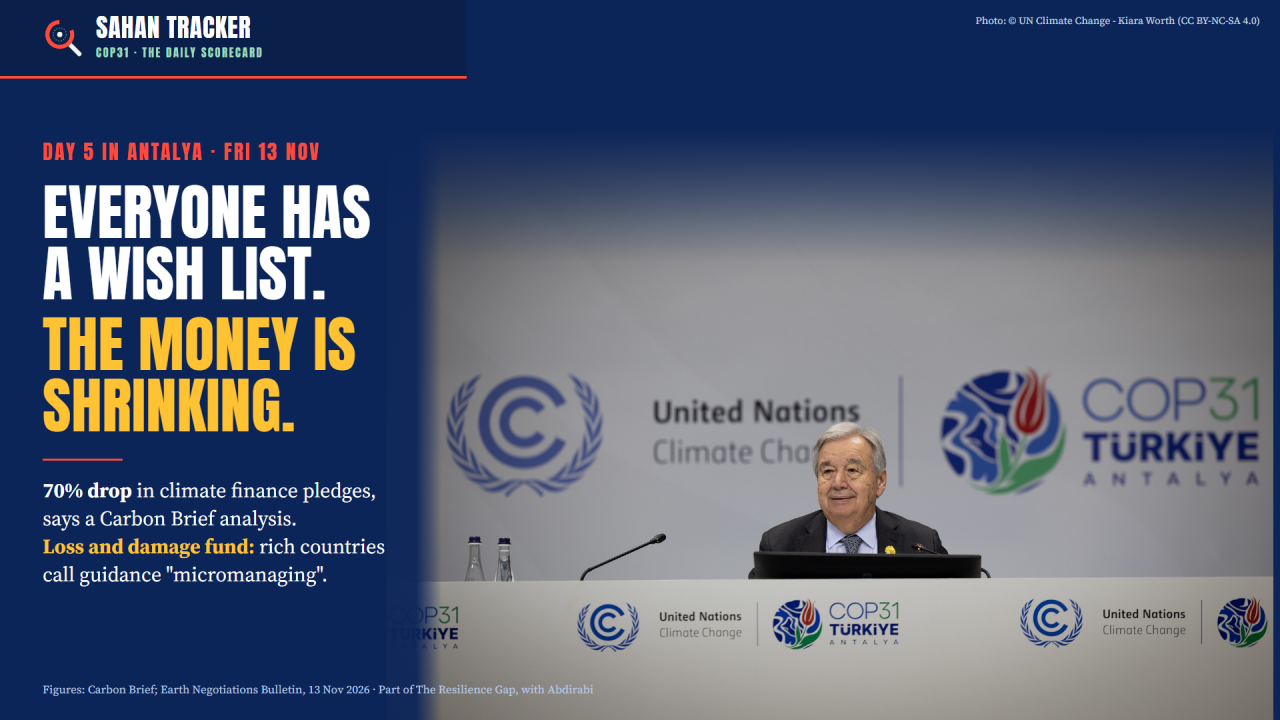
  • Sahan Tracker | COP31, Day 2: The talks got real. The money got smaller.

    Sahan Tracker | COP31, Day 2: The talks got real. The money got smaller.

    Tuesday 10 November 2026 · Antalya, Türkiye · Part of The Resilience Gap, with Abdirabi

    What is Sahan Tracker? It is my daily update during COP31, the UN climate conference in Antalya, Türkiye (9 to 20 November 2026). During COP31, The Resilience Gap comes to you every day as Sahan Tracker, focused on what is happening inside the negotiation rooms. After COP31, we go back to one edition a week.

    These are my notes from the day. I follow the talks from my home, reading the Earth Negotiations Bulletin, the UN, journalists and colleagues who are in the rooms, and I put it together in plain words. Every hard word gets an explanation.

    ⏱️ Day 2 in one minute

    The real negotiations started. On Tuesday morning, countries went straight into formal talks. The finance talks ran all day and into the evening.Tripling adaptation finance came back, in two different rooms. Developing countries still regret that it has no topic of its own.Poorer countries have asked the loss and damage fund for USD 2.8 billion. Rich countries say it is too early to give the fund new instructions.Support is shrinking. Cuts by the UK and the US to the Green Climate Fund mean USD 5.1 billion less in one year.On the energy side, Brazil handed its roadmap for moving away from fossil fuels to UN Secretary-General António Guterres.

    Delegates around the COP31 venue in Antalya. Photo: © UN Climate Change - Kubilay Ciftci (CC BY-NC-SA 4.0)
    Delegates around the COP31 venue in Antalya. Photo: © UN Climate Change – Kubilay Ciftci (CC BY-NC-SA 4.0)
    • The real negotiations started. On Tuesday morning, countries went straight into formal talks. The finance talks ran all day and into the evening.
    • Tripling adaptation finance came back, in two different rooms. Developing countries still regret that it has no topic of its own.
    • Poorer countries have asked the loss and damage fund for USD 2.8 billion. Rich countries say it is too early to give the fund new instructions.
    • Support is shrinking. Cuts by the UK and the US to the Green Climate Fund mean USD 5.1 billion less in one year.
    • On the energy side, Brazil handed its roadmap for moving away from fossil fuels to UN Secretary-General António Guterres.

    🟢 What moved forward?

    The work finally started. Day 1 was speeches and the agenda fight. Day 2 was the first full day of technical work. In small groups, the people leading each topic (called co-facilitators) asked countries for their views, so they can write the first draft texts. Delegates told the Earth Negotiations Bulletin it felt like “déjà vu”, with old positions repeated. But by the evening, the first possible areas of agreement started to appear.

    A shape for the adaptation goal. In the talks on the Global Goal on Adaptation, the shared goal for making the world more resilient, countries broadly agreed on a two-level plan: a small expert group for the technical work on indicators, plus a political process to test them. Youth and women’s groups asked that the indicators show impacts on young people, children, women and girls. A first draft text is coming.

    A shape for a just transition. In the talks on a fair shift to clean economies for workers and communities, countries also moved towards a two-level structure: a political body plus a technical arm.

    Help for the switch to clean energy. Tuesday was Energy and Transport Day, with around 370 events. An Australia-led declaration aims for 300 million homes with rooftop solar by 2030, signed by countries including Bangladesh, Kenya, Nigeria and Vanuatu. A new initiative of the Powering Past Coal Alliance will help coal-dependent countries in the Global South reach transition funding. These are voluntary initiatives. They do not change the negotiations.

    🔴 What got stuck?

    Who decides how adaptation money grows? Developing countries (the G77 and China) want the climate finance talks to focus on Article 9.1 of the Paris Agreement: rich countries shall provide finance. The EU wants a broad view of all climate finance, with tripling adaptation finance inside it. The UK, EU and Norway want tripling discussed in the finance talks, where it sits under the existing finance goal. Developing countries want clear starting points and ways to track the money.

    Loss and damage: a clear need, a slow answer. The loss and damage fund helps countries recover from climate disasters. 119 countries have asked it for USD 2.8 billion. Small island states, the African Group and Latin American countries (AILAC) want short political guidance that names this need and urges countries to pay what they pledged. The EU, UK and Canada say guidance is “premature”.

    The Adaptation Fund is short of money. The least developed countries, the Like-Minded Developing Countries and the Arab Group warned of a “serious shortfall” in contributions.

    How long to keep cutting emissions together? Countries broadly support continuing the programme on cutting emissions, but disagree on how long: to 2030, to 2040, or with no end date. Switzerland proposed a permanent committee. The Arab Group opposed it.

    Even the final deal is questioned. When heads of delegation met on the “cover decision”, the one text meant to sum up COP31, some asked why everyone assumes there will be one. So the Presidency may have to negotiate its purpose too.

    Getting to the venue. Some delegates needed three hours or more to reach the venue on crowded trams and shuttles, and morning talks started late.

    💰 The money picture

    This is the part of Day 2 I keep coming back to. UK and US cuts to the Green Climate Fund mean USD 5.1 billion less in one year. The latest round of funding for the Global Environment Facility is the lowest in its history. One observer told the Earth Negotiations Bulletin the direction is “clearly the wrong one”.

    So the needs are named: USD 2.8 billion for loss and damage alone. But the money behind them is moving the other way.

    🗣️ Who said what?

    High-level guests at the COP30 Presidency event on the roadmap to transition away from fossil fuels, 10 November. Photo: © UN Climate Change - Kiara Worth (CC BY-NC-SA 4.0)
    High-level guests at the COP30 Presidency event on the roadmap to transition away from fossil fuels, 10 November. Photo: © UN Climate Change – Kiara Worth (CC BY-NC-SA 4.0)

    Least developed countries: a “serious shortfall” in the Adaptation Fund. They also raised gaps in weather observation and early warning, and asked for predictable money for women-led projects.G77 and China: the finance talks must be about Article 9.1. They regret there is no topic for tripling adaptation finance, and want “common but differentiated responsibilities” in the adaptation text.African Group: wants guidance for the loss and damage fund. A just transition must include informal economies.Small island states (AOSIS): “chronic challenges” in getting finance, and a call for grants, not loans, for adaptation.European Union: finance talks should cover all of Article 9, including tripling. Guidance for the loss and damage fund is premature. Opposes “common but differentiated responsibilities” in the adaptation text.UK, Norway, Canada: tripling belongs in the finance talks.António Guterres, UN Secretary-General: asked every country for its own national plan to move away from fossil fuels, with timelines and financing needs, and progress by 2028.André Corrêa do Lago, COP30 President: the fossil fuel roadmap is “not a mandate”.

    • Least developed countries: a “serious shortfall” in the Adaptation Fund. They also raised gaps in weather observation and early warning, and asked for predictable money for women-led projects.
    • G77 and China: the finance talks must be about Article 9.1. They regret there is no topic for tripling adaptation finance, and want “common but differentiated responsibilities” in the adaptation text.
    • African Group: wants guidance for the loss and damage fund. A just transition must include informal economies.
    • Small island states (AOSIS): “chronic challenges” in getting finance, and a call for grants, not loans, for adaptation.
    • European Union: finance talks should cover all of Article 9, including tripling. Guidance for the loss and damage fund is premature. Opposes “common but differentiated responsibilities” in the adaptation text.
    • UK, Norway, Canada: tripling belongs in the finance talks.
    • António Guterres, UN Secretary-General: asked every country for its own national plan to move away from fossil fuels, with timelines and financing needs, and progress by 2028.
    • André Corrêa do Lago, COP30 President: the fossil fuel roadmap is “not a mandate”.

    🧭 So, who stands where?

    In one line: developing countries pull the money talks towards a legal duty to pay and clear numbers for tripling. Developed countries keep it broad, under the existing finance goal, and resist new guidance. That split was there on Day 1, and on Day 2 it showed up in almost every room.

    💡 My takeaways from Day 2

    One. The needs are clear. The money is not. USD 2.8 billion requested for loss and damage, a “serious shortfall” in the Adaptation Fund, and at the same time USD 5.1 billion less for the Green Climate Fund. This is the resilience gap in one day.

    Two. “Premature” is a word to watch. When rich countries call guidance “premature”, they are asking for more time. For communities hit by floods and droughts this year, time is the one thing they do not have.

    Three. Small details shape big texts. Whether tripling adaptation finance is discussed in the finance room or the adaptation room sounds technical. But it decides whether it ends up with a number and a way to track it, or stays a promise.

    📖 Words of the day

    Contact group: a formal negotiating group on one topic, usually open to observers.Co-facilitators: the two people who lead the talks on one topic and write the draft texts.Two-tier: a structure with two levels, such as an expert group plus a political process.Means of implementation: what countries need to act: finance, technology and training.Loss and damage: climate harm that is too late to prevent, like homes lost to floods.Share of proceeds: a small part of carbon market credits that goes to the Adaptation Fund.CBDR (common but differentiated responsibilities): all countries share the goal, but have different duties.

    • Contact group: a formal negotiating group on one topic, usually open to observers.
    • Co-facilitators: the two people who lead the talks on one topic and write the draft texts.
    • Two-tier: a structure with two levels, such as an expert group plus a political process.
    • Means of implementation: what countries need to act: finance, technology and training.
    • Loss and damage: climate harm that is too late to prevent, like homes lost to floods.
    • Share of proceeds: a small part of carbon market credits that goes to the Adaptation Fund.
    • CBDR (common but differentiated responsibilities): all countries share the goal, but have different duties.

    👀 What to watch on Day 3?

    • The first draft texts on the adaptation goal, the loss and damage fund and gender.
    • The World Leaders’ Summit on 11 and 12 November: will any leader bring new money for adaptation or loss and damage?
    • 13 November: Finance and Trade Day, and Chris Bowen’s summary of the cover decision.

    See you tomorrow.

    Abdirabi

    📚 Sources

    Earth Negotiations Bulletin (IISD), Vol. 12 No. 903, daily report for 10 November 2026: https://enb.iisd.org/sites/default/files/2026-11/enb12903e.pdfUNFCCC, press conference transcript, 10 November: https://unfccc.int/news/transcript-of-press-conference-opening-remarks-today-of-cop31-president-president-of-negotiations-unCarbon Brief Connect, fossil fuel roadmap presented at COP31: https://connect.carbonbrief.org/t/fossil-fuel-roadmap-presented-at-cop31/120UN News (via now.solar), energy transition takes centre stage: https://now.solar/2026/11/11/cop31-energy-transition-takes-centre-stage-as-countries-map-path-beyond-fossil-fuels-un-news/Climate Home News, COP31 Bulletin Day 2: https://www.climatechangenews.com/2026/11/10/cop31-bulletin-day-2-energy-day-off-to-slow-start-amid-transport-chaos/TRT World, day two programme: https://www.trtworld.com/article/adc1626e31f4

    First published on LinkedIn in The Resilience Gap newsletter by Abdirabi Mohamed. Read the original.
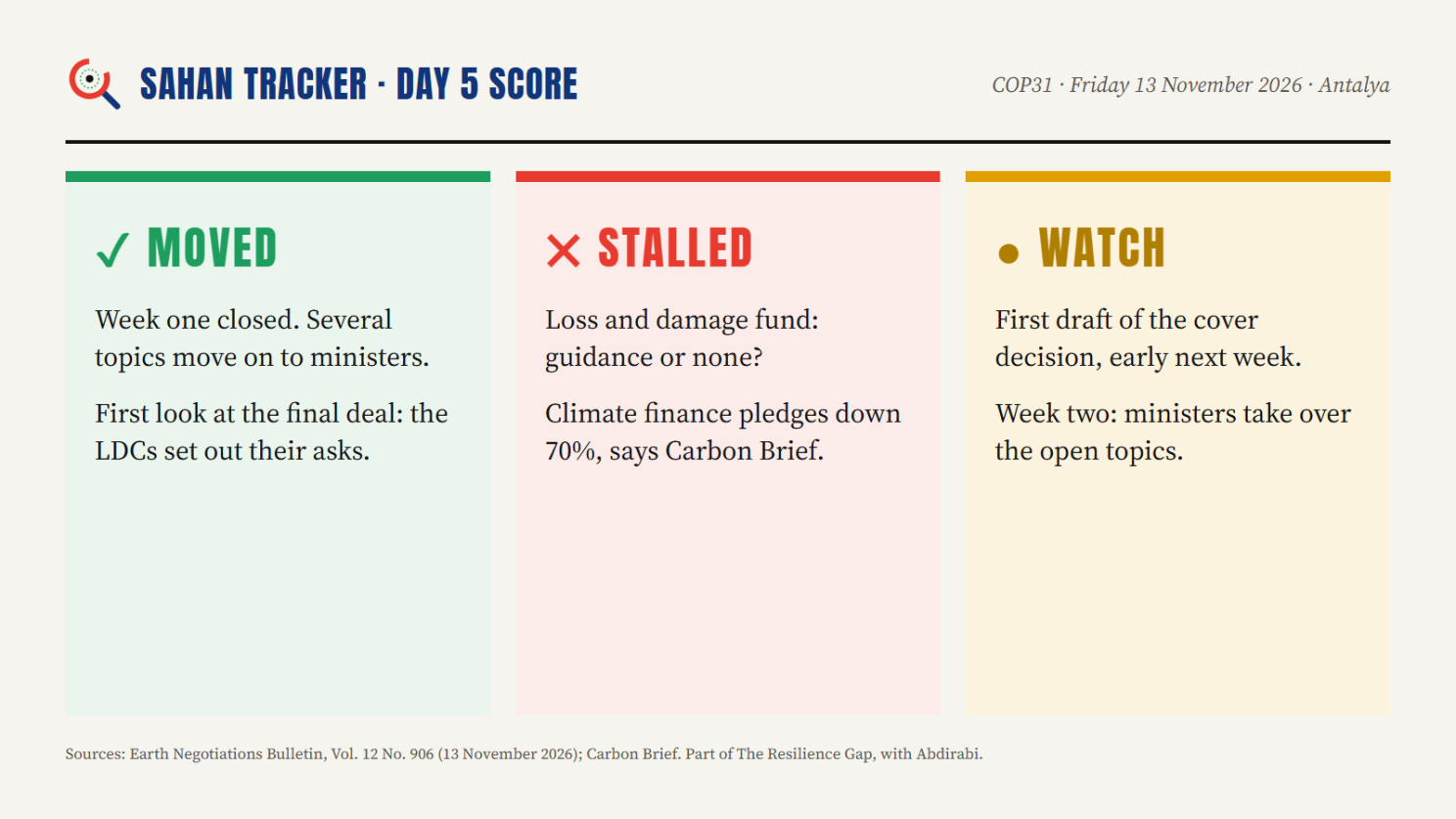
  • Sahan Tracker | COP31, Day 1: The talks open, and the first fight is about money

    Sahan Tracker | COP31, Day 1: The talks open, and the first fight is about money

    Monday 9 November 2026 · Antalya, Türkiye · Part of The Resilience Gap, with Abdirabi

    What is Sahan Tracker? It is my daily update during the days of COP31, the UN climate conference in Antalya, Türkiye (9 to 20 November 2026). It is part of The Resilience Gap. During COP31, The Resilience Gap comes to you every day as Sahan Tracker, focused on what is happening inside the negotiation rooms of Antalya. After COP31, we go back to one edition a week.

    Every day you get a simple score: what moved forward, what got stuck, and what to watch next. Climate talks use a lot of difficult language, so every hard word gets a plain explanation.

    ⏱️ Day 1 in one minute

    COP31 opened about one and a half hours late. Countries argued until late Sunday night about the agenda, the official list of topics they will negotiate.The fight was about money. Developing countries got climate finance talks onto the agenda, including the rule that rich countries “shall” provide finance.Adaptation finance, the money that helps countries cope with climate impacts, did not get its own topic. It will be discussed inside other topics.COP31 has two presidents. Türkiye’s Murat Kurum leads the conference. Australia’s Chris Bowen leads the negotiations.The group of least developed countries called the expected overshoot of 1.5°C “a grave betrayal” of the countries that did least to cause the crisis.

    Country delegations take their seats at the opening of COP31. Photo: © UN Climate Change - Kiara Worth (CC BY-NC-SA 4.0)
    Country delegations take their seats at the opening of COP31. Photo: © UN Climate Change – Kiara Worth (CC BY-NC-SA 4.0)
    • COP31 opened about one and a half hours late. Countries argued until late Sunday night about the agenda, the official list of topics they will negotiate.
    • The fight was about money. Developing countries got climate finance talks onto the agenda, including the rule that rich countries “shall” provide finance.
    • Adaptation finance, the money that helps countries cope with climate impacts, did not get its own topic. It will be discussed inside other topics.
    • COP31 has two presidents. Türkiye’s Murat Kurum leads the conference. Australia’s Chris Bowen leads the negotiations.
    • The group of least developed countries called the expected overshoot of 1.5°C “a grave betrayal” of the countries that did least to cause the crisis.

    🟢 What moved forward?

    Finance is on the table. The Climate Finance Work Programme is on the agenda. This is a two-year process agreed at COP30 in Belém, Brazil. It includes Article 9.1 of the Paris Agreement, which says developed countries shall provide finance to developing countries. “Shall” means a duty, not a wish. Getting this on the agenda was the main demand of the G77 and China, the large group of developing countries.

    A plan for the final deal. Chris Bowen said the presidencies will write an overall “cover decision” step by step during the conference, not only on the last night. He promised “no surprises”. A first high-level summary is expected on Friday 13 November, with written comments from countries until Saturday 14 November.

    New voluntary initiatives. Murat Kurum launched a “35-by-35” pledge: electricity should make up 35% of all energy used by 2035. He also launched a Climate Implementation Bridge to connect climate projects with investors, and asked every country to name a contact person for the voluntary Action Agenda. Türkiye also launched the Antalya Initiative for Resilient Health Systems. All of these are voluntary: countries choose whether to join. By Monday night, no country had joined the health initiative yet.

    🔴 What got stuck?

    Adaptation finance has no seat of its own. The African Group asked for three extra agenda items: tripling adaptation finance, trade measures, and the funding needs of the Green Climate Fund. All three were left off “without prejudice”. This means they can still be raised under other topics. Why it matters: at COP30, countries agreed to “at least triple” adaptation finance by 2035, but they set no starting year and no dollar figure. Without its own item, it is harder to turn that promise into a real number.

    Some topics pushed back. Nepal asked for formal talks on mountains after its flood disaster. Instead, the Presidency will hold informal consultations. A regular review of the UN climate finance system was moved to COP32.

    An old argument about USD 100 billion. Rich countries promised USD 100 billion a year in climate finance. In the first talks on long-term finance, the EU, UK, Canada, Japan, Norway and the Environmental Integrity Group want to record that the goal was met in 2022, 2023 and 2024. The African Group, the Arab Group and the Like-Minded Developing Countries say it was not met, because 2020 and 2021 fell short. A CARE analysis adds that repayments on public climate loans rose from USD 6.9 billion in 2020 to USD 20.1 billion in 2024. This is why many developing countries ask for grants, not loans.

    Health, again without money. Day 1 was the theme day on food, agriculture and health. No new money for health was announced, for the third COP in a row. Health has no topic of its own in the formal talks.

    🗣️ Who said what?

    Simon Stiell, UN Climate Change Executive Secretary, gives the opening remarks at COP31. Photo: © UN Climate Change - Kiara Worth (CC BY-NC-SA 4.0)
    Simon Stiell, UN Climate Change Executive Secretary, gives the opening remarks at COP31. Photo: © UN Climate Change – Kiara Worth (CC BY-NC-SA 4.0)

    Least developed countries (44 countries): “COP31 cannot be another exercise in deferring difficult decisions.” They want faster emission cuts, access to finance and real protection for people most at risk.African Group: African economies need USD 1.3 to 1.6 trillion by 2030, as grants or low-cost finance, not debt.European Union: Supports at least tripling adaptation finance by 2035, but inside the existing finance goal agreed at COP29. Does not want a new agenda item on trade.Umbrella Group (the UK speaking): Adaptation finance “is not an orphan”. It will be discussed under the finance work programme.India: Supports developing countries on Article 9.1. Wants talks on trade measures such as the EU’s carbon border tax.Simon Stiell, UN climate chief: Progress is not fast enough or fair enough. COP31 must triple adaptation finance, make finance easier to access, triple renewable energy by 2030 and cut methane.Chris Bowen, President of Negotiations: The countries that need climate finance most get the least.

    • Least developed countries (44 countries): “COP31 cannot be another exercise in deferring difficult decisions.” They want faster emission cuts, access to finance and real protection for people most at risk.
    • African Group: African economies need USD 1.3 to 1.6 trillion by 2030, as grants or low-cost finance, not debt.
    • European Union: Supports at least tripling adaptation finance by 2035, but inside the existing finance goal agreed at COP29. Does not want a new agenda item on trade.
    • Umbrella Group (the UK speaking): Adaptation finance “is not an orphan”. It will be discussed under the finance work programme.
    • India: Supports developing countries on Article 9.1. Wants talks on trade measures such as the EU’s carbon border tax.
    • Simon Stiell, UN climate chief: Progress is not fast enough or fair enough. COP31 must triple adaptation finance, make finance easier to access, triple renewable energy by 2030 and cut methane.
    • Chris Bowen, President of Negotiations: The countries that need climate finance most get the least.

    🧭 So, who stands where?

    Most developing countries stand together on one question: how will rich countries meet their legal duty to pay? The EU and its allies are ready to talk about adaptation finance, but only inside the existing finance goal, and they resist new promises. Before COP31, EU Climate Commissioner Wopke Hoekstra said demands for new finance commitments were “dead in the water”. Expect this split to shape the whole conference.

    📖 Words of the day

    Agenda: the official list of topics countries negotiate. If a topic is not on it, there is no formal place to decide on it.CMA: the meeting of the countries that signed the Paris Agreement. It runs alongside the COP.Cover decision: one political text that sums up the main results of a COP.Action Agenda: voluntary pledges and projects led by the host country. Not negotiated by all countries, and not binding.NCQG: the climate finance goal agreed at COP29: USD 300 billion a year by 2035.“Without prejudice”: left out for now, without closing the door for later.

    • Agenda: the official list of topics countries negotiate. If a topic is not on it, there is no formal place to decide on it.
    • CMA: the meeting of the countries that signed the Paris Agreement. It runs alongside the COP.
    • Cover decision: one political text that sums up the main results of a COP.
    • Action Agenda: voluntary pledges and projects led by the host country. Not negotiated by all countries, and not binding.
    • NCQG: the climate finance goal agreed at COP29: USD 300 billion a year by 2035.
    • “Without prejudice”: left out for now, without closing the door for later.

    👀 What to watch on Day 2?

    • The first talks on the finance work programme: will anyone put a number or a starting year on tripling adaptation finance?
    • The first draft texts on the Global Goal on Adaptation, the shared goal for making the world more resilient.
    • Any early sign of what the cover decision will say about adaptation finance.
    • The World Leaders’ Summit on 11 and 12 November.

    See you tomorrow.

    Abdirabi

    📚 Sources

    UN News, “COP31 opens in Antalya”: https://news.un.org/en/story/2026/11/1168763Earth Negotiations Bulletin (IISD), highlights for 9 November 2026: https://enb.iisd.org/antalya-un-climate-change-conference-cop31-09Nov2026Climate Home News, COP31 Bulletin Day 1: https://www.climatechangenews.com/2026/11/09/cop31-bulletin-day-1-australia-says-cover-decision-wont-spring-surprises/Health Policy Watch, “COP31 opens under pressure”: https://healthpolicy-watch.news/declarations-do-not-protect-people-cop31-opens-under-pressure-to-deliver-results-over-words/Business Standard, climate finance clash: https://www.business-standard.com/world-news/cop31-antalya-climate-finance-eu-g77-india-climate-talks-126111000162_1.htmlTurkish Minute (AFP), early dispute over finance: https://www.turkishminute.com/2026/11/09/cop31-opens-in-antalya-with-early-dispute-over-climate-finance/MyJoyOnline, leaders call for practical action: https://www.myjoyonline.com/cop31-leaders-call-for-shift-from-climate-promises-to-practical-action-as-implementation-takes-centre-stage/J. Silali (Substack), group statements: https://josephsilali.substack.com/p/cop31-opens-in-antalya-stiell-kurum

    First published on LinkedIn in The Resilience Gap newsletter by Abdirabi Mohamed. Read the original.