
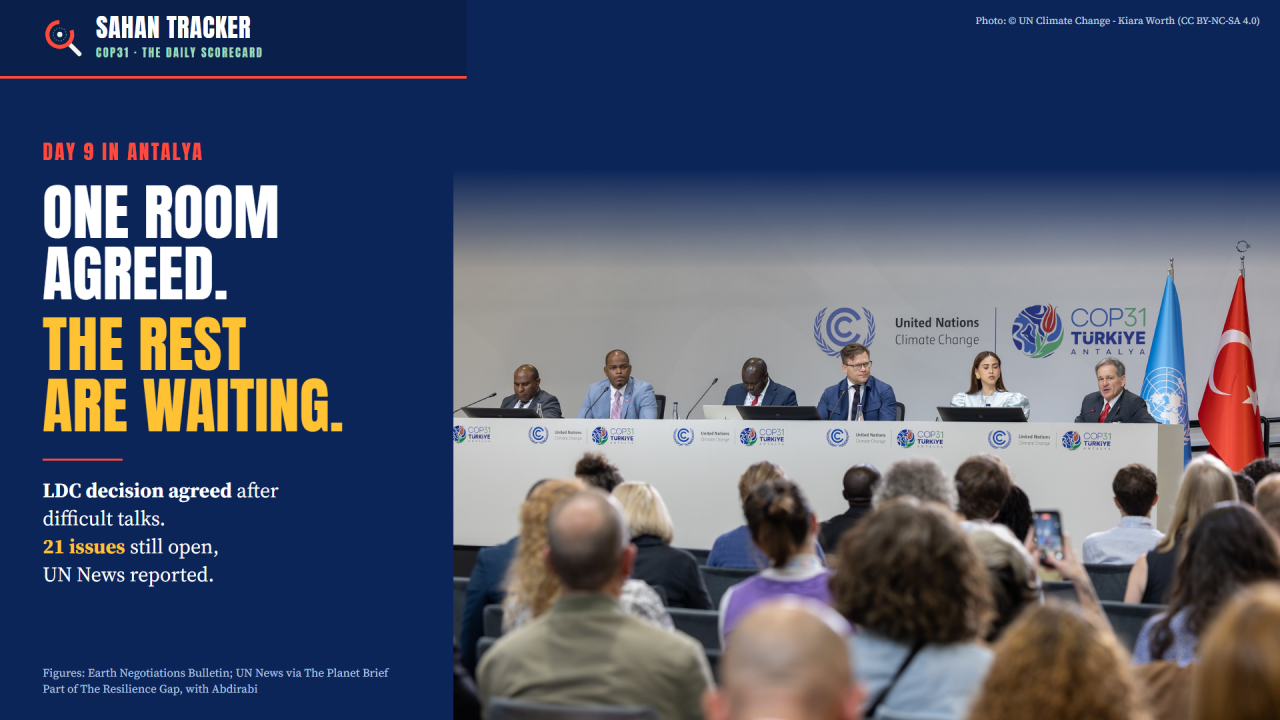
⏱️ Day 9 in one minute
- Countries agreed a text on matters relating to the least developed countries (LDCs), after difficult talks. It now goes to the COP and CMA for adoption.
- Ministers met behind closed doors in a “Divan”, a high-level meeting to move towards what the Presidency called a “balanced package”.
- UN News reported 21 unresolved issues, with new texts expected the next morning.
- The second global stocktake was launched. It will check, by 2028, whether the world is delivering on its climate promises.
- Finance stayed stuck. Rich and poor countries still disagree on who must pay for adaptation and for loss and damage.
🟢 What moved forward?
A text for the poorest countries. After difficult talks, countries agreed an unbracketed text on matters relating to the LDCs and sent it to the COP and CMA for adoption. The Arab Group asked to replace “finance providers” with “funding channels”, and the others accepted. One delegate told the Earth Negotiations Bulletin: “This decision may not make the headlines, but it means a lot for the more than one billion most vulnerable people who benefit from the work under this agenda item.” Japan welcomed the text, but said much of it was negotiated outside the official meetings.
The second global stocktake begins. The global stocktake is the Paris Agreement’s check on whether the world is on track. The second one started on Wednesday and ends at COP33 in 2028. UN climate chief Simon Stiell said 90% of countries reflected the results of the first stocktake in their national climate plans, according to The Planet Brief.
Ministers at the table. The Presidency asked governments to send their top people to a Divan at 5pm, Climate Home News reported. The word comes from an Ottoman council. The aim was to move towards a “balanced package” before the last days.
Electrification gains support. UN News reported that 75 countries now back the target to raise electricity to 35% of the world’s energy use by 2035, according to The Planet Brief.
🔴 What got stuck?
The loss and damage fund. The Arab Group said it cannot accept any call to scale up money unless it also mentions developed countries’ duty to pay. The EU, Switzerland and New Zealand said they cannot accept a text that does not mention all sources of finance. The LDCs, the Philippines, AILAC, China and others were disappointed that guidance on paying out money fast was removed. The EU again called such guidance “micromanaging”.
Pledges or real money. Many developing countries asked the text to show both the money pledged to the loss and damage fund and the money actually received. Canada said contributions depend on national processes and may change.
Finance talks linked together. The ministers said the Climate Finance Work Programme and the talks on aligning all finance flows with climate goals (Article 2.1(c)) are now linked. The Presidency offered three options: real decisions on both, procedural decisions on both, or no text on either. Countries still disagree on whether the work programme is about Article 9.1, rich countries’ duty to pay, or all of Article 9.
National adaptation plans. Many countries were disappointed that so little time was given to this item. The G77 and China agreed to send the draft text to the June 2027 session. The EU and UK opposed, saying the text is unbalanced and crosses red lines.
The Adaptation Fund. Developing countries want the Fund’s Board to report on the goal of tripling the money it pays out. The EU, Norway and the UK want minimal guidance.
Cutting emissions. In the mitigation work programme, the Arab Group called a wider scope a red line. The EU, UK, AILAC, AOSIS and Japan want a broader scope.
Who decides, and how. Russia proposed that objections raised by countries must be addressed before a decision is adopted. It cited the adoption of the climate finance goal at COP29 as an example. Tuvalu and AILAC could not support the proposal to keep using the draft rules of procedure without the rule on voting. The Presidency proposed to continue at COP32.
💰 The money picture
Loss and damage fund: no agreement on who must pay, or on guidance for fast payments.Pledged or paid: developing countries want both numbers in the text. Canada says amounts may change.Adaptation Fund: developing countries want a report on tripling its payouts. The EU, Norway and the UK prefer minimal guidance.Climate Technology Centre: the UK, Norway, the EU and Japan want to delete a request to at least double support to national bodies that work with the Centre.
- Loss and damage fund: no agreement on who must pay, or on guidance for fast payments.
- Pledged or paid: developing countries want both numbers in the text. Canada says amounts may change.
- Adaptation Fund: developing countries want a report on tripling its payouts. The EU, Norway and the UK prefer minimal guidance.
- Climate Technology Centre: the UK, Norway, the EU and Japan want to delete a request to at least double support to national bodies that work with the Centre.
🗣️ Who said what?
- One delegate, on the LDC decision: “This decision may not make the headlines, but it means a lot for the more than one billion most vulnerable people.”
- Arab Group: no call to scale up money without developed countries’ duty to pay.
- EU, Switzerland and New Zealand: the text must refer to all sources of finance.
- EU: guidance on fast payments from the loss and damage fund is “micromanaging”.
- Simon Stiell, UN climate chief: 90% of countries reflected the first stocktake in their national climate plans.
- One negotiator, in the finance meeting: warned against “hostage taking”, meaning blocking one issue to win another.
🧭 So, who stands where?
In one line: the LDCs got a text of their own, but on the big money files the lines have not moved. Developing countries want developed countries named as the ones who pay. Developed countries want the text to refer to all sources of finance.
💡 My takeaways from Day 9
One. Small wins still matter. The LDC text will not make headlines. But it shows that hard talks can end in agreement, when countries stay in the room.
Two. Pledged is not paid. Developing countries asked the loss and damage text to show both what was promised and what arrived. That one request explains the resilience gap better than any speech.
Three. Trust is now the missing piece. Negotiators spoke about “hostage taking” and about not reopening settled deals. With three official days left, the question is not only what is in the text, but whether countries trust each other enough to agree.
📖 Words of the day
Divan: a closed-door meeting of ministers with the Presidency. The word comes from an Ottoman council.Global stocktake: the Paris Agreement’s check on progress, every five years.Unbracketed text: a draft with no words in [brackets], meaning countries no longer dispute it.Rules of procedure: the rules for how a COP works. The rule on voting was never agreed, so COPs decide by consensus.Article 2.1(c): the Paris Agreement goal of making all finance flows consistent with climate goals.“Hostage taking”: blocking one issue to win something on another.
- Divan: a closed-door meeting of ministers with the Presidency. The word comes from an Ottoman council.
- Global stocktake: the Paris Agreement’s check on progress, every five years.
- Unbracketed text: a draft with no words in [brackets], meaning countries no longer dispute it.
- Rules of procedure: the rules for how a COP works. The rule on voting was never agreed, so COPs decide by consensus.
- Article 2.1(c): the Paris Agreement goal of making all finance flows consistent with climate goals.
- “Hostage taking”: blocking one issue to win something on another.
👀 What to watch tomorrow?
- The second draft of the cover decision: does it keep a number for tripling adaptation finance?
- The 21 open issues: how many can ministers close?
- The loss and damage fund: guidance on fast payments, or none.
- The fossil fuel language: does it stay in the text?
See you tomorrow.
Abdirabi
📚 Sources
Earth Negotiations Bulletin (IISD), daily report for 18 November 2026: https://enb.iisd.org/antalya-un-climate-change-conference-cop31-daily-report-18nov2026Climate Home News, COP31 Bulletin Day 9: https://www.climatechangenews.com/2026/11/18/cop31-bulletin-day-9-crunch-ministerial-talks-planned-for-wednesday-evening/The Planet Brief, COP31 Day 9 roundup (citing UN News and UN Climate Change): https://theplanetbrief.com/carbon/climate-policy/cop31-day-9-roundup-2026/
- Earth Negotiations Bulletin (IISD), daily report for 18 November 2026: https://enb.iisd.org/antalya-un-climate-change-conference-cop31-daily-report-18nov2026
- Climate Home News, COP31 Bulletin Day 9: https://www.climatechangenews.com/2026/11/18/cop31-bulletin-day-9-crunch-ministerial-talks-planned-for-wednesday-evening/
- The Planet Brief, COP31 Day 9 roundup (citing UN News and UN Climate Change): https://theplanetbrief.com/carbon/climate-policy/cop31-day-9-roundup-2026/
First published on LinkedIn in The Resilience Gap newsletter by Abdirabi Mohamed. Read the original.
Leave a Reply