
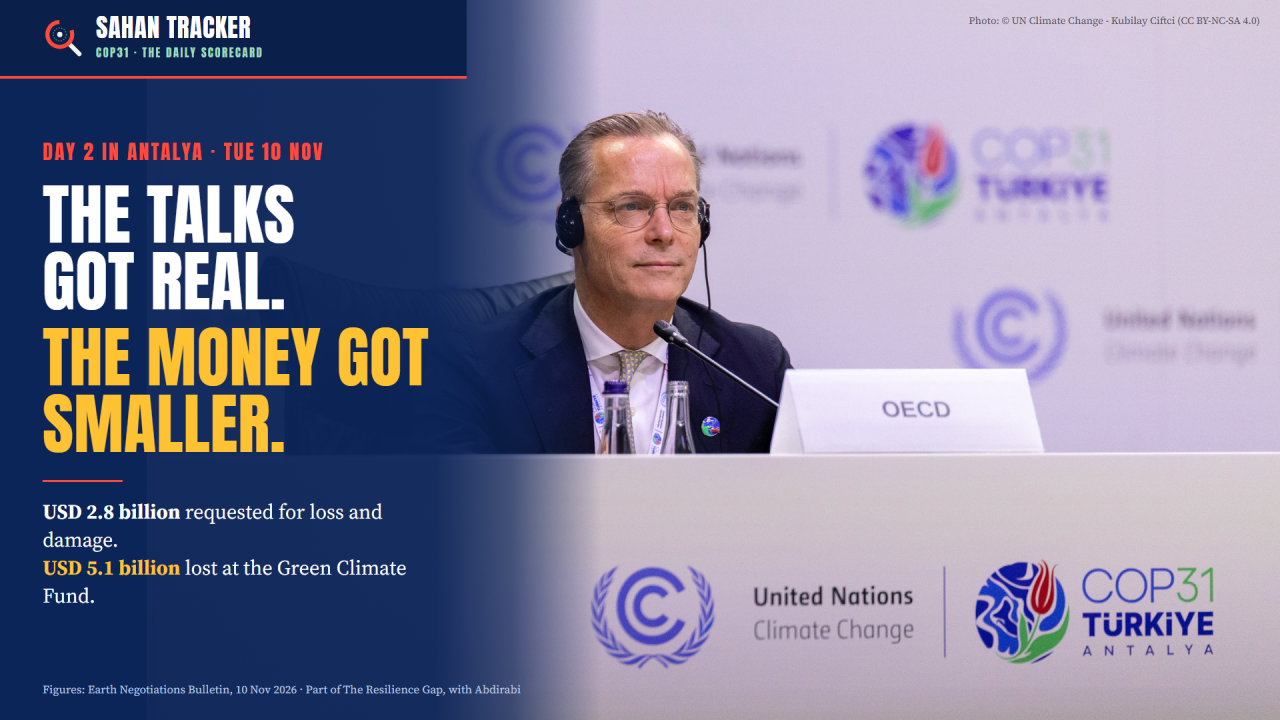
Tuesday 10 November 2026 · Antalya, Türkiye · Part of The Resilience Gap, with Abdirabi
What is Sahan Tracker? It is my daily update during COP31, the UN climate conference in Antalya, Türkiye (9 to 20 November 2026). During COP31, The Resilience Gap comes to you every day as Sahan Tracker, focused on what is happening inside the negotiation rooms. After COP31, we go back to one edition a week.
These are my notes from the day. I follow the talks from my home, reading the Earth Negotiations Bulletin, the UN, journalists and colleagues who are in the rooms, and I put it together in plain words. Every hard word gets an explanation.
⏱️ Day 2 in one minute
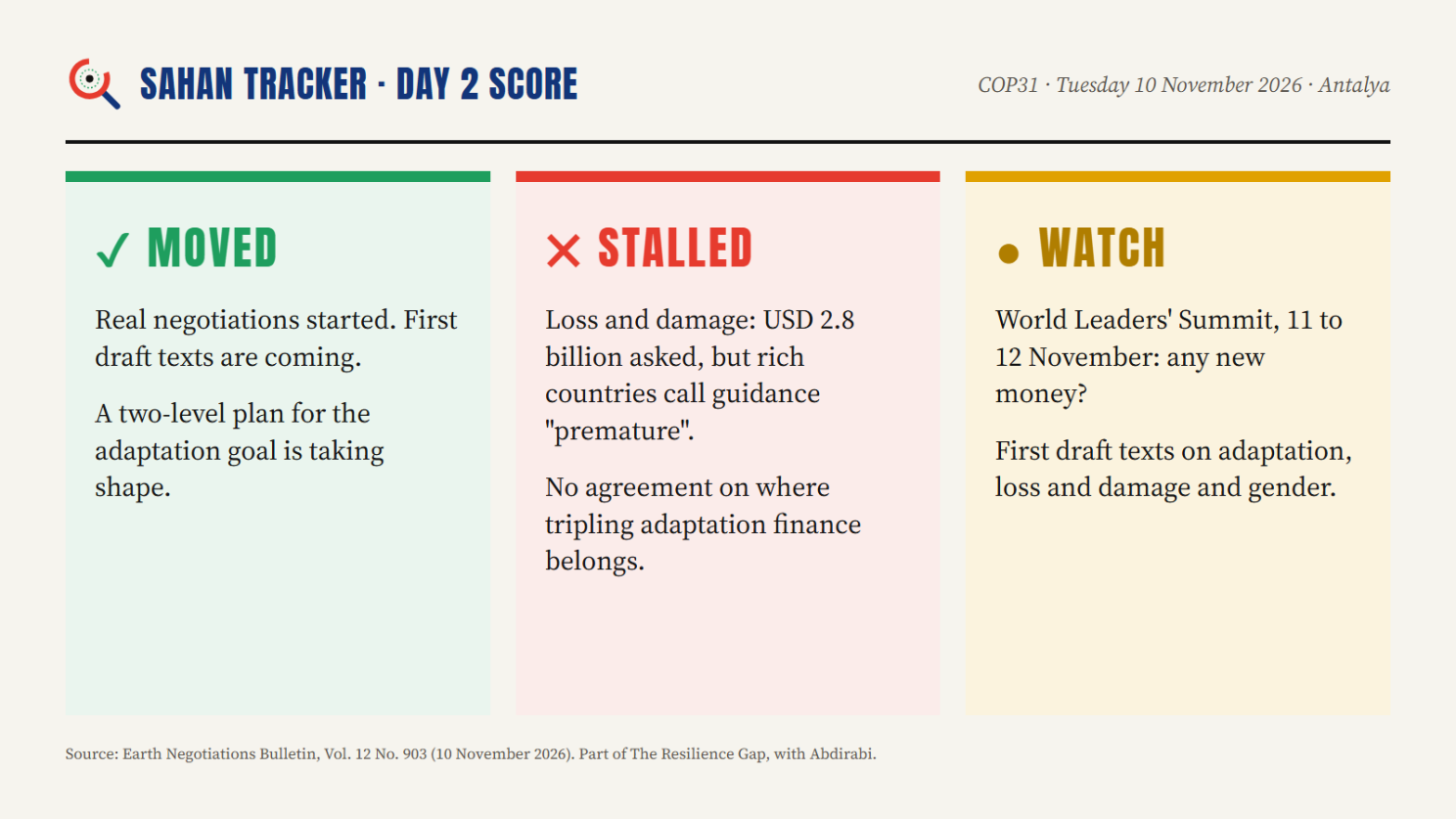
The real negotiations started. On Tuesday morning, countries went straight into formal talks. The finance talks ran all day and into the evening.Tripling adaptation finance came back, in two different rooms. Developing countries still regret that it has no topic of its own.Poorer countries have asked the loss and damage fund for USD 2.8 billion. Rich countries say it is too early to give the fund new instructions.Support is shrinking. Cuts by the UK and the US to the Green Climate Fund mean USD 5.1 billion less in one year.On the energy side, Brazil handed its roadmap for moving away from fossil fuels to UN Secretary-General António Guterres.

- The real negotiations started. On Tuesday morning, countries went straight into formal talks. The finance talks ran all day and into the evening.
- Tripling adaptation finance came back, in two different rooms. Developing countries still regret that it has no topic of its own.
- Poorer countries have asked the loss and damage fund for USD 2.8 billion. Rich countries say it is too early to give the fund new instructions.
- Support is shrinking. Cuts by the UK and the US to the Green Climate Fund mean USD 5.1 billion less in one year.
- On the energy side, Brazil handed its roadmap for moving away from fossil fuels to UN Secretary-General António Guterres.
🟢 What moved forward?
The work finally started. Day 1 was speeches and the agenda fight. Day 2 was the first full day of technical work. In small groups, the people leading each topic (called co-facilitators) asked countries for their views, so they can write the first draft texts. Delegates told the Earth Negotiations Bulletin it felt like “déjà vu”, with old positions repeated. But by the evening, the first possible areas of agreement started to appear.
A shape for the adaptation goal. In the talks on the Global Goal on Adaptation, the shared goal for making the world more resilient, countries broadly agreed on a two-level plan: a small expert group for the technical work on indicators, plus a political process to test them. Youth and women’s groups asked that the indicators show impacts on young people, children, women and girls. A first draft text is coming.
A shape for a just transition. In the talks on a fair shift to clean economies for workers and communities, countries also moved towards a two-level structure: a political body plus a technical arm.
Help for the switch to clean energy. Tuesday was Energy and Transport Day, with around 370 events. An Australia-led declaration aims for 300 million homes with rooftop solar by 2030, signed by countries including Bangladesh, Kenya, Nigeria and Vanuatu. A new initiative of the Powering Past Coal Alliance will help coal-dependent countries in the Global South reach transition funding. These are voluntary initiatives. They do not change the negotiations.
🔴 What got stuck?
Who decides how adaptation money grows? Developing countries (the G77 and China) want the climate finance talks to focus on Article 9.1 of the Paris Agreement: rich countries shall provide finance. The EU wants a broad view of all climate finance, with tripling adaptation finance inside it. The UK, EU and Norway want tripling discussed in the finance talks, where it sits under the existing finance goal. Developing countries want clear starting points and ways to track the money.
Loss and damage: a clear need, a slow answer. The loss and damage fund helps countries recover from climate disasters. 119 countries have asked it for USD 2.8 billion. Small island states, the African Group and Latin American countries (AILAC) want short political guidance that names this need and urges countries to pay what they pledged. The EU, UK and Canada say guidance is “premature”.
The Adaptation Fund is short of money. The least developed countries, the Like-Minded Developing Countries and the Arab Group warned of a “serious shortfall” in contributions.
How long to keep cutting emissions together? Countries broadly support continuing the programme on cutting emissions, but disagree on how long: to 2030, to 2040, or with no end date. Switzerland proposed a permanent committee. The Arab Group opposed it.
Even the final deal is questioned. When heads of delegation met on the “cover decision”, the one text meant to sum up COP31, some asked why everyone assumes there will be one. So the Presidency may have to negotiate its purpose too.
Getting to the venue. Some delegates needed three hours or more to reach the venue on crowded trams and shuttles, and morning talks started late.
💰 The money picture
This is the part of Day 2 I keep coming back to. UK and US cuts to the Green Climate Fund mean USD 5.1 billion less in one year. The latest round of funding for the Global Environment Facility is the lowest in its history. One observer told the Earth Negotiations Bulletin the direction is “clearly the wrong one”.
So the needs are named: USD 2.8 billion for loss and damage alone. But the money behind them is moving the other way.
🗣️ Who said what?
Least developed countries: a “serious shortfall” in the Adaptation Fund. They also raised gaps in weather observation and early warning, and asked for predictable money for women-led projects.G77 and China: the finance talks must be about Article 9.1. They regret there is no topic for tripling adaptation finance, and want “common but differentiated responsibilities” in the adaptation text.African Group: wants guidance for the loss and damage fund. A just transition must include informal economies.Small island states (AOSIS): “chronic challenges” in getting finance, and a call for grants, not loans, for adaptation.European Union: finance talks should cover all of Article 9, including tripling. Guidance for the loss and damage fund is premature. Opposes “common but differentiated responsibilities” in the adaptation text.UK, Norway, Canada: tripling belongs in the finance talks.António Guterres, UN Secretary-General: asked every country for its own national plan to move away from fossil fuels, with timelines and financing needs, and progress by 2028.André Corrêa do Lago, COP30 President: the fossil fuel roadmap is “not a mandate”.
- Least developed countries: a “serious shortfall” in the Adaptation Fund. They also raised gaps in weather observation and early warning, and asked for predictable money for women-led projects.
- G77 and China: the finance talks must be about Article 9.1. They regret there is no topic for tripling adaptation finance, and want “common but differentiated responsibilities” in the adaptation text.
- African Group: wants guidance for the loss and damage fund. A just transition must include informal economies.
- Small island states (AOSIS): “chronic challenges” in getting finance, and a call for grants, not loans, for adaptation.
- European Union: finance talks should cover all of Article 9, including tripling. Guidance for the loss and damage fund is premature. Opposes “common but differentiated responsibilities” in the adaptation text.
- UK, Norway, Canada: tripling belongs in the finance talks.
- António Guterres, UN Secretary-General: asked every country for its own national plan to move away from fossil fuels, with timelines and financing needs, and progress by 2028.
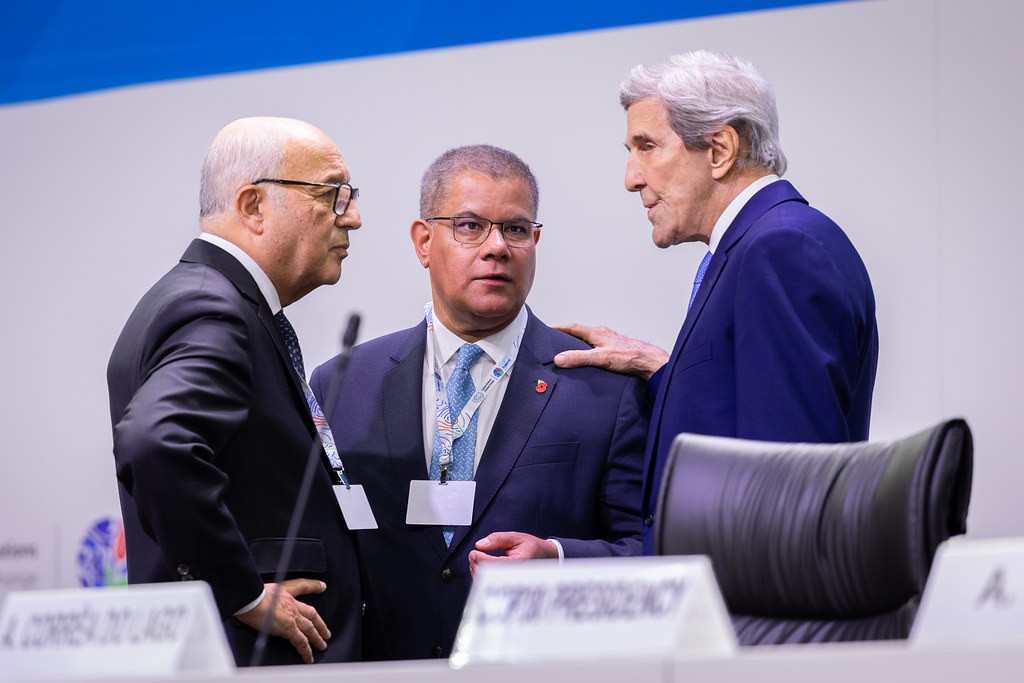
- André Corrêa do Lago, COP30 President: the fossil fuel roadmap is “not a mandate”.
🧭 So, who stands where?
In one line: developing countries pull the money talks towards a legal duty to pay and clear numbers for tripling. Developed countries keep it broad, under the existing finance goal, and resist new guidance. That split was there on Day 1, and on Day 2 it showed up in almost every room.
💡 My takeaways from Day 2
One. The needs are clear. The money is not. USD 2.8 billion requested for loss and damage, a “serious shortfall” in the Adaptation Fund, and at the same time USD 5.1 billion less for the Green Climate Fund. This is the resilience gap in one day.
Two. “Premature” is a word to watch. When rich countries call guidance “premature”, they are asking for more time. For communities hit by floods and droughts this year, time is the one thing they do not have.
Three. Small details shape big texts. Whether tripling adaptation finance is discussed in the finance room or the adaptation room sounds technical. But it decides whether it ends up with a number and a way to track it, or stays a promise.
📖 Words of the day
Contact group: a formal negotiating group on one topic, usually open to observers.Co-facilitators: the two people who lead the talks on one topic and write the draft texts.Two-tier: a structure with two levels, such as an expert group plus a political process.Means of implementation: what countries need to act: finance, technology and training.Loss and damage: climate harm that is too late to prevent, like homes lost to floods.Share of proceeds: a small part of carbon market credits that goes to the Adaptation Fund.CBDR (common but differentiated responsibilities): all countries share the goal, but have different duties.
- Contact group: a formal negotiating group on one topic, usually open to observers.
- Co-facilitators: the two people who lead the talks on one topic and write the draft texts.
- Two-tier: a structure with two levels, such as an expert group plus a political process.
- Means of implementation: what countries need to act: finance, technology and training.
- Loss and damage: climate harm that is too late to prevent, like homes lost to floods.
- Share of proceeds: a small part of carbon market credits that goes to the Adaptation Fund.
- CBDR (common but differentiated responsibilities): all countries share the goal, but have different duties.
👀 What to watch on Day 3?
- The first draft texts on the adaptation goal, the loss and damage fund and gender.
- The World Leaders’ Summit on 11 and 12 November: will any leader bring new money for adaptation or loss and damage?
- 13 November: Finance and Trade Day, and Chris Bowen’s summary of the cover decision.
See you tomorrow.
Abdirabi
📚 Sources
Earth Negotiations Bulletin (IISD), Vol. 12 No. 903, daily report for 10 November 2026: https://enb.iisd.org/sites/default/files/2026-11/enb12903e.pdfUNFCCC, press conference transcript, 10 November: https://unfccc.int/news/transcript-of-press-conference-opening-remarks-today-of-cop31-president-president-of-negotiations-unCarbon Brief Connect, fossil fuel roadmap presented at COP31: https://connect.carbonbrief.org/t/fossil-fuel-roadmap-presented-at-cop31/120UN News (via now.solar), energy transition takes centre stage: https://now.solar/2026/11/11/cop31-energy-transition-takes-centre-stage-as-countries-map-path-beyond-fossil-fuels-un-news/Climate Home News, COP31 Bulletin Day 2: https://www.climatechangenews.com/2026/11/10/cop31-bulletin-day-2-energy-day-off-to-slow-start-amid-transport-chaos/TRT World, day two programme: https://www.trtworld.com/article/adc1626e31f4
- Earth Negotiations Bulletin (IISD), Vol. 12 No. 903, daily report for 10 November 2026: https://enb.iisd.org/sites/default/files/2026-11/enb12903e.pdf
- UNFCCC, press conference transcript, 10 November: https://unfccc.int/news/transcript-of-press-conference-opening-remarks-today-of-cop31-president-president-of-negotiations-un
- Carbon Brief Connect, fossil fuel roadmap presented at COP31: https://connect.carbonbrief.org/t/fossil-fuel-roadmap-presented-at-cop31/120
- UN News (via now.solar), energy transition takes centre stage: https://now.solar/2026/11/11/cop31-energy-transition-takes-centre-stage-as-countries-map-path-beyond-fossil-fuels-un-news/
- Climate Home News, COP31 Bulletin Day 2: https://www.climatechangenews.com/2026/11/10/cop31-bulletin-day-2-energy-day-off-to-slow-start-amid-transport-chaos/
- TRT World, day two programme: https://www.trtworld.com/article/adc1626e31f4
First published on LinkedIn in The Resilience Gap newsletter by Abdirabi Mohamed. Read the original.
Leave a Reply