
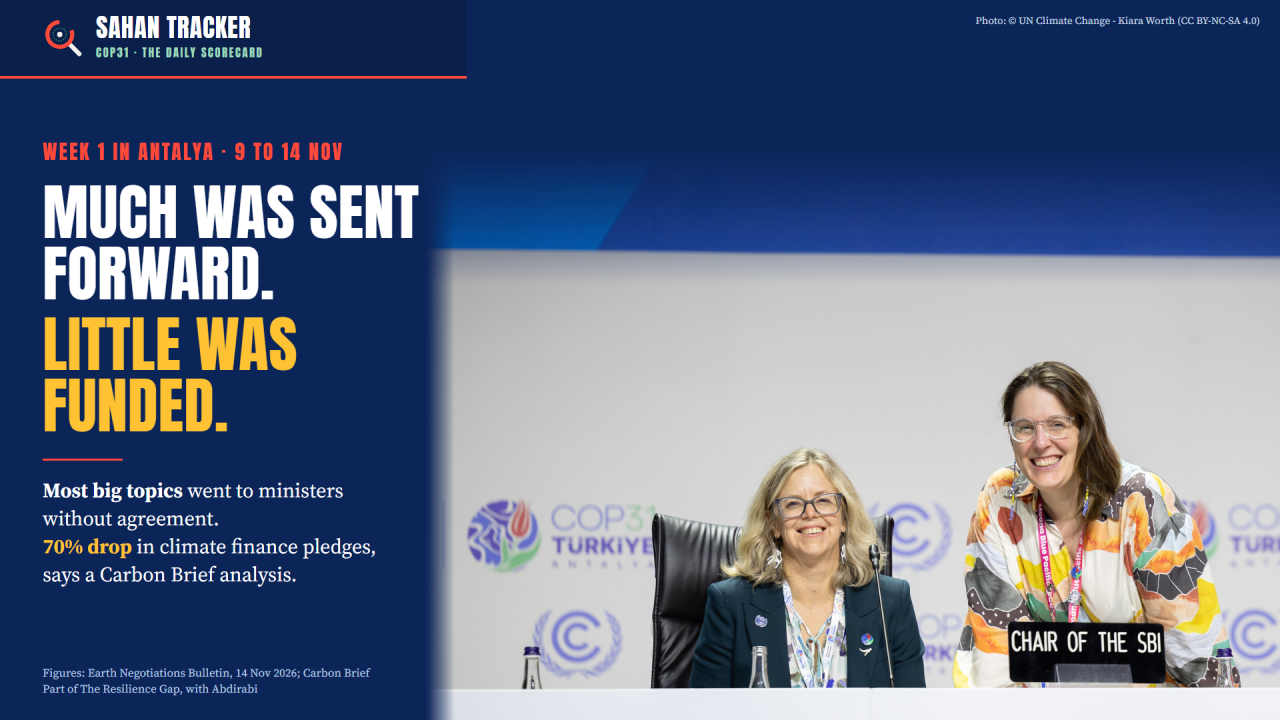
Monday 16 November 2026 · Antalya, Türkiye · Week 1 (9 to 14 November) · Part of The Resilience Gap, with Abdirabi
What is Sahan Tracker? It is my daily update during COP31, the UN climate conference in Antalya, Türkiye (9 to 20 November 2026). During COP31, The Resilience Gap comes to you every day as Sahan Tracker, focused on what is happening inside the negotiation rooms. After COP31, we go back to one edition a week.
⏱️ Week 1 in one minute
The technical talks closed at 12:48 am on Sunday 15 November. A few topics were agreed. Most of the big ones, including the adaptation goal, national adaptation plans, the mitigation work programme and the just transition, were sent to week two without agreement.From Monday, ministers take over the hardest topics in five pairs: mitigation, finance, adaptation, just transition and the Ocean.The cover decision, the one text meant to sum up COP31, is now the main fight. The Arab Group and the Like-Minded Developing Countries (LMDCs) said no to new targets for sectors. Some countries question whether there should be a cover decision at all.Money moved the wrong way all week: USD 5.1 billion less for the Green Climate Fund, a 27% smaller Global Environment Facility, and climate finance pledges down 70%, according to Carbon Brief.The smallest pledge of the week sent the biggest message: Solomon Islands gave USD 400,000 to the Green Climate Fund.
- The technical talks closed at 12:48 am on Sunday 15 November. A few topics were agreed. Most of the big ones, including the adaptation goal, national adaptation plans, the mitigation work programme and the just transition, were sent to week two without agreement.
- From Monday, ministers take over the hardest topics in five pairs: mitigation, finance, adaptation, just transition and the Ocean.
- The cover decision, the one text meant to sum up COP31, is now the main fight. The Arab Group and the Like-Minded Developing Countries (LMDCs) said no to new targets for sectors. Some countries question whether there should be a cover decision at all.
- Money moved the wrong way all week: USD 5.1 billion less for the Green Climate Fund, a 27% smaller Global Environment Facility, and climate finance pledges down 70%, according to Carbon Brief.
- The smallest pledge of the week sent the biggest message: Solomon Islands gave USD 400,000 to the Green Climate Fund.
📅 The week, day by day
- Day 1 (Mon 9 Nov): The agenda fight. The finance work programme, including Article 9.1, made it onto the agenda. Tripling adaptation finance did not get its own item.
- Day 2 (Tue 10 Nov): Real talks began. 119 countries have asked the loss and damage fund for USD 2.8 billion. The EU, UK and Canada called guidance to the fund “premature”.
- Day 3 (Wed 11 Nov): Leaders arrived. Guterres called for a “climate justice compact” and a windfall tax on fossil fuel profits. No new money for adaptation or loss and damage was reported.
- Day 4 (Thu 12 Nov): First draft texts arrived. A debate opened on how to fix the UN climate process. Solomon Islands made its pledge.
- Day 5 (Fri 13 Nov): Everyone shared a wish list for the cover decision. Developed countries called loss and damage guidance “micromanaging”.
- Day 6 (Sat 14 Nov): The technical talks closed after midnight. People marched in Antalya for climate justice. It was also Children, Youth, Education and Skills Day
🟢 What moved forward?
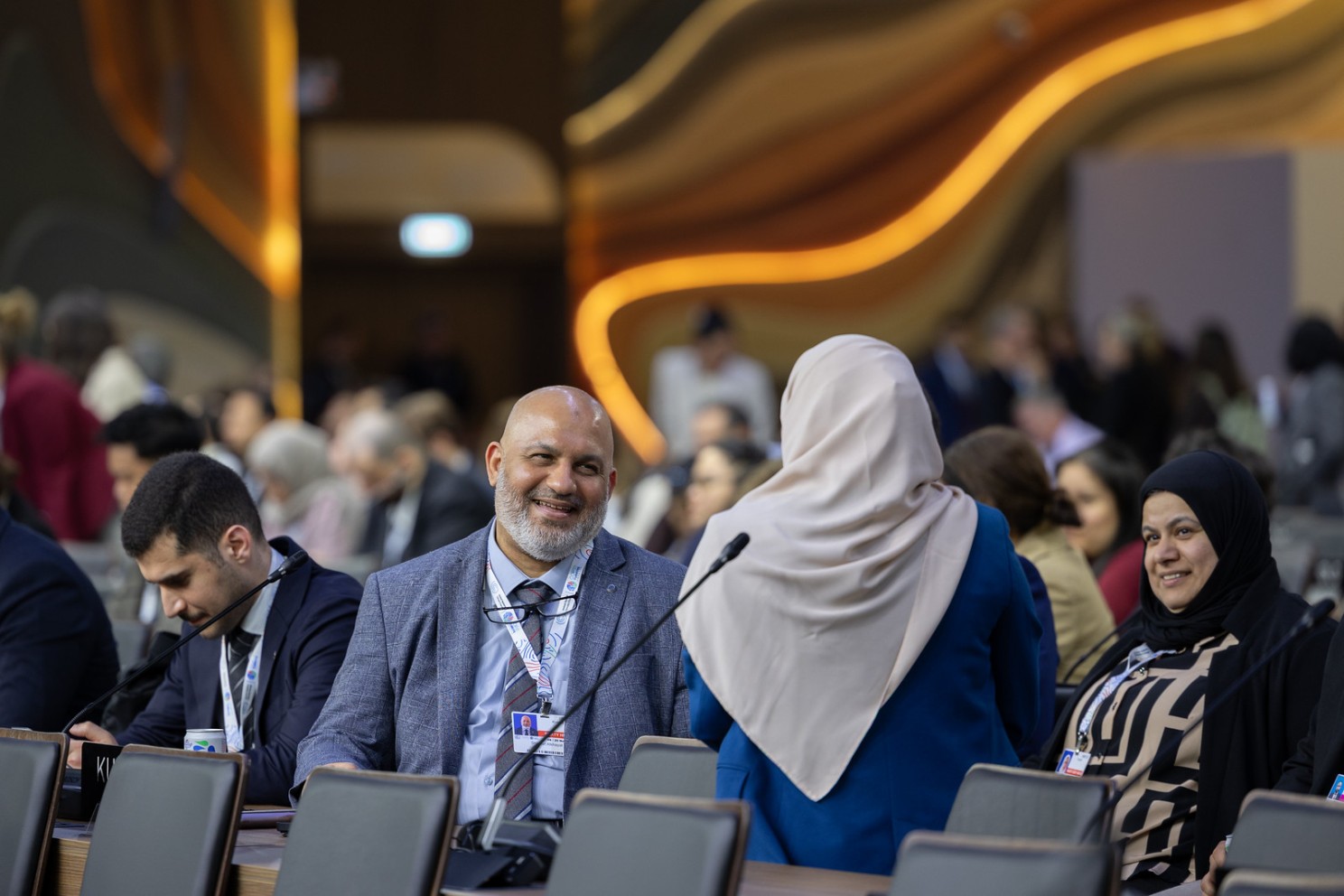
A few topics were agreed. The technical bodies adopted short outcomes, called conclusions, on guidance for adaptation communications (the reports where countries share their adaptation needs and actions), matters relating to the least developed countries (LDCs), gender, research and systematic observation, capacity-building, and support for developing countries’ reporting.
Loss and damage reporting. The report of the Warsaw International Mechanism on loss and damage was adopted as COP and CMA decisions.
Ministers have a plan for week two. The COP31 President, Murat Kurum, set out four streams of work and named five pairs of ministers: Germany and India on mitigation, France and the Philippines on climate finance, Sierra Leone and the UK on adaptation, Mexico and Poland on the just transition, and Canada and Palau on the Ocean.
A carbon market starts to work. The Article 6.4 mechanism, the new UN carbon market, issued its first credits this week.
Tripling adaptation finance has support as a topic. In the finance talks, there was broad support for discussing tripling adaptation finance and access to finance. That is a start, but there is still no starting year and no dollar figure.
🔴 What got stuck?
The adaptation goal. The Global Goal on Adaptation, the shared goal for making the world more resilient, was sent to the CMA on a draft text with “no formal status”. The Secretariat said it can still be the basis for talks.
National adaptation plans. Many countries were disappointed that there was not more time. The text was sent to the COP for week two.
The mitigation work programme. The African Group, the Arab Group and the LMDCs rejected the updated informal note, saying it goes beyond the mandate. The matter was sent to the CMA with no agreed text. Countries still disagree on whether it should run to 2030 or 2040.
The just transition work programme. Sent on to the CMA, taking note of an informal note.
Agriculture and food security. A procedural decision was adopted, but a real decision is delayed until 2027. One observer called it “a real shame”.
The Adaptation Fund. Countries are still divided over how the Fund moves to serve only the Paris Agreement, and over who sits on its Board. The EU and Norway want to change the terms used for Board seats. The African Group asked whether that would also remove the invitation for developed countries to keep funding it. The LDCs defended the Fund as a source of grants.
Cooperation with other organisations. This item, which includes the link between the three Rio Conventions on climate, biodiversity and land, was put off to June 2027. One delegate said: “refusing to negotiate is something else.”
📝 The cover decision: the fight of week two
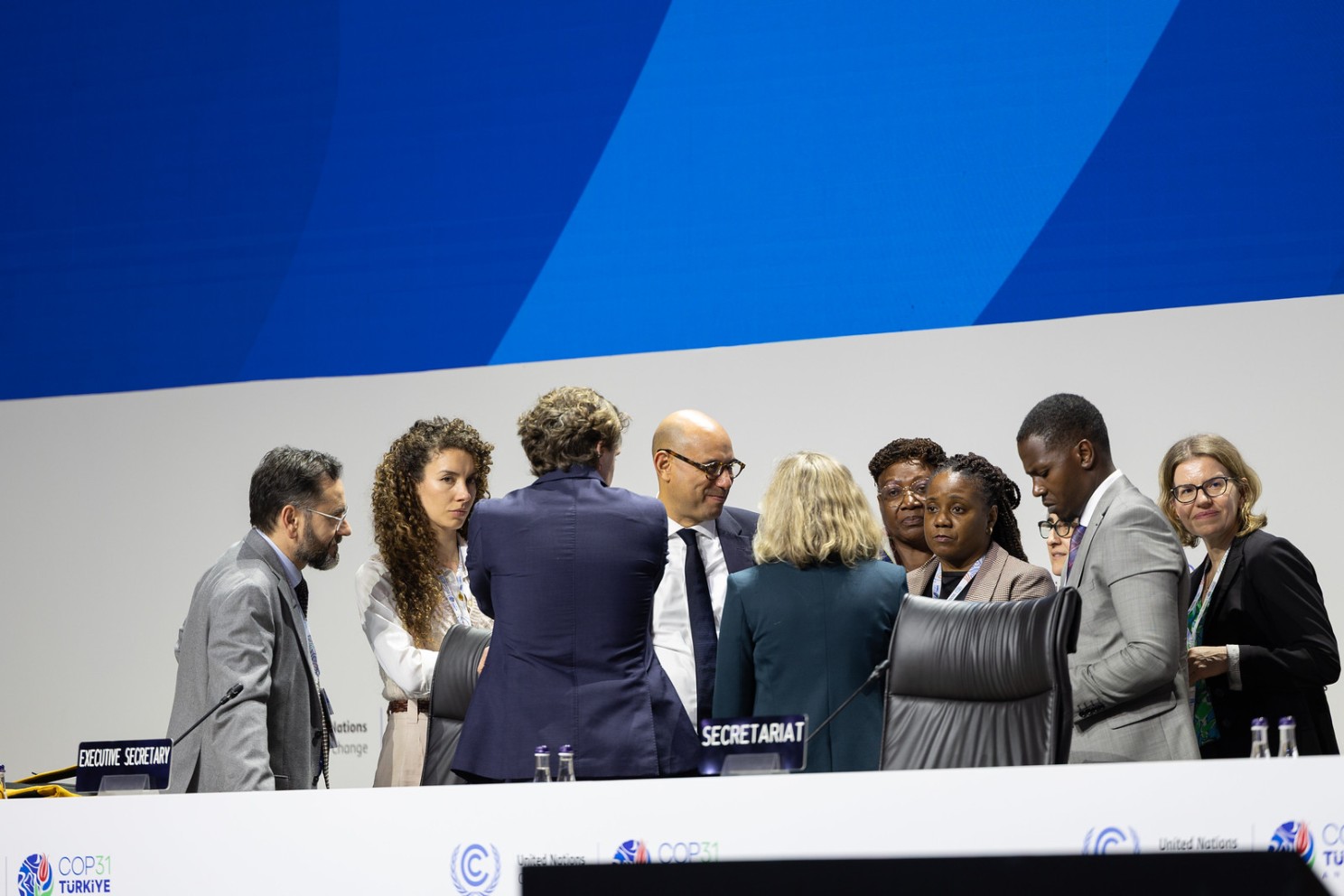
This is the main story going into week two.
What is on the table? The Presidencies’ note on the cover decision still holds almost every idea: responding to overshoot of 1.5°C, welcoming the COP30 roadmaps on fossil fuels and deforestation, and a 35% electrification target by 2035.
The red lines are out. At the Saturday night stocktake, the Arab Group said it will not accept “top-down” global targets, or targets for specific sectors or energy sources. Climate Home News reported that Saudi Arabia rejected mentioning Brazil’s roadmap to move away from fossil fuels, and that India opposed mentioning reports “external” to the UN process, like the UN Environment Programme’s report on overshoot.
Reform of the process. Russia, the Arab Group, the African Group, the LMDCs and Argentina opposed putting the outcome of the talks on reforming the UN climate process into the cover decision. The EU, the Umbrella Group, the LDCs, AILAC, AOSIS and Switzerland supported continuing those talks.
The overshoot fight. The EU, the UK, the LDCs and the small island states want COP31 to make the response to overshooting 1.5°C a priority. Saudi Arabia and other large developing countries questioned the science of the UNEP report on overshoot. Its authors defended it.
The first draft is out. On Monday 16 November, the first draft of the cover decision was published. Climate Home News reports it holds asks from 160 countries and now has to be cut down.
Why it matters for LDCs: tripling adaptation finance has no agenda item of its own. The cover decision is the main political place where it can get a number, a starting year and a way to track it. The LDC asks (concrete adaptation measures, new money for the funds including the loss and damage fund, and milestones to track progress) now need to survive into the next drafts.
💰 The money picture
USD 2.8 billion: what 119 countries have asked the loss and damage fund for.USD 5.1 billion: how much less the Green Climate Fund gets in one year after UK and US cuts.27%: how much smaller the new funding round of the Global Environment Facility (GEF-9) is.70%: the drop in climate finance pledges, according to Carbon Brief.USD 7.9 billion of USD 10 billion: the Tropical Forest Forever Facility is still short of its start-up target.USD 400,000: the pledge from Solomon Islands to the Green Climate Fund, the first from a small island developing state to the fund’s replenishment.GBP 6 billion over three years: the climate finance figure the UK spoke of.
- USD 2.8 billion: what 119 countries have asked the loss and damage fund for.
- USD 5.1 billion: how much less the Green Climate Fund gets in one year after UK and US cuts.
- 27%: how much smaller the new funding round of the Global Environment Facility (GEF-9) is.
- 70%: the drop in climate finance pledges, according to Carbon Brief.
- USD 7.9 billion of USD 10 billion: the Tropical Forest Forever Facility is still short of its start-up target.
- USD 400,000: the pledge from Solomon Islands to the Green Climate Fund, the first from a small island developing state to the fund’s replenishment.
- GBP 6 billion over three years: the climate finance figure the UK spoke of.
Grants or loans? In the talks on guidance to the Green Climate Fund, the Philippines said loans are inappropriate, especially for adaptation. The EU supported grants for adaptation in the LDCs and small island states. The Arab Group said expanding the donor base, meaning asking more countries to pay in, is a red line.
🗣️ Who said what?
Least developed countries: the expected overshoot of 1.5°C is “a grave betrayal”. Give guidance to the loss and damage fund and speed up its replenishment.Landlocked developing countries: “A plan that cannot be financed protects no one.”António Guterres, UN Secretary-General: “polluters must pay”.Arab Group: no top-down global targets, and no targets for specific sectors or energy sources.EU, Japan, Canada, New Zealand and Norway: detailed guidance for the loss and damage fund is “micromanaging”.Switzerland: limiting overshoot of 1.5°C is important.Argentina: splitting the talks into “technical” and “political” tracks risks undermining the Convention and the Paris Agreement.One delegate, on a long draft text: “This document does not need streamlining, it needs a chainsaw.”
- Least developed countries: the expected overshoot of 1.5°C is “a grave betrayal”. Give guidance to the loss and damage fund and speed up its replenishment.
- Landlocked developing countries: “A plan that cannot be financed protects no one.”
- António Guterres, UN Secretary-General: “polluters must pay”.
- Arab Group: no top-down global targets, and no targets for specific sectors or energy sources.
- EU, Japan, Canada, New Zealand and Norway: detailed guidance for the loss and damage fund is “micromanaging”.
- Switzerland: limiting overshoot of 1.5°C is important.
- Argentina: splitting the talks into “technical” and “political” tracks risks undermining the Convention and the Paris Agreement.
- One delegate, on a long draft text: “This document does not need streamlining, it needs a chainsaw.”
🧭 So, who stands where?
In one line: developing countries stand together on public money, grants and Article 9.1. Developed countries keep finance broad and resist new guidance for the funds. On the cover decision, the lines are different: the Arab Group and the LMDCs reject new targets, while the LDCs, small islands, the EU and AILAC push for strong text on overshoot and ambition.
💡 My takeaways from Week 1
One. Sent forward is not the same as solved. Almost every big topic went to week two without agreement. Ministers now have one week to do what negotiators could not.
Two. The money is moving the other way. Every day this week, I wrote about a need: USD 2.8 billion for loss and damage, tripling adaptation finance, help to turn adaptation plans into projects. And every day, the money got smaller. That is the resilience gap in one week.
Three. The LDCs can be a bridge. On finance, they stand with the G77 and China. On the cover decision and overshoot, they stand closer to the EU and small islands than to some large developing countries. That gives them a chance to connect the two sides, if they keep their asks clear and simple.
📖 Words of the week
Subsidiary Bodies (SBs): the two technical bodies (SBI and SBSTA) that prepare work for the COP. They close at the end of week one.Forwarded: a topic sent on to the COP or CMA for week two, often without agreement.“No formal status”: a draft text that countries have not agreed, but that can still be used as a starting point.Ministerial pair: two ministers, usually one from a developed and one from a developing country, who lead talks on a hard topic.Overshoot: when warming goes above 1.5°C for a time before, hopefully, coming back down.Sectoral target: a goal for one part of the economy, like electricity or transport.Donor base: the group of countries that pay into a fund.
- Subsidiary Bodies (SBs): the two technical bodies (SBI and SBSTA) that prepare work for the COP. They close at the end of week one.
- Forwarded: a topic sent on to the COP or CMA for week two, often without agreement.
- “No formal status”: a draft text that countries have not agreed, but that can still be used as a starting point.
- Ministerial pair: two ministers, usually one from a developed and one from a developing country, who lead talks on a hard topic.
- Overshoot: when warming goes above 1.5°C for a time before, hopefully, coming back down.
- Sectoral target: a goal for one part of the economy, like electricity or transport.
- Donor base: the group of countries that pay into a fund.
👀 What to watch in Week 2?
- The first draft of the cover decision, and how many LDC asks survive into the next version.
- The finance ministers (France and the Philippines): will tripling adaptation finance get a starting year and a number?
- The adaptation ministers (Sierra Leone and the UK): can they turn the adaptation goal text into an agreement?
- Loss and damage: guidance for the fund, or none.
See you tomorrow.
Abdirabi
📚 Sources
Earth Negotiations Bulletin (IISD), daily report for 14 November 2026: https://enb.iisd.org/antalya-un-climate-change-conference-cop31-daily-report-14nov2026Earth Negotiations Bulletin (IISD), daily reports for 9 to 13 November 2026: https://enb.iisd.org/antalya-un-climate-change-conference-cop31Climate Home News, COP31 Bulletin Day 6: https://www.climatechangenews.com/2026/11/14/cop31-bulletin-day-6-limited-progress-as-ministers-arrive-in-antalya/Climate Home News, COP31 Bulletin Day 7: https://www.climatechangenews.com/2026/11/16/cop31-bulletin-day-7-sharp-divisions-lower-expectations-for-cop-outcome/Climate Home News, scientists defend UN overshoot report: https://www.climatechangenews.com/2026/11/14/scientists-defend-un-overshoot-report-after-saudi-led-push-to-sideline-it-at-cop31/Carbon Brief, DeBriefed 13 November 2026: https://www.carbonbrief.org/debriefed-13-november-2026-make-or-bake-electrification-push-climate-finance-down-70UN News, Guterres urges climate justice pact: https://news.un.org/en/story/2026/11/1168783
- Earth Negotiations Bulletin (IISD), daily report for 14 November 2026: https://enb.iisd.org/antalya-un-climate-change-conference-cop31-daily-report-14nov2026
- Earth Negotiations Bulletin (IISD), daily reports for 9 to 13 November 2026: https://enb.iisd.org/antalya-un-climate-change-conference-cop31
- Climate Home News, COP31 Bulletin Day 6: https://www.climatechangenews.com/2026/11/14/cop31-bulletin-day-6-limited-progress-as-ministers-arrive-in-antalya/
- Climate Home News, COP31 Bulletin Day 7: https://www.climatechangenews.com/2026/11/16/cop31-bulletin-day-7-sharp-divisions-lower-expectations-for-cop-outcome/
- Climate Home News, scientists defend UN overshoot report: https://www.climatechangenews.com/2026/11/14/scientists-defend-un-overshoot-report-after-saudi-led-push-to-sideline-it-at-cop31/
- Carbon Brief, DeBriefed 13 November 2026: https://www.carbonbrief.org/debriefed-13-november-2026-make-or-bake-electrification-push-climate-finance-down-70
- UN News, Guterres urges climate justice pact: https://news.un.org/en/story/2026/11/1168783
First published on LinkedIn in The Resilience Gap newsletter by Abdirabi Mohamed. Read the original.
Leave a Reply