
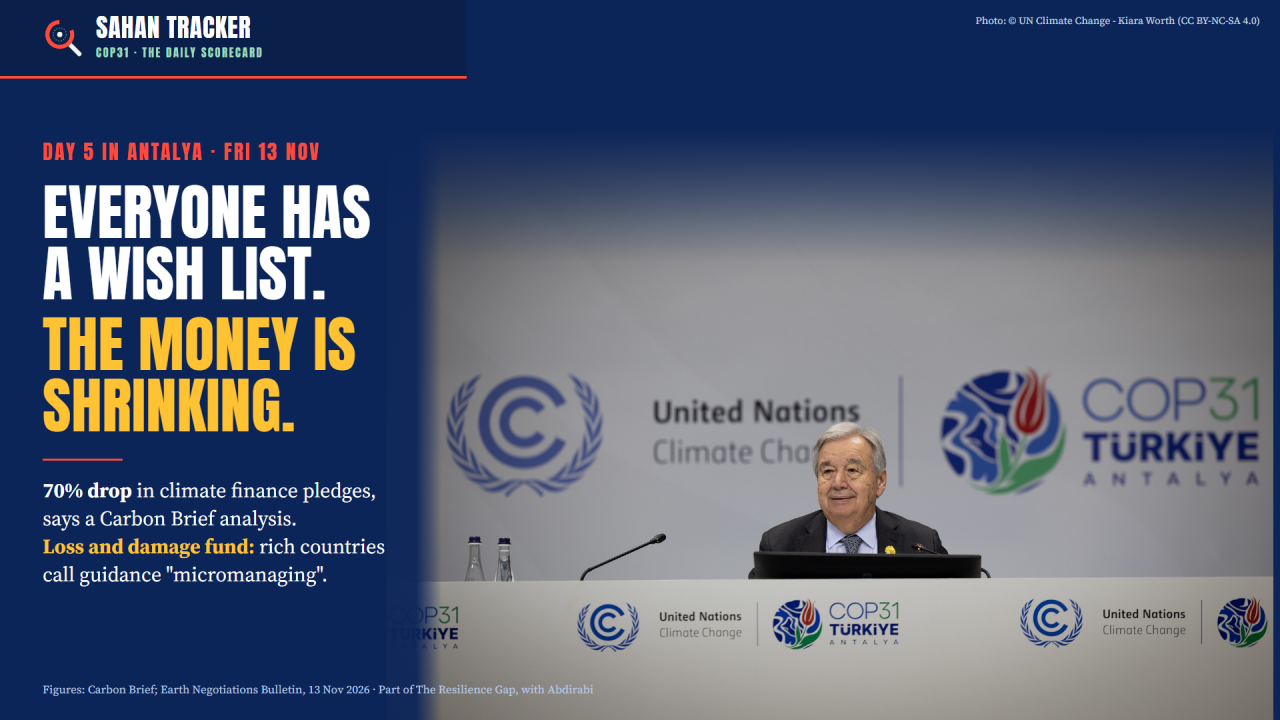
Friday 13 November 2026 · Antalya, Türkiye · Part of The Resilience Gap, with Abdirabi
What is Sahan Tracker? It is my daily update during COP31, the UN climate conference in Antalya, Türkiye (9 to 20 November 2026). During COP31, The Resilience Gap comes to you every day as Sahan Tracker, focused on what is happening inside the negotiation rooms. After COP31, we go back to one edition a week.
⏱️ Day 5 in one minute
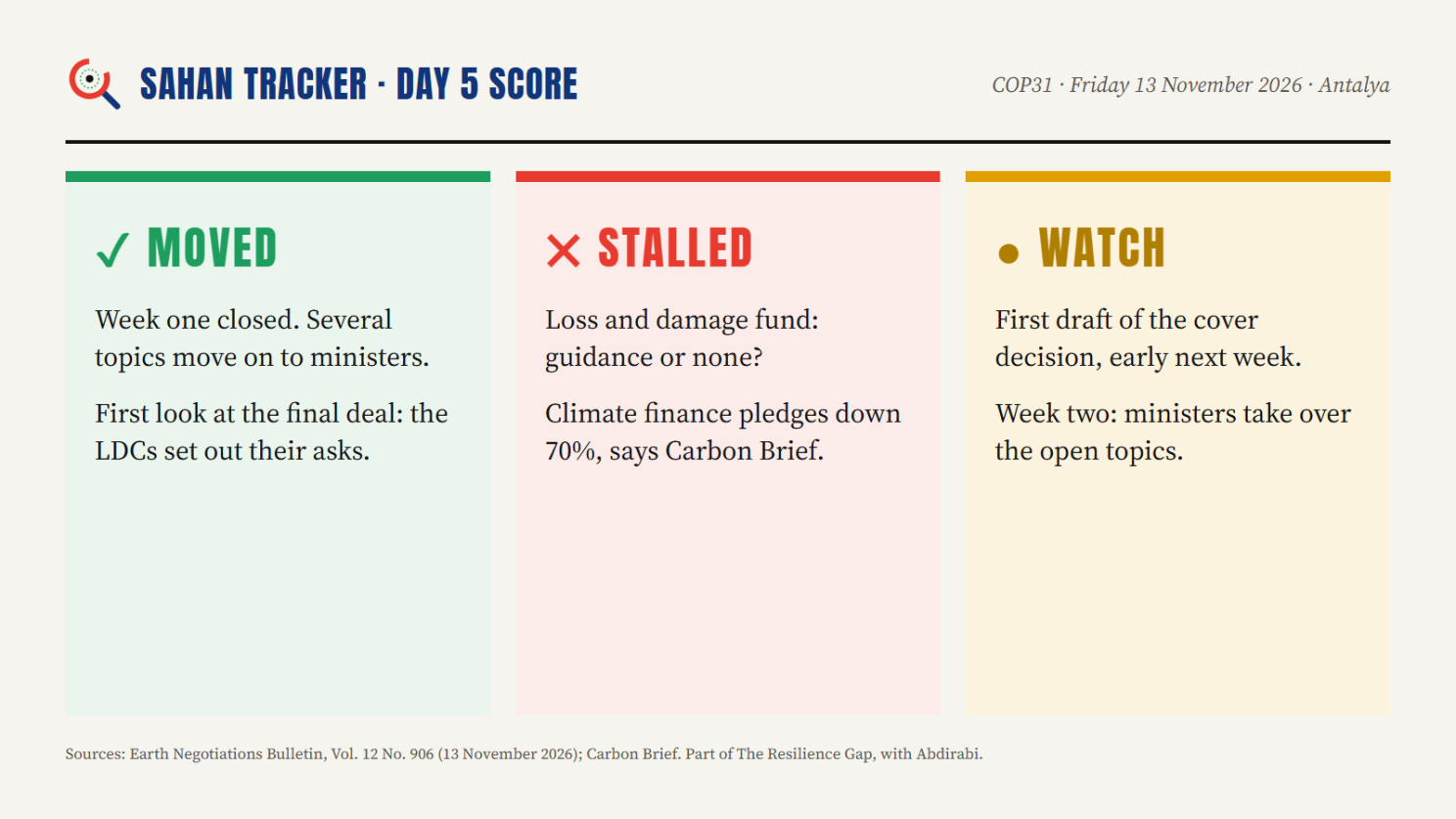
Week one is closing. Several rooms agreed conclusions or sent their topics to week two, when ministers arrive.We got a first look at the cover decision, the one text meant to sum up COP31. The Presidencies published a “Summary of Reflections” of countries’ views. It is not a negotiated draft, and a first draft is due early next week.The least developed countries (LDCs) set out what they want in it: concrete adaptation measures, new money for the climate funds, including the loss and damage fund, and a way to track milestones and progress.The loss and damage fund split the room. All the main developing country groups want the COP to give the fund guidance. The EU, Japan, Canada, New Zealand and Norway want none.It was Finance and Trade Day. A Carbon Brief analysis found that climate finance pledges have dropped by 70%.
- Week one is closing. Several rooms agreed conclusions or sent their topics to week two, when ministers arrive.
- We got a first look at the cover decision, the one text meant to sum up COP31. The Presidencies published a “Summary of Reflections” of countries’ views. It is not a negotiated draft, and a first draft is due early next week.
- The least developed countries (LDCs) set out what they want in it: concrete adaptation measures, new money for the climate funds, including the loss and damage fund, and a way to track milestones and progress.
- The loss and damage fund split the room. All the main developing country groups want the COP to give the fund guidance. The EU, Japan, Canada, New Zealand and Norway want none.
- It was Finance and Trade Day. A Carbon Brief analysis found that climate finance pledges have dropped by 70%.
🟢 What moved forward?
Week one wrapped up. Negotiators tried to close topics at the technical level before the closing meetings on Saturday. Several rooms agreed short outcomes, called conclusions, or sent their topics on to week two.
The cover decision is taking shape. The people leading the talks invited views on an informal note. Almost everything is still in it, including responding to overshooting 1.5°C, welcoming the COP30 roadmaps on fossil fuels and deforestation, and a 35% electrification target.
More openness. Observers could follow the cover decision talks online and in overflow rooms. One observer called it “a glimpse behind the curtain”.
A carbon market starts to work. The Article 6.4 mechanism, the new UN carbon market, has issued its first credits. It now has five methodologies, the rules for counting credits, including one for clean cooking.
More countries back electrification. More than 50 countries now support the electrification push, according to Carbon Brief.
🔴 What got stuck?
Guidance for the loss and damage fund. Draft texts offer two options: give the fund guidance, or give none. The African Group, Arab Group, LDCs, small island states (AOSIS), China, the Philippines and Brazil want guidance, including on how the fund will work in the long term, fast payments and grants. The EU, Japan, Canada, New Zealand and Norway want none and called it “micromanaging”. Switzerland and the UK want limited guidance. The LDCs asked to speed up new pledges to the fund, because demand is bigger than the money. The EU said this is already under way.
Was the USD 100 billion goal met? Countries are still split. The OECD and Oxfam use different methods and reach different answers. The Like-Minded Developing Countries (LMDCs) want to continue the work on long-term finance. Canada said it ends in 2027, as agreed.
Weaker words on the LDCs. In the talks on matters related to the LDCs, the LDCs said the new text waters down the language on their challenges, and asked to go back to the earlier version.
Adaptation plans and the money behind them. The UK and EU want the text on national adaptation plans to mention the new finance goal, private finance and locally-led adaptation. The LMDCs, with Grupo Sur, the African Group and the LDCs, want the finance overview revised to match the mandate. The people leading the talks asked for guidance from above.
How long to keep cutting emissions together. The Arab Group, the African Group and Malaysia want the mitigation work programme to run to 2030. The EU and Mongolia want 2040. Switzerland wants 2031 or no end date.
The carbon market needs money. The Article 6.4 mechanism is not yet paying for itself and needs more money to continue after 2027.
Technology outage. A global Microsoft outage slowed emails and draft texts. One co-facilitator joked that “the keyboard does not allow us to place any new brackets”.
📝 What goes into the final deal?
This was the main story of Day 5. Countries said what they want in, or out of, the cover decision:
Least developed countries: concrete adaptation measures, ongoing work on the first Global Stocktake, new money for the funds including the loss and damage fund, and tracking of milestones and progress.Small island states (AOSIS): new money for the Green Climate Fund, and the best available science guiding national climate plans.African Group: no language that weakens “common but differentiated responsibilities”. Overshoot raises adaptation costs. No electrification targets without the money and support to reach them.Latin American countries (AILAC): developed countries’ historical responsibility, a clearer pathway to tripling adaptation finance, and Article 9.1 duties.Arab Group: against top-down targets for sectors and energy. Developed countries failed on finance.Like-Minded Developing Countries: address implementation gaps. Developed countries must provide finance.European Union: no new mandates. Reflect overshoot, the move away from fossil fuels, human rights and gender.Environmental Integrity Group (EIG): carbon capture, early warning systems and phasing out inefficient fuel subsidies.UK: resilience of public budgets against climate shocks, and GBP 6 billion in climate finance over three years.
- Least developed countries: concrete adaptation measures, ongoing work on the first Global Stocktake, new money for the funds including the loss and damage fund, and tracking of milestones and progress.
- Small island states (AOSIS): new money for the Green Climate Fund, and the best available science guiding national climate plans.
- African Group: no language that weakens “common but differentiated responsibilities”. Overshoot raises adaptation costs. No electrification targets without the money and support to reach them.
- Latin American countries (AILAC): developed countries’ historical responsibility, a clearer pathway to tripling adaptation finance, and Article 9.1 duties.
- Arab Group: against top-down targets for sectors and energy. Developed countries failed on finance.
- Like-Minded Developing Countries: address implementation gaps. Developed countries must provide finance.
- European Union: no new mandates. Reflect overshoot, the move away from fossil fuels, human rights and gender.
- Environmental Integrity Group (EIG): carbon capture, early warning systems and phasing out inefficient fuel subsidies.
- UK: resilience of public budgets against climate shocks, and GBP 6 billion in climate finance over three years.
A trade topic was dropped from the agenda at the start, so its supporters now see the cover decision as the next-best place for it. One delegate summed up the mood: “we have more than enough work to do under the existing mandates.”
Why it matters for LDCs: the cover decision is the political home for issues that have no agenda item of their own, like tripling adaptation finance. The LDC asks now need to survive into the first draft.
💰 The money picture
Pledges are falling. A Carbon Brief analysis found that climate finance pledges have dropped by 70%.The loss and damage fund needs more. The LDCs said demand is bigger than the money available and asked to speed up new pledges.A new UK figure. The UK spoke of GBP 6 billion in climate finance over three years.The old goal is still disputed. Countries do not agree on whether the USD 100 billion a year goal was met.
- Pledges are falling. A Carbon Brief analysis found that climate finance pledges have dropped by 70%.
- The loss and damage fund needs more. The LDCs said demand is bigger than the money available and asked to speed up new pledges.
- A new UK figure. The UK spoke of GBP 6 billion in climate finance over three years.
- The old goal is still disputed. Countries do not agree on whether the USD 100 billion a year goal was met.
🗣️ Who said what?
- Least developed countries: give guidance to the loss and damage fund and speed up its replenishment. Restore the stronger text on LDC challenges.
- African Group: protect common but differentiated responsibilities. No electrification targets without support.
- Small island states (AOSIS): new money for the Green Climate Fund, and guidance for the loss and damage fund.
- EU, Japan, Canada, New Zealand and Norway: no guidance for the loss and damage fund, calling it “micromanaging”.
- European Commission: the EU supports the Presidencies’ proposal to acknowledge and address overshoot in the cover decision.
- Russia, the Arab Group and China: questioned the mandate for the talks on reforming the UN climate process.
🧭 So, who stands where?
In one line: on the loss and damage fund, all the main developing country groups stand together for guidance, against a united group of developed countries.
💡 My takeaways from Day 5
One. Everyone has a wish list, but the money is moving the other way. The cover decision now holds almost every idea, from overshoot to electrification. At the same time, climate finance pledges have dropped by 70%, according to Carbon Brief. A long list of goals means little without the money to reach them.
Two. “Micromanaging” is the word of the week. When developing countries ask the COP to guide the loss and damage fund on fast payments and grants, developed countries call it micromanaging. For communities waiting for help after a disaster, how fast the money moves is not a detail.
Three. Watch the first draft. The LDC asks on adaptation, new money for the funds and milestones are now on the table. Next week will show whether they survive into the first draft of the cover decision.
📖 Words of the day
Cover decision: the one text meant to sum up the political message of a COP.Summary of Reflections: a Presidency paper that lists countries’ views. It is not negotiated text.Conclusions: a short outcome from a technical body, often sending a topic to the COP or to the next session.Long-term model: how the loss and damage fund will work after its start-up phase.Self-financing: a body that pays for itself from fees, like the Article 6.4 carbon market.Micromanaging: the word developed countries use for detailed guidance they see as interfering with a fund’s Board.
- Cover decision: the one text meant to sum up the political message of a COP.
- Summary of Reflections: a Presidency paper that lists countries’ views. It is not negotiated text.
- Conclusions: a short outcome from a technical body, often sending a topic to the COP or to the next session.
- Long-term model: how the loss and damage fund will work after its start-up phase.
- Self-financing: a body that pays for itself from fees, like the Article 6.4 carbon market.
- Micromanaging: the word developed countries use for detailed guidance they see as interfering with a fund’s Board.
👀 What to watch next?
- Saturday 14 November: closing meetings of the technical bodies, the deadline for written views on the cover decision, and Children, Youth, Education and Skills Day.
- Early next week: the first draft of the cover decision.
- Week two: ministers take over the open topics, including guidance for the loss and damage fund, the mitigation work programme, the adaptation goal and the finance work programme.
See you tomorrow.
Abdirabi
📚 Sources
Earth Negotiations Bulletin (IISD), Vol. 12 No. 906, daily report for 13 November 2026: https://enb.iisd.org/antalya-un-climate-change-conference-cop31-daily-report-13nov2026Climate Home News, COP31 Bulletin Day 5: https://www.climatechangenews.com/2026/11/13/cop31-bulletin-day-5-cover-decision-wishlist-issued-as-china-bows-out-of-cop33/Carbon Brief, DeBriefed 13 November 2026: https://www.carbonbrief.org/debriefed-13-november-2026-make-or-bake-electrification-push-climate-finance-down-70The Climate Watch, COP31 divisions deepen: https://theclimatewatch.com/cop31-divisions-deepen-over-climate-finance-and-fossil-fuel-transition/Royal Meteorological Society (RMetS), COP31 Day 5: https://www.rmets.org/news/cop31-day-5-climate-finance-why-science-must-guide-investment-our-future-13-november-2026
- Earth Negotiations Bulletin (IISD), Vol. 12 No. 906, daily report for 13 November 2026: https://enb.iisd.org/antalya-un-climate-change-conference-cop31-daily-report-13nov2026
- Climate Home News, COP31 Bulletin Day 5: https://www.climatechangenews.com/2026/11/13/cop31-bulletin-day-5-cover-decision-wishlist-issued-as-china-bows-out-of-cop33/
- Carbon Brief, DeBriefed 13 November 2026: https://www.carbonbrief.org/debriefed-13-november-2026-make-or-bake-electrification-push-climate-finance-down-70
- The Climate Watch, COP31 divisions deepen: https://theclimatewatch.com/cop31-divisions-deepen-over-climate-finance-and-fossil-fuel-transition/
- Royal Meteorological Society (RMetS), COP31 Day 5: https://www.rmets.org/news/cop31-day-5-climate-finance-why-science-must-guide-investment-our-future-13-november-2026
First published on LinkedIn in The Resilience Gap newsletter by Abdirabi Mohamed. Read the original.
Leave a Reply