
Welcome to The Resilience Gap. Every week I will track one thing: the distance between climate promises and the communities still waiting for them.
I am Abdirabi Mohamed, a youth climate activist from Somalia. I lead PUSAN, the Punt. Sustainable Agri-livestock Network, and I am the Contact Point of LCOY Somalia 2026. Here I explain climate adaptation, resilience and finance in simple words, from the frontline.
On 9 November, COP31 opens in Antalya, Türkiye. The COP31 President-Designate, Murat Kurum, calls it an implementation-focused summit. On its official Instagram account, the Presidency says COP31 aims to “help close the gap between pledges and progress.” Its three principles are Dialogue, Consensus and Action.
That gap is why this newsletter exists. So this first edition asks one question: what must an implementation COP mean for the countries that have waited longest?
The Delivery Gap
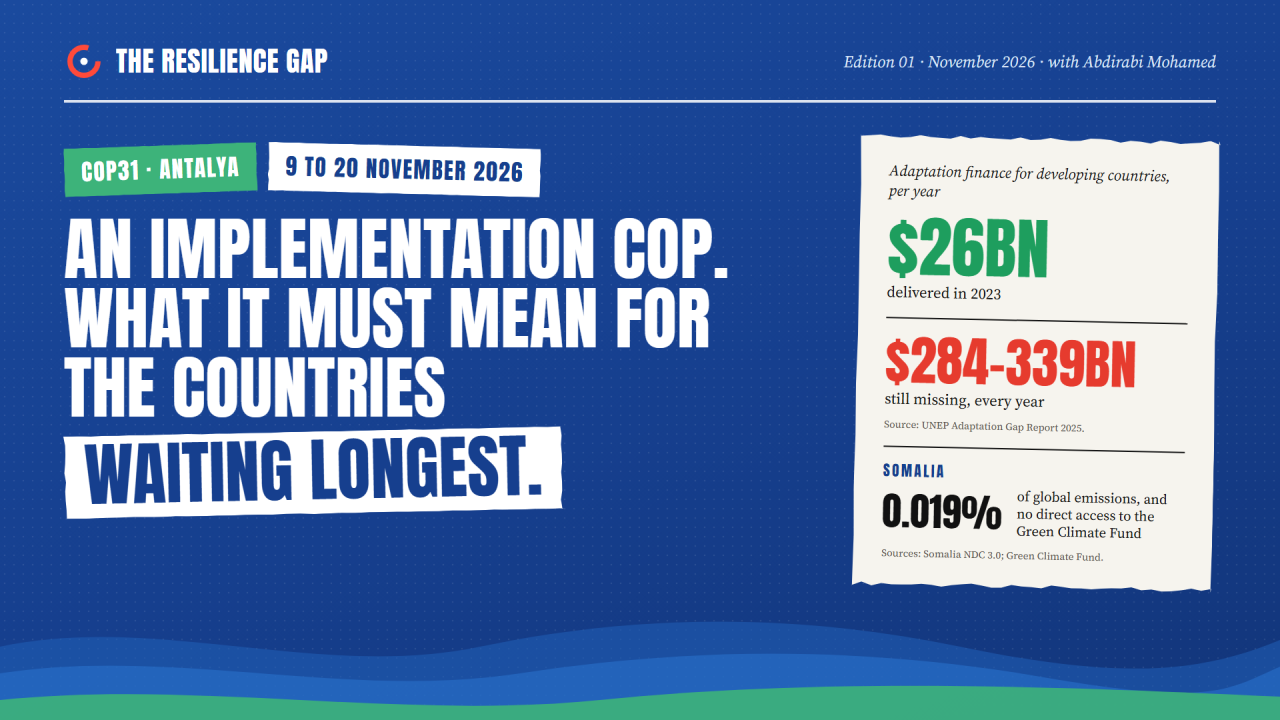
Start with adaptation finance, the money that helps communities prepare for drought, floods and heat. In 2023, developing countries received USD 26 billion in international public adaptation finance. The gap between what they receive and what they need is USD 284 to 339 billion every year, according to the UNEP Adaptation Gap Report 2025.
At COP29 in Baku, countries agreed a new climate finance goal: at least USD 300 billion a year for developing countries by 2035, and a call to scale up finance from all sources to USD 1.3 trillion a year. That is a promise for the next ten years. Implementation means turning it into money that reaches people.
Now look at Somalia. Somalia produces 0.019% of global emissions, according to its NDC 3.0. Yet carrying out that NDC needs about USD 11.5 billion up to 2035, and of its 34% emissions target, 29% depends on international support. Somalia still has no Direct Access Entity to the Green Climate Fund, so no Somali institution can receive money from the Fund directly.
At the same time, 5.4 million people in Somalia face crisis levels of hunger or worse (IPC Phase 3 and above, October to December 2026). And 3.3 million people are internally displaced (Humanitarian Needs and Response Plan 2026).
A country that did almost nothing to cause this crisis is paying for it. That is the delivery gap.
The Progress
There is progress, and it deserves to be named.
In Somalia, young people are moving from being consulted to shaping the national position. After the LCOY Somalia 2026 national conference, the Director of Climate Change at the Ministry of Environment and Climate Change committed to make the National Youth Statement part of Somalia’s national position at COP31. This is a commitment, not yet a result. The Resilience Gap will report on whether it is kept.
The COP31 Action Agenda also opens doors. Three of its ten themes match the work of young people on the frontline: 03 Food Security, 06 Youth and Education, and 09 Rio Synergy, which links the climate, biodiversity and desertification conventions. Theme 05, the Climate Implementation Bridge, is named for exactly the problem this newsletter tracks. For networks like PUSAN, which work on climate-resilient farming and livestock, these are the themes to watch.
The Frontline
The frontline this week is young Somalis themselves.
Between July and October 2026, LCOY Somalia held four consultations. A launch webinar on 15 July brought together 89 young people. A workshop at Banadir University on 17 July had 40. A pre-LCOY consultation with UNICEF Somalia on 24 September had more than 50. The national conference in Mogadishu on 7 and 8 October had 100. In total there were more than 279 youth participations, plus more than 600 responses to an online survey. Young women were more than 45% of participants.
This matters in a country where more than 70% of people are under 30.
The result is the National Youth Statement on Climate Change 2026. It sets out ten priority demands. Each demand is linked to Somalia’s NDC 3.0, its National Adaptation Plan or its National Climate Change Action Plan. Each names a responsible ministry and a timeline. This is what implementation looks like from below: a clear ask, a named owner and a deadline.
The process was supported by UNICEF Somalia and FAO Somalia, with the Ministry of Environment and Climate Change and the Ministry of Youth and Sports as partners. LCOY Somalia’s delegate to COP31, Abdullahi Adeid, will carry the Statement to Antalya.
My test for Antalya
For the countries waiting longest, I will judge COP31 on three questions.
First, does adaptation finance reach least developed countries in a form they can use? For Somalia, that means support to build direct access, not only more promises.
Second, does COP31 measure delivery, not only pledges? The second Global Stocktake begins at COP31. It should count what has arrived, not only what was announced.
Third, do commitments to youth become national action? If the Youth Statement becomes part of Somalia’s position, the next step is to see its demands in budgets and plans.
What You Can Do
Read and share the National Youth Statement. Send it to one person who makes decisions on climate in Somalia or in your organisation.
Ask one question. If you work in a ministry, a UN agency, a fund or an NGO, ask how your work helps Somali institutions get direct access to climate finance.
Follow Reality Check. From 9 to 20 November I will post a short daily update on what moved, what stalled and what it means for least developed countries.
Subscribe and forward. If this edition helped you understand the gap, share it with one person who should read it.
The resilience gap is the distance between climate promises and the communities still waiting for them. Over the next two weeks, we will see whether Antalya makes it shorter.
Abdirabi
Sources
COP31 Presidency, cop31.tr (dates, Action Agenda themes, Dialogue, Consensus, Action, “implementation-focused summit”)
@turkiyecop31 on Instagram, “How the UN Climate Regime Works” (“help close the gap between pledges and progress”; COP29 finance goal; second Global Stocktake)
UNEP Adaptation Gap Report 2025 (USD 26 billion delivered in 2023; gap of USD 284 to 339 billion a year)
Federal Republic of Somalia, NDC 3.0 (0.019% of global emissions; about USD 11.5 billion to 2035; 29% of the 34% target conditional)
Green Climate Fund (no Somali Direct Access Entity)
IPC Somalia analysis, October to December 2026 (5.4 million people in Phase 3 and above)
Somalia Humanitarian Needs and Response Plan 2026 (3.3 million internally displaced)
LCOY Somalia, National Youth Statement on Climate Change 2026 (consultations, participation figures, ten demands, MoECC commitment; more than 70% under 30)
First published on LinkedIn in The Resilience Gap newsletter by Abdirabi Mohamed. Read the original.