
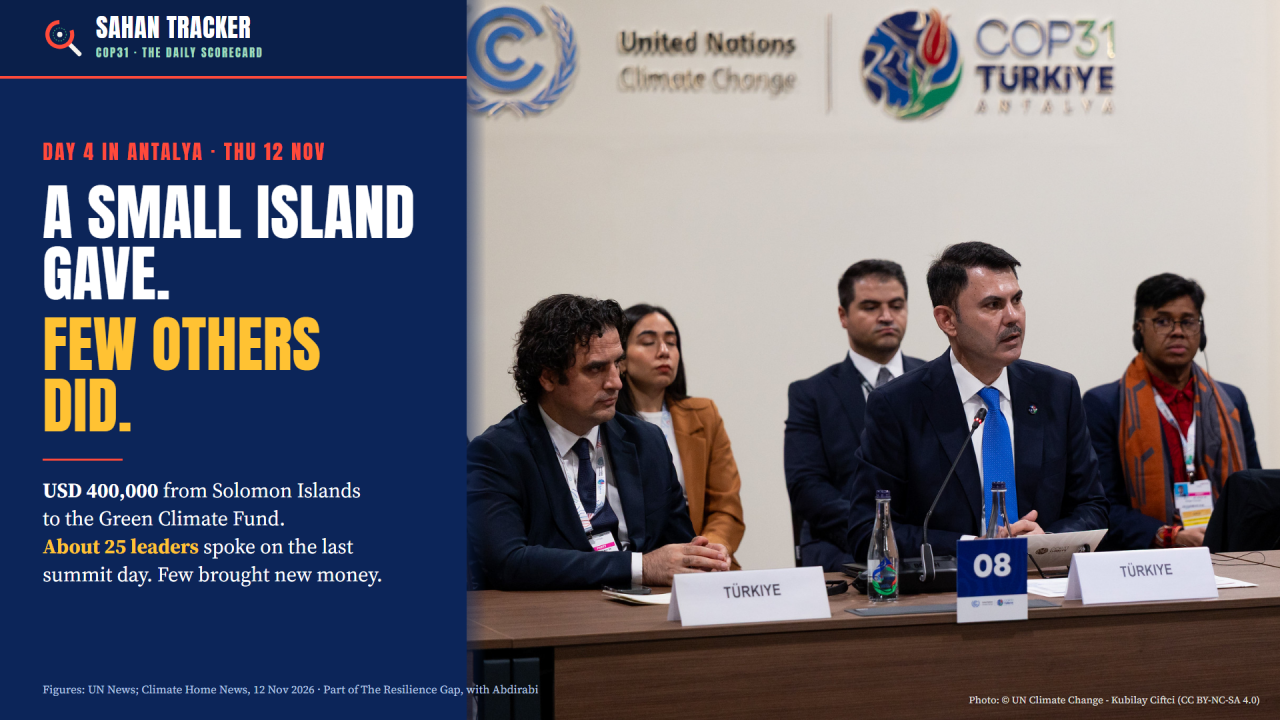
Thursday 12 November 2026 · Antalya, Türkiye · Part of The Resilience Gap, with Abdirabi
What is Sahan Tracker? It is my daily update during COP31, the UN climate conference in Antalya, Türkiye (9 to 20 November 2026). During COP31, The Resilience Gap comes to you every day as Sahan Tracker, focused on what is happening inside the negotiation rooms. After COP31, we go back to one edition a week
⏱️ Day 4 in one minute
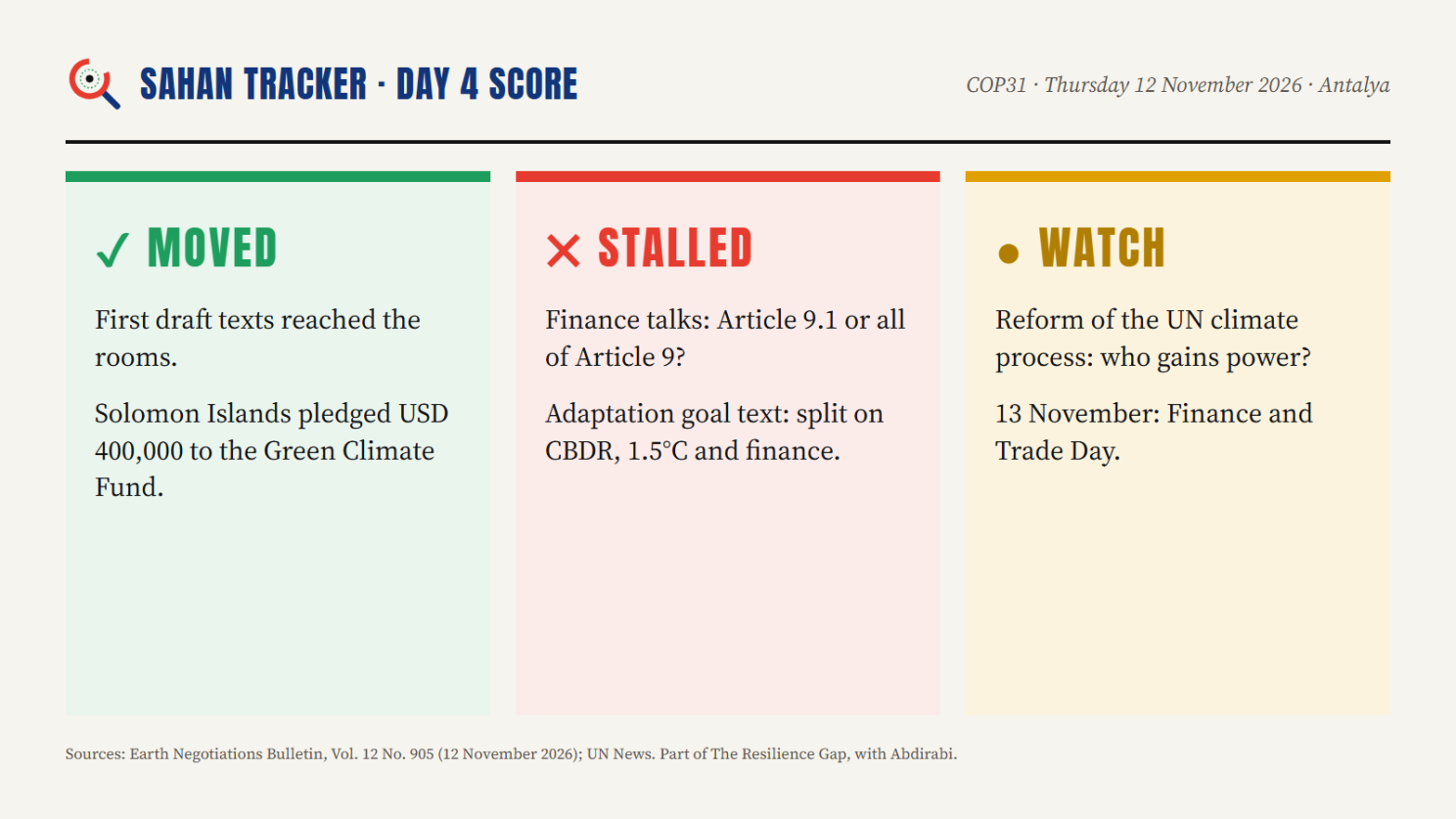
The Leaders’ Summit closed. About 25 leaders spoke on Thursday, after around 40 on Wednesday. Many said climate finance is not enough, but few offered new money.Solomon Islands, a small island state and one of the least developed countries, pledged USD 400,000 to the Green Climate Fund. It is the first small island developing state to give to the fund’s replenishment.The COP31 Presidency opened a debate on how to fix the UN climate process itself. Ideas ranged from multi-year agendas to holding COPs only every two or three years.The first draft texts reached the rooms, so countries moved from general views to arguing about exact wording.The finance split stayed wide. But there was broad support for tripling adaptation finance and access to finance as topics in the finance talks.
- The Leaders’ Summit closed. About 25 leaders spoke on Thursday, after around 40 on Wednesday. Many said climate finance is not enough, but few offered new money.
- Solomon Islands, a small island state and one of the least developed countries, pledged USD 400,000 to the Green Climate Fund. It is the first small island developing state to give to the fund’s replenishment.
- The COP31 Presidency opened a debate on how to fix the UN climate process itself. Ideas ranged from multi-year agendas to holding COPs only every two or three years.
- The first draft texts reached the rooms, so countries moved from general views to arguing about exact wording.
- The finance split stayed wide. But there was broad support for tripling adaptation finance and access to finance as topics in the finance talks.
🟢 What moved forward?
Draft texts arrived. The people leading each topic (co-facilitators) shared first drafts or informal notes on many items, including the Global Goal on Adaptation, the shared goal for making the world more resilient. Countries can now negotiate real words, not just positions.
Tripling adaptation finance has support as a topic. In the Climate Finance Work Programme, there was broad support for discussing tripling adaptation finance and access to finance. A first text is coming.
Adaptation reporting may be close. On guidance for adaptation communications (the reports where countries share their adaptation needs and actions), Latin American countries in Grupo Sur said agreement was close. A revised text with options is coming.
The just transition work will continue. There was broad consensus to extend the work programme on a fair shift to clean economies.
One small technical step. A draft text on how to fund the work under Article 6.2 (rules for countries trading carbon credits) was sent to the next level of the talks.
🔴 What got stuck?
What does the finance work programme cover? The least developed countries (LDCs), landlocked countries (LLDCs), the Like-Minded Developing Countries (LMDCs) and South Africa say it is about Article 9.1 of the Paris Agreement: rich countries shall provide finance. New Zealand, Canada, the UK, Norway, Switzerland, Korea and Japan want all of Article 9, including other sources of money. Countries still do not even agree on whether the programme started last year or starts now.
The adaptation goal text. The G77 and China want “common but differentiated responsibilities” in the text. The EU, UK, Canada and Norway oppose. The small island states (AOSIS), with the EU and Latin American countries (AILAC), want the 1.5°C goal recognised. Russia opposes. Countries also argued over who sits on a new taskforce, and over whether finance belongs in this text at all. The G77 and China say the finance paragraphs are critical. Developed countries say finance belongs in the finance talks.
Loss and damage support. The G77 and China asked for a minimum share of technical help to go to vulnerable communities, no role for the private sector, reporting by developed countries on loss and damage support, and multi-year funding for the Santiago Network, which connects countries to technical help. The EU, UK, Norway and the Environmental Integrity Group said this goes beyond the mandate.
Food systems in the just transition. The LDCs, India and others oppose references to a just transition in food systems. The EU supports them. Brazil and the African Group said food security is non-negotiable.
Keep or end a review of the 1.5°C goal? Canada and the EU want to end the periodic review of the long-term goal, saying the Global Stocktake already does this job. AOSIS and the African Group want to keep it, calling it the only space for the 1.5°C goal.
“Mandate-mania.” The Earth Negotiations Bulletin noted that many rooms argued about who is allowed to do what. Mandates protect a process led by countries, but they can also become roadblocks.
🏛️ Can the COP fix itself?
This was the main story of Day 4. The Presidency asked heads of delegation how to make the UN climate process stronger, more effective and more inclusive. The answers showed very different ideas:
Environmental Integrity Group (EIG): the biggest package. A ministerial process reporting to COP32 in 2027, with changes from 2028: multi-year planning, limits on new agenda items, end dates for old ones, caps on delegation size, COPs every two to three years, an independent review, and agreeing the rules of procedure, including on voting.Small island states (AOSIS): group related items, make agendas shorter, plan over several years, but keep a way to handle urgent new issues.European Union: organise the agenda by themes and find overlapping or outdated mandates.Japan: there are too many mandates for a stretched Secretariat after its largest contributor left.Norway and Canada: the process is not broken, but it can improve.Brazil: a dedicated process with a clear end date.African Group: efficiency must not cost equity, inclusion and consensus.Like-Minded Developing Countries: questioned the value of these talks.
- Environmental Integrity Group (EIG): the biggest package. A ministerial process reporting to COP32 in 2027, with changes from 2028: multi-year planning, limits on new agenda items, end dates for old ones, caps on delegation size, COPs every two to three years, an independent review, and agreeing the rules of procedure, including on voting.
- Small island states (AOSIS): group related items, make agendas shorter, plan over several years, but keep a way to handle urgent new issues.
- European Union: organise the agenda by themes and find overlapping or outdated mandates.
- Japan: there are too many mandates for a stretched Secretariat after its largest contributor left.
- Norway and Canada: the process is not broken, but it can improve.
- Brazil: a dedicated process with a clear end date.
- African Group: efficiency must not cost equity, inclusion and consensus.
- Like-Minded Developing Countries: questioned the value of these talks.
On the rules of procedure, there was a proposal from the COP30 Presidency to keep applying the draft rules, except rule 42 on voting, without agreeing it again every year. AILAC and the African Group warned against “opening Pandora’s box”. Tuvalu wants a real discussion on voting options. The Arab Group said consensus is the only way.
Why it matters for LDCs: LDC delegations are small. Fewer agenda items and multi-year planning could help them follow the talks. But voting rules and caps on delegation size change who has power, so these ideas need careful reading.
💰 The money picture
The smallest pledge with the biggest message. Solomon Islands pledged USD 400,000 to the Green Climate Fund. It is a small island and an LDC, and the first small island developing state to give to the fund’s replenishment.Few new pledges from leaders. Many leaders said climate finance is not enough, but few offered new money.Who pays, and how much? The Arab Group, the Philippines and South Africa asked for burden-sharing, meaning an agreement on how much each developed country should give.No reopening of the finance goal. Switzerland, the EU, Korea and Japan said the finance work programme cannot reopen the new finance goal agreed in 2024 (the NCQG).
- The smallest pledge with the biggest message. Solomon Islands pledged USD 400,000 to the Green Climate Fund. It is a small island and an LDC, and the first small island developing state to give to the fund’s replenishment.
- Few new pledges from leaders. Many leaders said climate finance is not enough, but few offered new money.
- Who pays, and how much? The Arab Group, the Philippines and South Africa asked for burden-sharing, meaning an agreement on how much each developed country should give.
- No reopening of the finance goal. Switzerland, the EU, Korea and Japan said the finance work programme cannot reopen the new finance goal agreed in 2024 (the NCQG).
🗣️ Who said what?
- Andy Burnham, for the UK: said the old consensus on climate science is “gone” and the world will reach 1.5°C. He named the UK’s first special representative for climate security.
- Seychelles: warned that recovering from storms and floods can trap small countries in debt.
- Nepal: raised the dangers for mountain communities.
- Mali: those who contributed least should not carry the biggest burden.
- Least developed countries: the finance work programme is about Article 9.1. They want the adaptation reporting review to start in 2027 and stronger text on overshooting 1.5°C.
- African Group: efficiency must not cost equity. Food security is non-negotiable.
- Tuvalu: wants a real discussion on voting options.
- Arab Group: consensus is the only way.
On the final deal: Russia, Saudi Arabia and the Like-Minded Developing Countries pushed back on the cover decision, the text meant to sum up COP31, and emerging economies questioned the need for one.
🧭 So, who stands where?
In one line: on finance, developing countries stand together on Article 9.1 and tripling adaptation finance. On the just transition, the LDCs part ways with the EU over food systems. On reform, small islands want a leaner process, while the African Group and the LMDCs warn it must not cost fairness.
💡 My takeaways from Day 4
One. A small island showed what leadership looks like. Solomon Islands gave USD 400,000 to the Green Climate Fund, at a summit where many leaders asked for money and few offered it. The amount is small. The message is not.
Two. Fixing the process is not a neutral topic. Shorter agendas could help small delegations like those of the LDCs. But voting rules and caps on delegation size decide who has power in the room. I will watch this closely.
Three. Everyone talks about tripling adaptation finance. Nobody agrees where it lives. Developed countries want it in the finance talks. Developing countries also want it in the adaptation goal. As I wrote on Day 2, where a topic sits decides whether it gets a number and a way to track it, or stays a promise.
📖 Words of the day
Rules of procedure: the rules for how a COP works. They were never formally adopted because countries disagree on rule 42 on voting, so COPs decide by consensus.Mandate: the official permission a body or meeting has to do a task.Held in abeyance: an agenda item that is kept open but not discussed.Burden-sharing: agreeing how much each developed country should give.Periodic review: a UN review of whether the long-term temperature goal is enough.Replenishment: a funding round where countries pledge new money to a fund.
- Rules of procedure: the rules for how a COP works. They were never formally adopted because countries disagree on rule 42 on voting, so COPs decide by consensus.
- Mandate: the official permission a body or meeting has to do a task.
- Held in abeyance: an agenda item that is kept open but not discussed.
- Burden-sharing: agreeing how much each developed country should give.
- Periodic review: a UN review of whether the long-term temperature goal is enough.
- Replenishment: a funding round where countries pledge new money to a fund.
👀 What to watch on Day 5?
- 13 November: Finance and Trade Day, and the Presidency’s summary on the cover decision.
- New draft texts: the first finance work programme text, a revised adaptation goal text and a revised adaptation reporting text.
- 14 November: Children, Youth, Education and Skills Day.
- Next week: ministers arrive and the harder political trade-offs begin.
See you tomorrow.
Abdirabi
📚 Sources
Earth Negotiations Bulletin (IISD), Vol. 12 No. 905, daily report for 12 November 2026: https://enb.iisd.org/antalya-un-climate-change-conference-cop31UN News, cities rise up the climate agenda: https://news.un.org/en/story/2026/11/1168792Climate Home News, COP31 Bulletin Day 4: https://www.climatechangenews.com/2026/11/12/cop31-bulletin-day-4-burnham-speaks-with-uk-climate-policy-under-fire/UPI, leaders warn climate goals slipping away: https://www.upi.com/Top_News/World-News/2026/11/12/un-cop31-burnham-thunberg-climate-change/7781794506629/
- Earth Negotiations Bulletin (IISD), Vol. 12 No. 905, daily report for 12 November 2026: https://enb.iisd.org/antalya-un-climate-change-conference-cop31
- UN News, cities rise up the climate agenda: https://news.un.org/en/story/2026/11/1168792
- Climate Home News, COP31 Bulletin Day 4: https://www.climatechangenews.com/2026/11/12/cop31-bulletin-day-4-burnham-speaks-with-uk-climate-policy-under-fire/
- UPI, leaders warn climate goals slipping away: https://www.upi.com/Top_News/World-News/2026/11/12/un-cop31-burnham-thunberg-climate-change/7781794506629/
First published on LinkedIn in The Resilience Gap newsletter by Abdirabi Mohamed. Read the original.
Leave a Reply